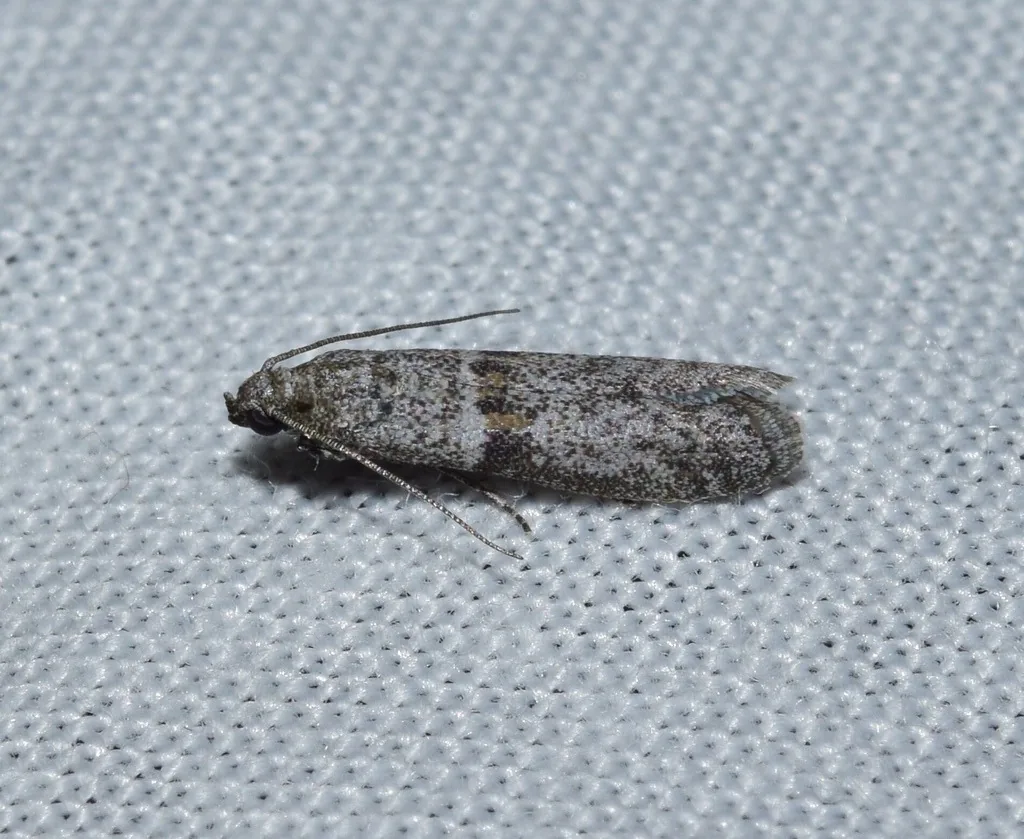
How to identify it
- Adults have a wingspan of about 14 to 20 millimeters, and on most moths the front wings are a mottled gray.[1]
- Moths fly with a rapid wing vibration and dart about quickly.[1]
- Larvae are cream or dirty white caterpillars with brown or purple dots on the back, each dot bearing a black hair; the head and first segment are dark brown.[1]
- Living larvae may show some pink markings, but these don't form stripes along the body.[3]
- Like other food-infesting moths, the caterpillars spin large amounts of silk webbing through infested food, a key sign of an infestation.[2]
Look-alikes
| Look-alike | How to tell them apart |
|---|---|
| Indian meal moth | Easier to recognize: the front part of each wing is light tan and the back part a striking copper color.[2] |
| Mediterranean flour moth | Looks very much like the almond moth, but has two black zigzag bands across the front wings.[1] |
| Clothes moths | Weak fliers seen near closets, with a fuzzy reddish head on the webbing clothes moth; food moths are strong fliers seen anywhere in the house.[2] |
Where it lives
A cosmopolitan pest found worldwide, most common in tropical and subtropical regions, and present in the United States.[1][3]
Biology and life cycle
Females lay about 110 to 120 eggs, and the life cycle takes about 60 to 80 days; adults live one to two weeks.[1]
USDA port inspectors commonly intercept the larvae in stored products from countries around the world; about a quarter of interceptions come from India.[3]
Mature caterpillars of pantry moths wander off to pupate and often chew through the packaging of the food they grew in.[2]
Damage and signs
Health risk
The concern is contaminated food: the caterpillars infest dried fruit, nuts, grains and seeds and fill them with silk webbing.[1][2]
Control
Prevention
Store susceptible foods in bug-proof glass or plastic containers, or in the refrigerator or freezer.[2]
Sanitation
Whatever the moth species, the treatment is the same: find the infested products and discard them, then check everything else stored nearby.[2]
Look beyond the kitchen: dry pet food, bird seed, nuts, trail mix in camping gear, dried flower arrangements and rodent caches in walls can all harbor caterpillars.[2]
Empty the pantry and vacuum spilled food, cracks and crevices, which also removes wandering caterpillars and pupae.[2]
Traps and physical control
Holding items in a deep freezer at 0 degrees F or lower for a week or more will control most stored food pests.[2]
Pesticides
Insecticides aren't really necessary after thorough cleanup and are no substitute for it; any product used must be labeled for food storage areas and applied to an empty pantry.[2]
Common questions
- Do almond moths only infest almonds?
- No. Despite the name, the University of Florida says they prefer dried figs and dates, and they also infest other nuts, grains, seeds and candy.[1]
- Is the almond moth the same as the tropical warehouse moth?
- Yes. USDA's identification resource lists both names for Cadra cautella.[3]
Sources
- University of Florida, Entomology and Nematology Department, “Almond moth, Cadra cautella (stored product pests image gallery).” entnemdept.ufl.edu/projex/gallery/dl/stored_product_pests/text/Almond_moth.htm (accessed 2026-10-06)
- Mississippi State University Extension Service, “Bug-Wise No. 14: Moths That Infest Stored Foods (August 2005).” extension.msstate.edu/sites/default/files/newsletter/bw1405.pdf (accessed 2026-10-06)
- USDA APHIS PPQ Identification Technology Program, “LepIntercept fact sheet: Cadra cautella (almond moth, tropical warehouse moth).” idtools.org/id/lepintercept/cautella.html (accessed 2026-10-06)
- iNaturalist, “Cadra cautella taxon page (order and family).” www.inaturalist.org/taxa/215616 (accessed 2026-10-06)