The short answer
- Moths flying around the kitchen or pantry, or seen in well-lit rooms, are most likely pantry moths, usually the Indian meal moth. Its front wings are pale gray on the inner part and coppery brown on the outer part.[1][3][4]
- Small, plain buff or golden moths that stay in dark closets, basements or attics and flutter rather than fly straight are likely clothes moths. They avoid light, so you see them less often.[2][4]
- Larger gray-brown moths (wingspan 1.5 to 2 inches) that pour in around doors and lights in late spring in Colorado and nearby states are miller moths. They don't eat food or fabric and don't breed indoors.[9][10]
- Tiny fuzzy gray "moths" around a sink, tub or floor drain are drain flies, also called moth flies. They are flies that breed in the thin film of microbes inside drains.[13]
Moths you might find indoors
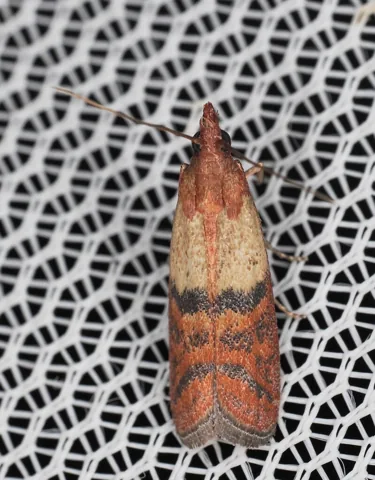 Indianmeal Moth
Plodia interpunctella
The Indianmeal moth is the most common moth infesting stored food in the home; all damage is done by the larvae, which feed in cereals, flour, nuts, dried fruit, chocolate and pet food.
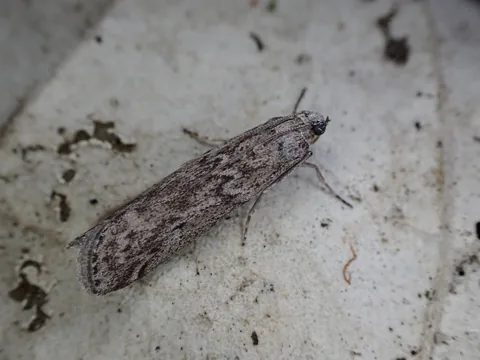 Mediterranean Flour Moth
Ephestia kuehniella (also listed as Anagasta kuehniella)
The Mediterranean flour moth is a gray pantry moth whose caterpillars line flour and other dry foods with silk webbing. Washington State University calls it a frequent food-infesting moth in homes, though less common than the Indian meal moth.
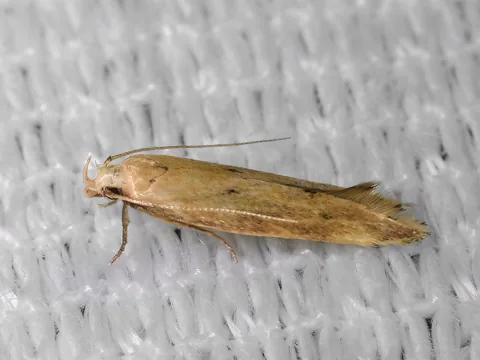 Angoumois Grain Moth
Sitotroga cerealella
The Angoumois grain moth is a primary pest of stored grain: its caterpillars develop entirely inside single kernels, so infested corn or wheat can look normal until moths appear. USDA's stored-grain handbook calls it the moth most commonly found in infested grain in the United States.
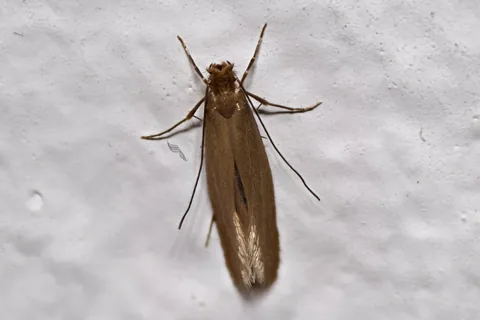 Webbing Clothes Moth
Tineola bisselliella
The webbing clothes moth is probably the most commonly encountered clothes moth in the United States. Its larvae feed on wool, fur, feathers and other animal fibers in hidden spots, and the moths are seldom seen because they avoid light.
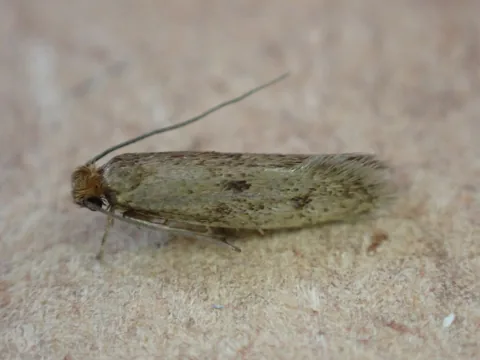 Casemaking Clothes Moth
Tinea pellionella
The casemaking clothes moth is a small fabric pest whose larvae feed on wool, fur, feathers and other animal fibers. Each larva lives inside a portable silk tube that takes on the color of whatever it has been eating.
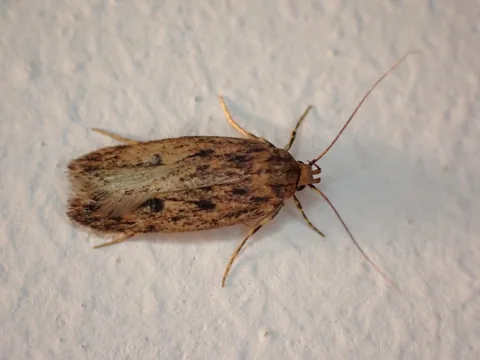 Brown House Moth
Hofmannophila pseudospretella
The brown house moth is an omnivorous household scavenger that usually breeds in bird nests and dry debris in attics and roof spaces. Its wandering larvae occasionally damage carpets and other woolens, and it is also a minor pest of stored food.
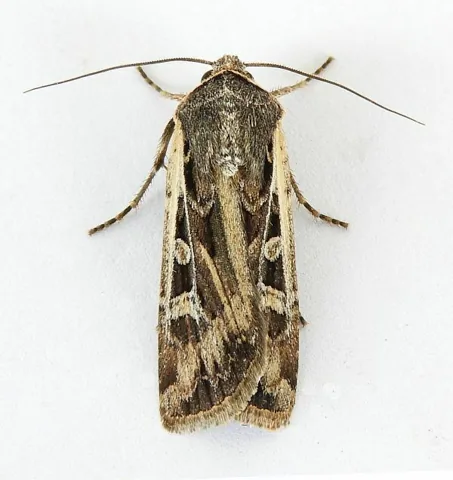 Miller Moth (Army Cutworm Moth)
Euxoa auxiliaris
Miller is a name for any moth that turns up in large numbers around homes. In Colorado and much of the Rocky Mountain West it is mainly the adult army cutworm, which passes through on a yearly migration from the plains to the mountains.
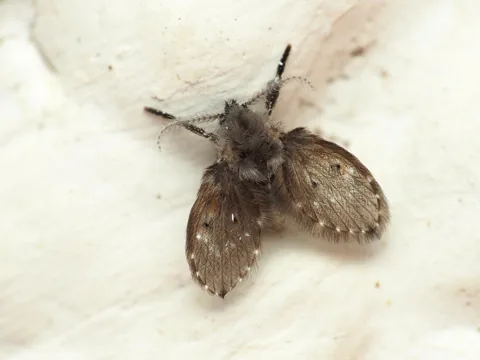 Drain Fly (Moth Fly)
Psychodidae (shown: Clogmia albipunctata)
Drain flies, also called moth flies or filter flies, are small, fuzzy, non-biting flies whose larvae live in the slimy film inside drains, toilets and other places where water stands.
Sort it out by where and how it flies
Kentucky Extension says clothes moths are often mistaken for grain moths from the pantry. A few observations separate the main groups before you open a single cupboard:[4]
- Where you see it: Kentucky Extension says clothes moths avoid light and stay in dark, undisturbed places such as closets, basements and attics, while similar moths in kitchens and other well-lit areas are likely grain moths from cereals, dried fruit, nuts or other stored food.[4]
- How it flies: UC IPM says clothes moths flutter about near the infested items, while food-infesting moths fly in a direct, steady way and frequently fly around the house.[2]
- Size at rest: UC IPM says a resting clothes moth is only about 1/4 inch long, and most food-infesting moths are about double that.[2]
- The head: clothes moths have little tufts of hair on the head and food moths don't. UC IPM suggests catching one and looking with a hand lens.[2]
- Lights: UC IPM says webbing clothes moths are weak flyers that aren't attracted to lights, while University of Georgia Extension says moths and other insects gather around doors and windows at night, drawn to bright lights.[2][11]
- Season and numbers: Colorado State says miller moth flights in outbreak years usually start between mid-May and early June, and Montana State says they are usually around for two to three weeks.[9][10]
Pantry moths
UC IPM says pantry pests usually arrive in an infested package of food, and the first sign is often small moths flying about. The Indian meal moth is the most common one in home pantries. Its larvae feed on cereal, flour, cornmeal, rice, dried fruit, nuts, dry pet food and many other foods, spin webbing as they feed and leave silk threads wherever they crawl.[1][5][7]
Sizes differ slightly between sources: Clemson gives a wingspan of about 1/2 inch, UC IPM about 3/5 inch with a body 1/3 to 2/5 inch long, and Washington State 1/2 to 3/4 inch. All describe the same two-tone wings, gray near the body and reddish or coppery brown toward the tips. UC IPM says the life cycle takes about six to eight weeks in warm weather; Kentucky Extension says it can be as short as 25 days.[5][1][7][3]
Two other pantry moths turn up less often. Washington State says the Mediterranean flour moth is a frequent food-infesting moth with a wingspan of about one inch and grayish front wings with dark zigzag lines, and it rests with the front of its body raised so the wings slope down. Kentucky Extension says the Angoumois grain moth is 1/2 inch long and pale yellow brown, develops inside whole kernels, often comes in on decorative ear corn, and looks like a clothes moth except for a finger-like point at the hind wing tip.[8][3]
The pantry moth guide covers finding every infested package, cleaning shelves, freezing what you keep and storing food so it can't happen again. Pantry pests covers the beetles, weevils and mites that often show up with them.[1][5]
Clothes moths
Two species are common in North America. Kentucky Extension describes the webbing clothes moth as a uniform buff color with a tuft of reddish hairs on top of the head, and the casemaking clothes moth as similar but with dark specks on the wings. UC IPM gives a wingspan of about 1/2 inch and says the webbing clothes moth is the more common one in the United States.[4][2]
The moths themselves don't feed, so they don't harm fabric; Kentucky Extension says the larvae do, feeding on animal fibers such as wool, fur, silk, feathers, felt and leather. UC IPM says webbing clothes moth larvae leave silk feeding tubes and patches of webbing behind, while casemaking larvae carry a silk case colored like the fabric they ate. Kentucky Extension adds that infestations may start in a bird nest or animal carcass in an attic, chimney or wall, or in lint and pet hair in vents and ducts.[4][2]
Holes alone don't prove clothes moths: carpet beetle larvae eat the same materials and are very common in homes. The clothes moth and carpet beetle guide explains how to tell the damage apart, and covers cleaning, freezing, storage and mothball safety.[4][6]
Small caterpillars on walls and ceilings
Kentucky Extension says caterpillars crawling up walls or across ceilings are often one of the first signs of pantry pests. Washington State says Indian meal moth larvae ready to pupate wander considerable distances, often to walls, countertops and ceilings, and Clemson says they can get through packaging and even plastic film. Look for the food source, not just the caterpillars.[3][7][5]
Casemaking clothes moth larvae wander too. Kentucky Extension says they often crawl off the item they fed on to spin cocoons in crevices of shelving or where walls meet the ceiling. A larva in a small silk case, colored like a nearby rug or sweater, points to clothes moths rather than the pantry.[4][2]
Miller moths and other moths from outside
Colorado State says "miller moth" is a name for any moth that is abundant around homes. In Colorado and much of the Rocky Mountain West it is usually the army cutworm moth, which migrates from the plains toward the mountains in late spring. Montana State says the main miller species varies from state to state. The moths hide in small cracks during the day, and Colorado State says a wrong turn through a gap around a door can bring them indoors.[9][10]
Both universities say miller moths don't feed on or reproduce in anything in the home, and Colorado State says moths that get in will eventually find a way out or die. The trouble they cause is mostly nuisance: Colorado State says they can spot drapes or unfinished wood with a slightly acidic fluid, and dead ones left in a house can become food for carpet beetles. Vacuum them up.[9][10]
What helps, from Colorado State and Montana State: seal obvious openings around windows and doors before flights, turn off unneeded lights at night, and vacuum or swat moths indoors. Both describe a light hung over a bucket of soapy water as a trap; Colorado State warns to keep water and electricity apart and use a GFI outlet. Both say insecticides help little because the moths aren't very susceptible, and Colorado State adds that new moths keep arriving each night.[9][10]
Elsewhere, many other night-flying moths gather at doors and windows. University of Georgia Extension says spraying these flying insects is the least effective approach because more arrive the next night; keeping outdoor lights off or using yellow bulbs, which attract fewer insects, works better. A field study in Ecology and Evolution found LED bulbs attracted fewer flying insects than older bulb types, though that study focused mainly on flies.[11][12][9]
Moths at the sink? Probably drain flies
Texas A&M says drain flies are also called moth flies because of their fuzzy, moth-like look. They are small (1/16 to 1/5 inch), grayish and hairy, hold their broad wings flat or roof-like at rest, and usually fly only a few feet at a time. The larvae live in the film inside sink and floor drains, condensate pans and other wet spots, so Texas A&M says the drains themselves must be cleaned to remove that film. The fruit fly and drain fly guide covers it.[13]
Using traps to confirm what you have
Pheromone traps attract only the males of the species they're made for. UC IPM says clothes moth traps won't catch other moths and grain-moth traps won't catch clothes moths, and Kentucky Extension says webbing and casemaking clothes moths each have their own pheromone, so know which you have before buying. Washington State says pantry moth traps can be used to monitor Indian meal moths.[2][4][7]
Traps don't fix an infestation on their own: UC IPM says that if you catch clothes moths you still need to clean or launder the exposed items. The pheromone trap guide covers placement and what catches mean.[2]
Common questions
- Are the moths in my house eating my clothes?
- Only if they're clothes moths, and even then the moths themselves don't feed; the larvae do. Pantry moths eat stored food, and miller moths don't eat anything in the house.[4][1][9]
- Why do I see moths in the kitchen but can't find the source?
- The infested item is often a damaged or forgotten package, dried fruit, nuts or dry pet food. UC IPM says to look for the food source and remove it right away.[1][7]
- Will miller moths lay eggs in my house?
- No. Colorado State and Montana State both say miller moths don't reproduce in the home; they lay eggs in fields and weedy areas in late summer and fall.[9][10]
- Do moths come from the drain?
- No. The small fuzzy insects around drains are drain flies (moth flies), which breed in the film inside drains and other wet places.[13]
- Is one moth a sign of an infestation?
- Not necessarily. One moth near a porch light at night is likely from outside. Repeated moths in the kitchen, or in a closet with fabric damage, point to an infestation, and a trap for the right species can confirm it.[2][4][11]
Photo credits
- Indianmeal Moth: (c) Rosario Douglas, some rights reserved (CC BY) — via iNaturalist, CC BY 4.0
- Mediterranean Flour Moth: (c) dr_robert, some rights reserved (CC BY) — via iNaturalist, CC BY 4.0
- Angoumois Grain Moth: Boza48, public domain (CC0), via iNaturalist
- Webbing Clothes Moth: (c) David Kleuker, some rights reserved (CC BY) — via iNaturalist, CC BY 4.0
- Casemaking Clothes Moth: Stephen James McWilliam, public domain (CC0), via iNaturalist
- Brown House Moth: (c) Gabriele Vaudano, some rights reserved (CC BY) — via iNaturalist, CC BY 4.0
- Miller Moth (Army Cutworm Moth): (c) jimeckert49, some rights reserved (CC BY) — via iNaturalist, CC BY 4.0
- Drain Fly (Moth Fly): (c) Katja Schulz, some rights reserved (CC BY) — via iNaturalist, CC BY 4.0
Sources
- University of California Statewide IPM Program, “Pest Notes: Pantry Pests (Home and Landscape).” ipm.ucanr.edu/home-and-landscape/pantry-pests/ (accessed 2026-11-10)
- University of California Statewide IPM Program, “Pest Notes: Clothes Moths (Home and Landscape).” ipm.ucanr.edu/home-and-landscape/clothes-moths/ (accessed 2026-11-10)
- University of Kentucky Entomology, “ENTFACT-612: Stored Product Pests in the Pantry.” entomology.mgcafe.uky.edu/ef612 (accessed 2026-11-10)
- University of Kentucky Entomology, “ENTFACT-609: Clothes Moths.” entomology.ca.uky.edu/ef609 (accessed 2026-11-10)
- Clemson Cooperative Extension, Home & Garden Information Center, “Indian Meal Moth.” hgic.clemson.edu/factsheet/indian-meal-moth/ (accessed 2026-11-10)
- Clemson Cooperative Extension, Home & Garden Information Center, “Controlling Fabric Pests.” hgic.clemson.edu/factsheet/controlling-fabric-pests/ (accessed 2026-11-10)
- Washington State University Extension, “Indian Meal Moth (PestSense fact sheet).” pestsense.cahnrs.wsu.edu/fact-sheet/indian-meal-moth/ (accessed 2026-11-10)
- Washington State University Extension, “Mediterranean Flour Moth (PestSense fact sheet).” pestsense.cahnrs.wsu.edu/fact-sheet/mediterranean-flour-moth/ (accessed 2026-11-10)
- Colorado State University Extension, “Miller Moths (Fact Sheet 5.597).” extension.colostate.edu/resource/miller-moths/ (accessed 2026-11-10)
- Montana State University Extension, Urban and Horticulture IPM, “Miller Moths (Army Cutworm, Euxoa auxiliaris).” urbanipm.montana.edu/entomology/resources/fact-sheets/spiders_of_montana/miller-moths.html (accessed 2026-11-10)
- University of Georgia Cooperative Extension, “Don't be bugged by insects seeing the light (P. Pugliese).” fieldreport.caes.uga.edu/news/dont-be-bugged-by-insects-seeing-the-light/ (accessed 2026-11-10)
- Ecology and Evolution, abstract via PubMed, “Wakefield and others 2016, Experimentally comparing the attractiveness of domestic lights to insects: Do LEDs attract fewer insects than conventional light types?.” pubmed.ncbi.nlm.nih.gov/27878075/ (accessed 2026-11-10)
- Texas A&M AgriLife Extension, “Indoor Flies and Their Control.” agrilifeextension.tamu.edu/library/insects/indoor-flies-and-their-control/ (accessed 2026-11-10)