How to identify it
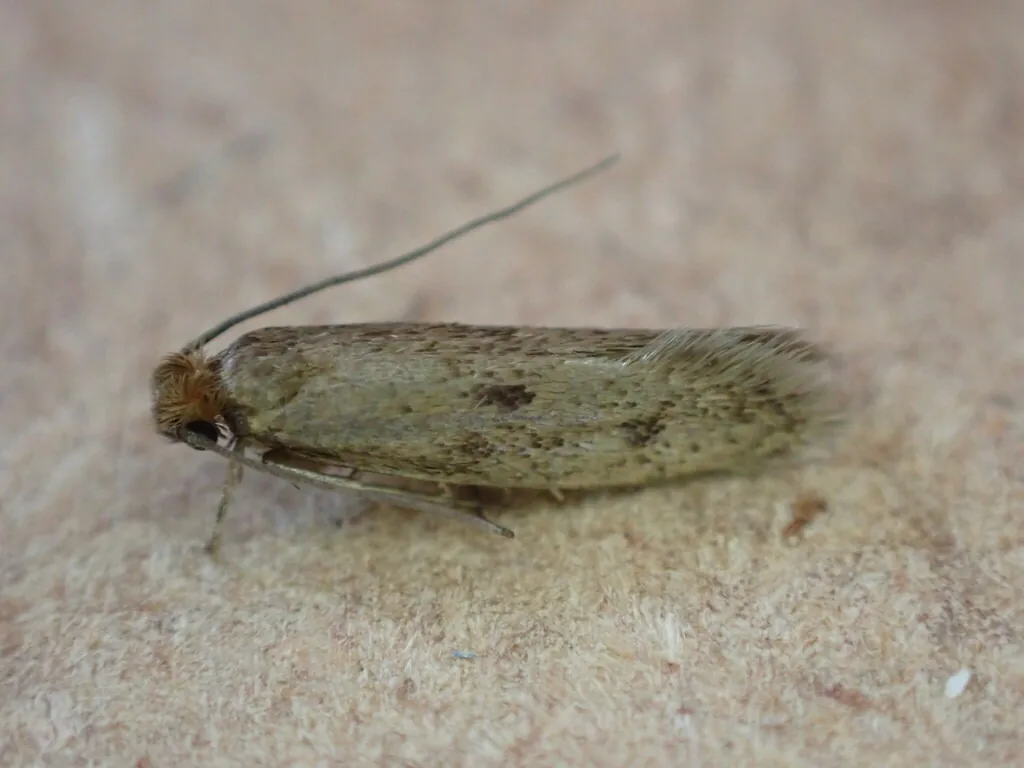
- Adults are small, narrow-winged, buff to brownish moths with fringed wings, only about 1/4 inch long at rest.[1][2]
- The wings carry faint dark spots or specks, and the hairs on the head are lighter than the webbing clothes moth's reddish tuft.[1][2]
- Larvae are shiny creamy-white caterpillars with dark heads that always stay inside an open-ended silken case they drag along and enlarge as they grow.[1][2]
- Full-grown cases are cigar-shaped, about 3/8 inch long, with bits of the infested fabric woven in.[1][2]
- Adults are weak fliers that avoid light and flutter near the infested items rather than flying steadily around the house.[1][2]
Look-alikes
| Look-alike | How to tell them apart |
|---|---|
| Webbing clothes moth | A uniform golden-buff moth without wing spots, with a reddish hair tuft; its larvae leave silk feeding tubes and webbing behind instead of carrying a case.[1][2] |
| Indianmeal moth and other pantry moths | About twice as long at rest, lack the hair tufts on the head, fly steadily in lit rooms like kitchens, and come from stored food.[1][2] |
| Carpet beetles | Their larvae eat the same animal-fiber materials, so damage blamed on moths may be carpet beetles; the insects themselves look very different.[2] |
Where it lives
One of the two clothes moths common in North America; it is less common than the webbing clothes moth and of far less economic importance.[1][2]
Biology and life cycle
Larvae digest keratin, the protein in animal fibers; in nature they feed in bird and mammal nests or on carcasses.[2]
Females lay about 40 to 50 eggs over 2 to 3 weeks, gluing them to fabric threads, then die; eggs hatch in 4 to 10 days in warm weather.[1][2]
The larval stage lasts from about a month to more than 2 years depending on temperature and food, and larvae can feed from either end of the case.[1][2]
When ready to pupate, larvae crawl off the item to find crevices in shelving or where walls meet the ceiling.[1][2]
Heated homes let them keep developing through winter; there are usually two generations a year.[1]
Damage and signs
- Only larvae damage fabric; adults don't feed.[1][2]
- They eat wool, fur, silk, feathers, felt and leather, plus blends containing wool; pure cotton and synthetics are rarely attacked unless heavily soiled.[1][2]
- Damage shows up in hidden spots such as under collars and cuffs, in upholstery crevices, along rug edges and beneath furniture; stained fabrics are hit harder.[1][2]
- Infestations can also start from lint and pet hair in vents, or from old bird or animal nests in attics, chimneys or wall cavities.[2]
Health risk
Adult clothes moths don't feed and cause no injury; the bigger safety concern is mothballs, flakes or crystals, which are toxic and must be kept away from children and pets.[1][2]
Control
Prevention
Clean woolens before storing them, then pack them in airtight bags or containers; cedar chests are of debatable or little value.[1][2]
Sanitation
Find every infested item, then hot-launder, dry clean or bag and discard it; hot washing for 20 to 30 minutes at 120 degrees F or higher kills all stages.[1][2]
Vacuum closets, carpet edges, baseboards, under furniture and inside vents, and empty the vacuum promptly since it may hold eggs and larvae.[1][2]
Traps and physical control
Freeze sealed, bagged items at 0 degrees F for at least a week, or heat items above 120 degrees F for at least 30 minutes if the fabric can take it.[1][2]
Use pheromone traps made for this species to detect moths early; webbing and casemaking moths respond to different lures.[1][2]
Pesticides
For articles that can't be cleaned, heated, frozen or fumigated, use a spray that lists clothes moths on its label, usually pyrethrins, and test a hidden spot for staining first.[1]
When to call a professional
Persistent or widespread infestations, and stuffed furniture that needs fumigation, may require a professional pest control firm.[1][2]
Common questions
- What are the little cases stuck to my closet wall?
- Larvae crawl off the fabric to pupate in crevices and wall-ceiling joints, so cases there point to an infested wool, fur or feather item nearby.[2][1]
- Do mothballs work?
- Their vapors kill only when sealed in an airtight container with the clothes; in an open closet they barely repel adults, and larvae keep feeding.[1][2]
- Why is the case the same color as my sweater?
- Larvae weave fibers of the fabric they eat into the silk case, so it takes on that color.[1][2]
Sources
- University of California Statewide IPM Program, “Pest Notes: Clothes Moths, Publication 7435.” ipm.ucanr.edu/home-and-landscape/clothes-moths/ (accessed 2026-10-06)
- University of Kentucky Entomology, “Clothes Moths (ENTFACT-609, revised March 2026).” entomology.mgcafe.uky.edu/ef609 (accessed 2026-10-06)
- iNaturalist, “Tinea pellionella taxon page (order and family).” www.inaturalist.org/taxa/193928 (accessed 2026-10-06)