The short answer
- Each lure attracts its own pest. Most use a sex attractant that draws male moths onto a sticky surface, and a trap for grain-infesting moths won't attract clothes moths, or the other way around.[1][2][5]
- Use them to detect and time: to find a hidden pantry or closet infestation, to check that it's gone after cleanup, or to see when codling moths start flying so sprays hit hatching larvae.[2][1][3][6][7][8]
- Trapping alone isn't a reliable way to cut codling moth damage, and mating-disruption products don't work on small plantings: under 5 acres according to UC IPM, under 10 acres according to Colorado State and Utah State. On single trees they can even increase damage.[3][7][9]
- Japanese beetle traps attract many more beetles than they catch, so in most landscapes they probably do more harm than good.[4][10]
- Pantry pest traps stay effective for about three months. Check them weekly and inspect stored food again whenever they catch a new batch.[2]
Pests these traps monitor
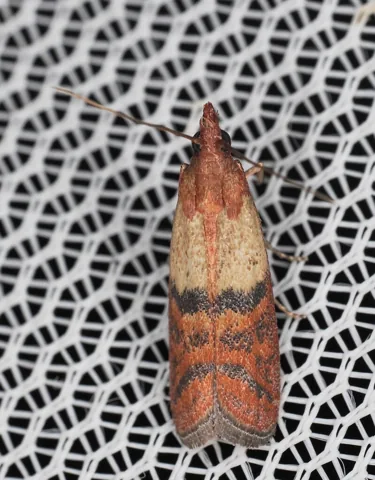 Indianmeal Moth
Plodia interpunctella
The Indianmeal moth is the most common moth infesting stored food in the home; all damage is done by the larvae, which feed in cereals, flour, nuts, dried fruit, chocolate and pet food.
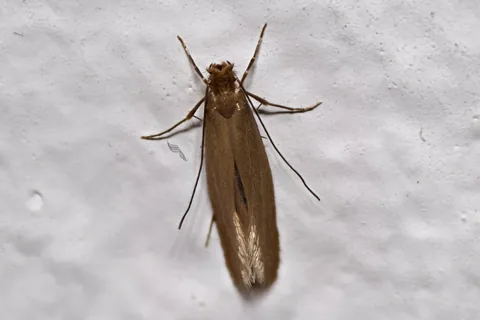 Webbing Clothes Moth
Tineola bisselliella
The webbing clothes moth is probably the most commonly encountered clothes moth in the United States. Its larvae feed on wool, fur, feathers and other animal fibers in hidden spots, and the moths are seldom seen because they avoid light.
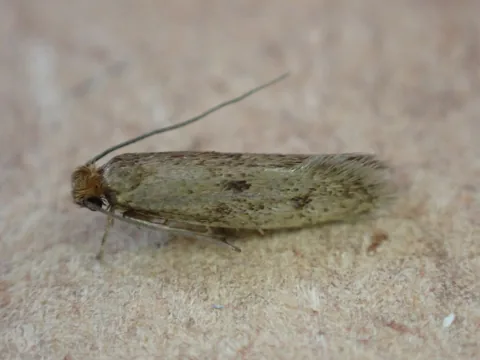 Casemaking Clothes Moth
Tinea pellionella
The casemaking clothes moth is a small fabric pest whose larvae feed on wool, fur, feathers and other animal fibers. Each larva lives inside a portable silk tube that takes on the color of whatever it has been eating.
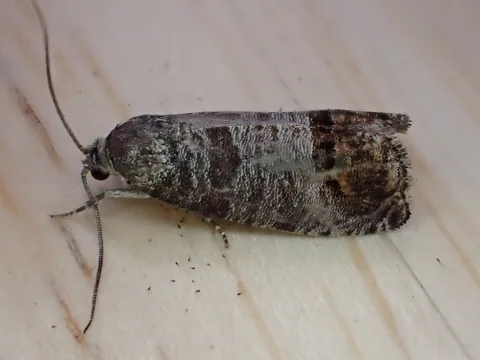 Codling Moth
Cydia pomonella
Codling moth is the infamous worm in the apple. Its caterpillars bore into apples, pears and English walnuts soon after hatching and tunnel toward the core, leaving holes packed with reddish-brown droppings.
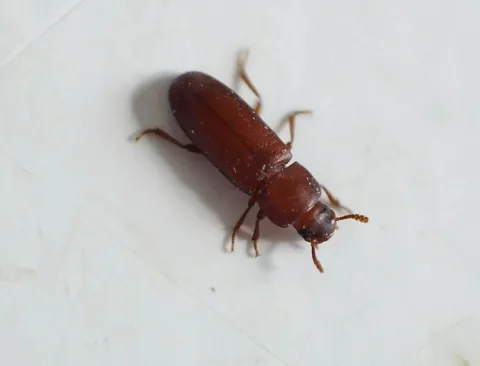 Red Flour Beetle
Tribolium castaneum
The red flour beetle is a shiny reddish-brown beetle that lives in flour, mixes and other processed or broken grain products; it can't chew into whole, sound kernels. Researchers call it a major storage pest.
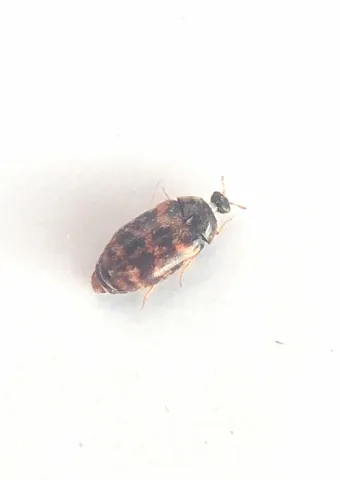 Warehouse Beetle
Trogoderma variabile
The warehouse beetle is a dermestid beetle that infests a very wide range of dry foods, from cereals and flour to pet food, nuts, spices and candy. Its hairy larvae do the feeding, and their shed hairs make infested food unfit to eat.
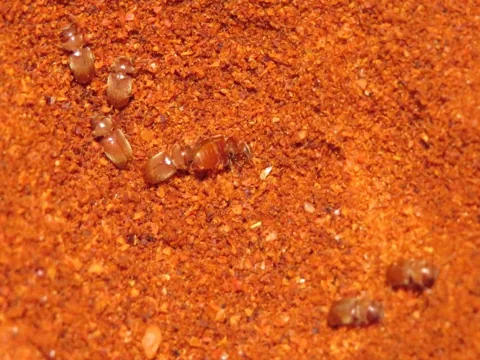 Cigarette Beetle
Lasioderma serricorne
The cigarette beetle is the most important insect pest of stored tobacco, and Texas A&M calls it the most common pantry pest in Texas. In homes its larvae feed in spices, pet food, flour, cereals and dried plant decorations.
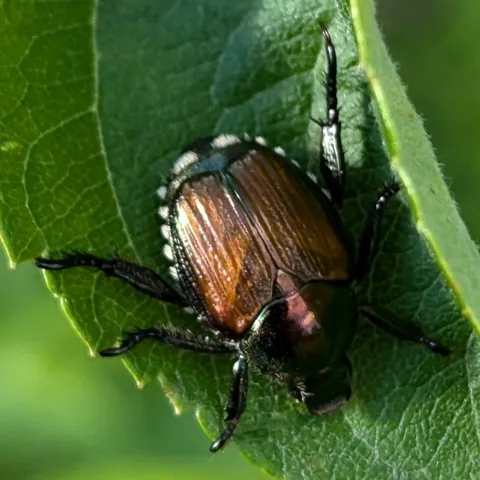 Japanese Beetle
Popillia japonica
The Japanese beetle damages landscapes twice: metallic green adults chew the leaves, flowers and fruit of hundreds of plants in early summer, and their white grubs feed on grass roots underground. A review of its biology calls it the most widespread and destructive insect pest of turf, landscapes and nursery crops in the eastern United States.
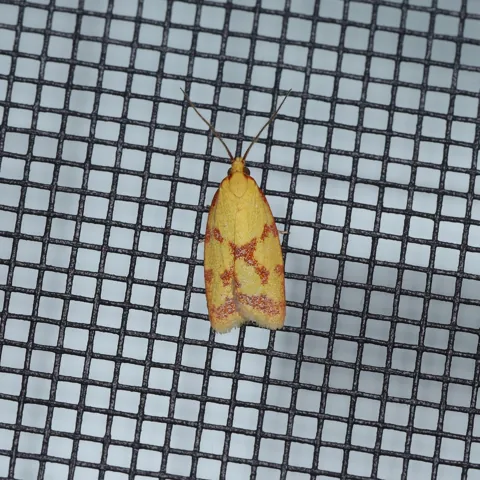 Sparganothis Fruitworm
Sparganothis sulfureana
Sparganothis fruitworm is a native moth in the leafroller family and one of the most damaging pests of cranberry. Its caterpillars web and skeletonize the leaves and eat the blossoms, and the summer brood bores into the berries. It also feeds on blueberries and on plants in nearly 20 other families.
How pheromone traps work
Pheromones are chemicals an organism produces to affect the behavior of other members of its species. Most moth traps use a sex pheromone: the lure mimics the scent of a female, so males fly in and get stuck on the trap's sticky sides.[1][2][3][5]
Because the scent is specific, a trap attracts only the insects it was made for. Clothes moth traps won't attract other moth species, traps for grain-infesting moths won't attract clothes moths, and traps made for the Indian meal moth won't attract pantry beetles.[1][2][6]
Not every lure is a sex attractant. Flour beetle lures are aggregation pheromones that draw both sexes, some pantry traps add a food-oil lure, and some are made to attract several pantry pests at once, such as Indian meal moth, red and confused flour beetles, warehouse beetle and cigarette beetle.[2][5]
Georgia Extension adds that food lures are the better choice when you don't know which pest you have, or when no pheromone is made for it.[5]
Moth traps catch males and don't attract females. Catching males before they mate may reduce egg-laying, which gives some control, but traps are used mainly to detect and monitor pests.[2][1]
Sources differ on how much that control is worth. UC IPM says clothes moth traps give some control because trapped males can't mate, and that catching pantry moth males before they mate may cut egg-laying. University of Georgia Extension says traps for pantry pests show whether pests are present and how many, and whether control is working, but aren't useful for reducing numbers or ending an infestation. Colorado State says codling moth pheromone traps used alone are not useful for control.[1][2][5][7]
Getting useful counts from a trap
A trap only tells you something if it's set up and kept the way the maker and the fact sheets describe. Read and follow the label for the number of traps and where they go.[5][9]
- Don't add extra traps. Georgia Extension warns that too many sex-pheromone traps can fill the air with attractant, confuse the insects and make every trap less effective, so use no more than the maker recommends.[5]
- Keep the sticky surface clean. Dirty traps, or traps crowded with insects, attract much less. Colorado State says to change codling moth traps when the sticky bottom gets covered with soil, debris and moths, and Utah State says to change sticky panels after catching 20 to 30 moths or once debris builds up.[5][7][9]
- Replace lures on schedule. Lure life varies by product: UC IPM says most pantry traps stay effective for about three months, while Colorado State says codling moth lures typically last about 3 to 4 weeks. Utah State says to follow the maker's stated lure life.[2][7][9]
- Don't mix lures. Minnesota advises handling codling moth lures with tweezers kept only for that purpose, or with disposable gloves, so you don't spread the scent to other surfaces. Utah State says not to store unsealed lures for different species together and not to reuse a trap that held another species' lure.[8][9]
- An empty trap is not proof the pest is gone. Utah State says codling moths don't fly much when evening temperatures are below 60°F, a still evening keeps the trap from building a scent plume, and old or weak lures can also catch nothing.[9]
Pantry moths and beetles
Traps back up the cleanup; they don't replace it. If you see small moths or beetles in the kitchen, find the infested food and get rid of it right away; throw out any food that shows signs of infestation.[2][5]
Georgia Extension makes the same point about sprays: insecticides alone are unlikely to end a pantry infestation, must never go directly on food, and traps should be used to check whether control is working, not as the only control.[5]
- Use a trap labeled for pantry pests and match it to the pest. A trap made only for Indian meal moths won't catch beetles.[2]
- Put traps where the infestation was and check them weekly. Most traps remain effective for about three months.[2]
- Keep trapping after the infested food is gone. Pantry pests can live for many weeks without food, and the traps show whether any are left in the house.[2]
- Each time the traps catch a new batch of moths or beetles, inspect food packages again for an infestation.[2]
Clothes moths
Kentucky Entomology says pheromone traps are especially good at revealing clothes moth infestations early, when they're hard to find by looking.[6]
- Use traps made for clothes moths. There are traps for both the webbing clothes moth and the casemaking clothes moth, and major hardware stores carry them.[1][6]
- Know which moth you have before you buy. Webbing and casemaking clothes moths each have their own pheromone, so Kentucky says to find out which one you have before ordering traps.[6]
- Place them in closets and other areas where clothes are stored.[1][6]
- In a large closet or storage room, Kentucky suggests setting several traps in a grid. Traps that catch more moths tend to be closer to the infested items.[6]
- Trapping helps you detect clothes moths and gives some control, since trapped males can't mate. If you catch moths, also dry-clean or launder the clothes that were exposed.[1]
Codling moth in apple, pear and walnut trees
Codling moth traps usually have a sticky cardboard bottom and a sex-pheromone lure, and they're sold at hardware stores, garden centers and online. Their important use is monitoring moth flights so insecticide treatments can be timed.[3][7][8]
Timing matters because sprays work only when they hit caterpillars just as they hatch, before they tunnel into fruit. UC IPM's method is to hang a trap in the tree in March (mid-March in California's Central Valley, by the end of March in coastal areas) and check it every few days. Once moths are caught and sunset temperatures pass 62°F, start calculating degree-days; eggs hatch about 250 to 300 degree-days after the first moths are trapped.[3]
Other regions time the trap differently. Colorado State puts traps out before first bloom and expects the first eggs about a week after moths are caught consistently; it and Utah State start the degree-day count (the biofix) when at least two moths are caught on consecutive nights. Minnesota says to hang the trap in early May and check it weekly from mid-May. Utah State says to check traps every 1 to 2 days until the first moth is caught.[7][9][8]
Advice on height differs too. UC IPM says to hang the trap as high as possible in the canopy and Utah State says the upper third, preferably 6 to 7 feet up, while Minnesota says about eye level on the outside of the canopy.[3][9][8]
One trap is enough for monitoring. In the trap, codling moths stand out from other moths by the dark, coppery brown band at the tip of each wing.[3]
That advice is for a backyard tree. Utah State's guidance for orchards calls for at least two traps per orchard, one at the edge and one near the center.[9]
Without degree-days, you can watch the fruit instead and start treatment as soon as you see stings, the small entry marks of newly hatched larvae.[3]
Can traps control pests on their own?
Rarely. Hanging traps in each susceptible fruit or nut tree might reduce codling moths on isolated trees, but UC IPM says it isn't a reliable way to reduce damage. If it works at all, it's where the trees are isolated from other apple, pear or English walnut trees and several traps hang in each tree.[3][7]
Colorado State notes one exception: a fairly isolated backyard tree may see some reduction from traps whose lures attract both sexes. Adding pear ester to the pheromone lure catches females as well as males, though Colorado State expects only minor suppression from it.[7]
Mating disruption products release large amounts of pheromone to prevent mating, or pair pheromone with an insecticide to attract and kill males. They've proven effective in large commercial plantings but aren't effective on orchards smaller than 5 acres, and they can increase damage on small plantings or individual trees.[3]
Colorado State and Utah State set the cutoff higher than UC IPM: both say mating disruption isn't effective or recommended for backyard trees or plantings under 10 acres. Colorado State explains why: in small plantings, moths mate outside the treated area and mated females then fly in to lay eggs, and disruption does nothing to a female that has already mated.[7][9]
Japanese beetle traps pair a lure that mimics the scent of virgin females with a sweet food-type lure that attracts both sexes, and they can pull in thousands of beetles a day. University of Kentucky research showed they attract many more beetles than they catch, so plants near the traps or along the beetles' flight path are likely to suffer much more damage than with no traps at all.[4][10]
Minnesota Extension says Japanese beetle traps were developed to monitor where the beetles are present so control could be planned, and advises against hanging them in home gardens.[10]
If you experiment with Japanese beetle traps anyway, put them well away from gardens and landscape plants.[4]
Common questions
- Will a pantry moth trap catch clothes moths?
- No. The lures are specific to their pests: traps for grain-infesting moths won't attract clothes moths, and clothes moth traps won't attract other moth species. Buy the trap made for the pest you have.[1]
- How long does a pantry pest trap last?
- Most remain effective for about three months. Check them weekly, and keep one out after cleanup, since pantry pests can live for weeks without food.[2]
- Should I hang Japanese beetle traps?
- Usually not. University of Kentucky research found the traps attract many more beetles than they catch, so nearby plants can end up with more damage. If you try them, place them well away from the plants you want to protect.[4][10]
- Do I need degree-days to use a codling moth trap?
- Degree-days plus a trap is the most effective way to time sprays, but home gardeners can also watch the fruit and start as soon as they see the first stings.[3]
- My trap caught nothing. Does that mean I have no moths?
- Not necessarily. Utah State says cool evenings below 60°F, still air and old lures can all leave a codling moth trap empty, and Georgia Extension says traps become much less attractive when they're dirty or crowded with insects. Check the lure date and the trap surface before you trust a zero.[9][5]
- Will more traps catch more moths?
- Not reliably. Georgia Extension warns that too many sex-pheromone traps can saturate the air and confuse the insects, so use no more than the maker recommends. For monitoring codling moth on a home tree, UC IPM says one trap is enough.[5][3]
Photo credits
- Indianmeal Moth: (c) Rosario Douglas, some rights reserved (CC BY) — via iNaturalist, CC BY 4.0
- Webbing Clothes Moth: (c) David Kleuker, some rights reserved (CC BY) — via iNaturalist, CC BY 4.0
- Casemaking Clothes Moth: Stephen James McWilliam, public domain (CC0), via iNaturalist
- Codling Moth: Stephen James McWilliam, public domain (CC0), via iNaturalist
- Red Flour Beetle: (c) Roman, some rights reserved (CC BY) — via iNaturalist, CC BY 4.0
- Warehouse Beetle: (c) Viktor Strenada, some rights reserved (CC BY) — via iNaturalist, CC BY 4.0
- Cigarette Beetle: (c) Ezequiel Vera, some rights reserved (CC BY) — via iNaturalist, CC BY 4.0
- Japanese Beetle: (c) Emmett Collins-Sussman, some rights reserved (CC BY) — via iNaturalist, CC BY 4.0
- Sparganothis Fruitworm: (c) Adrienne van den Beemt, some rights reserved (CC BY) — via iNaturalist, CC BY 4.0
Sources
- University of California Statewide IPM Program, “Pest Notes: Clothes Moths (Home and Landscape).” ipm.ucanr.edu/home-and-landscape/clothes-moths/ (accessed 2026-11-10)
- University of California Statewide IPM Program, “Pest Notes: Pantry Pests (Home and Landscape).” ipm.ucanr.edu/home-and-landscape/pantry-pests/ (accessed 2026-11-10)
- University of California Statewide IPM Program, “Pest Notes: Codling Moth (Home and Landscape).” ipm.ucanr.edu/home-and-landscape/codling-moth/ (accessed 2026-11-10)
- University of Kentucky Entomology, “ENTFACT-451: Japanese Beetles in the Urban Landscape.” entomology.mgcafe.uky.edu/ef451 (accessed 2026-11-10)
- University of Georgia Cooperative Extension, “Bulletin 1378: Stored Product Pests in the Home (Suiter, Toews and Ames).” fieldreport.caes.uga.edu/publications/B1378/ (accessed 2026-11-10)
- University of Kentucky Entomology, “ENTFACT-609: Clothes Moths.” entomology.ca.uky.edu/ef609 (accessed 2026-11-10)
- Colorado State University Extension, “Codling Moth: Control in Home Plantings, Fact Sheet 5.613.” extension.colostate.edu/topic-areas/insects/codling-moth-control-in-home-plantings-5-613/ (accessed 2026-11-10)
- University of Minnesota Extension, “Codling moths in home orchards (Jeffrey Hahn, reviewed 2019).” extension.umn.edu/yard-and-garden-insects/codling-moths (accessed 2026-11-10)
- Utah State University Extension and Utah Plant Pest Diagnostic Laboratory, “Codling Moth (Cydia pomonella), ENT-13-06 (Alston, Murray and Reding, 2010).” extension.usu.edu/files-ou/publications/factsheet/codling-moths06.pdf (accessed 2026-11-10)
- University of Minnesota Extension, “Japanese beetles in yards and gardens.” extension.umn.edu/yard-and-garden-insects/japanese-beetles (accessed 2026-11-10)