The short answer
- Hang baited red sticky spheres in the tree by the end of June. They mimic a ripe apple and catch females that come to lay eggs. On their own they can give fairly good control where fly numbers are low to moderate, but Washington State University says they aren't effective as a stand-alone method.[1][3][5]
- Bag apples while they are small, after thinning to one fruit per cluster. Bagged fruit stays protected for the rest of the season.[3][1][2]
- Pick up dropped apples right away, before the larvae leave them for the soil, and put them in the trash, not the compost.[1][3][5]
- If you spray, let the traps tell you when. The University of Minnesota says to spray after one fly on an unbaited trap or five on a baited one; the insecticide must be labeled for apples, and you must observe the label's wait before harvest.[3][1]
- In the West, apple maggot is a quarantine pest: Washington and several California counties restrict moving home-grown fruit.[5][4][6]
Apple maggot and similar fruit pests
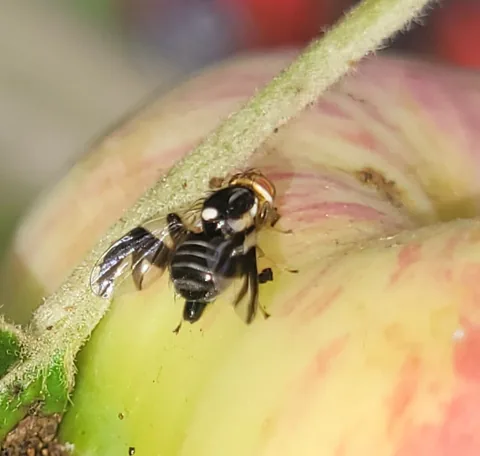 Apple Maggot
Rhagoletis pomonella
The apple maggot is a small fruit fly whose larvae tunnel through apples and leave brown, rotting trails. Minnesota Extension calls it the most important insect pest of Minnesota-grown apples, and Wisconsin's fruit specialists say few pests are as damaging to home apple growing.
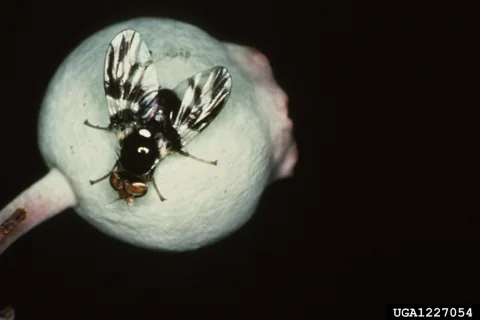 Blueberry Maggot
Rhagoletis mendax
The blueberry maggot (blueberry fruit fly) is a small black fruit fly with white markings and dark zigzag-banded wings. Its white, legless maggots feed inside ripening blueberries.
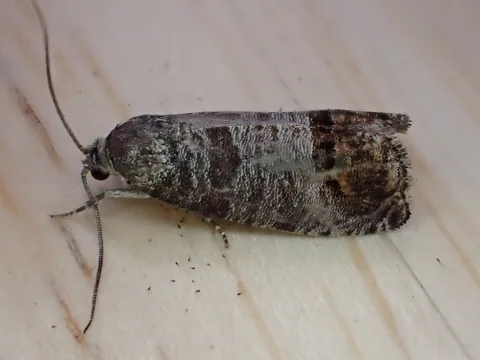 Codling Moth
Cydia pomonella
Codling moth is the infamous worm in the apple. Its caterpillars bore into apples, pears and English walnuts soon after hatching and tunnel toward the core, leaving holes packed with reddish-brown droppings.
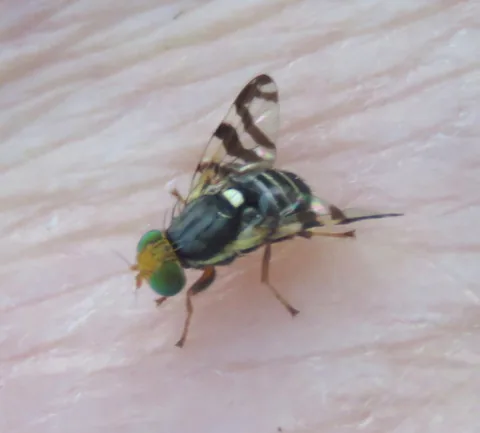 Western Cherry Fruit Fly
Rhagoletis indifferens
The western cherry fruit fly is a small fly, about 1/5 inch long with dark-banded wings, whose white maggots feed inside ripening sweet, tart and wild cherries in the western United States.
Is it apple maggot?
Look at the apple first. Where a female laid an egg there is a small sting or dimple; in soft varieties a small dark decayed spot forms, and in hard-fleshed ones a dimple. Inside, the larvae leave slender brown, winding trails all through the flesh, and the fruit rots along them, often becoming pitted and misshapen. Infested apples usually drop early.[1][3][4]
That spread-out tunneling is the main way to tell it from codling moth. Codling moth larvae feed mainly in the core, while apple maggot trails run throughout the fruit. The maggots are cream colored, legless and headless apart from two black mouth hooks, and much smaller than codling moth larvae. Early in their growth they match the color of the flesh, so a lightly infested apple can look sound and the larvae keep feeding in storage.[1][3][4]
The adult is a fly smaller than a house fly with dark bands on clear wings, a white spot on the back where the thorax meets the abdomen, and a black abdomen with pale cross bands (four on females, three on males). Sources give slightly different sizes: about 1/5 inch at UC IPM, 3/16 to 1/4 inch at the University of Wisconsin, 1/4 inch at Minnesota, and 1/4 to 3/8 inch at Washington State.[1][3][4][5]
Look-alikes: blueberry maggot looks almost the same but stays on blueberry and related plants. In California, UC IPM separates apple maggot from olive fruit fly and walnut husk fly by its body color and wing pattern, and notes that the vinegar flies also called fruit flies are much smaller. In Washington, the snowberry fly looks so similar, and is caught on the same traps, that it adds work to apple maggot surveys.[1][4][12]
Life cycle and timing: why late June matters
Apple maggot spends the winter as a pupa a few inches deep in the soil. The University of Wisconsin says the flies dig out from the end of June or early July once the soil is moist enough, and can keep emerging into early September; in a dry spell they wait for rain or irrigation. Minnesota puts peak activity from late July through early August, and UC IPM says adults emerge in California from June through August with a peak in July.[1][3][4]
New flies feed on honeydew, pollen and other residues on leaves for about 7 to 10 days before the females can lay eggs. That gap is why a trap catch gives you some warning. Each female lays eggs just under the skin of the fruit, about 300 over a 30-day life according to UC IPM, or 300 to 500 over a few weeks according to the University of Wisconsin. Eggs hatch in a few days.[1][4]
The larvae feed for about three to four weeks according to UC IPM and Minnesota; the University of Wisconsin gives 2 to 6 weeks or more, faster in warm weather and in softer, riper fruit. By then the apple has usually dropped, and the larvae leave it and burrow about 2 inches into the soil to pupate until the next summer. Some pupae stay in the soil an extra year.[1][3][4]
There is usually one generation a year, though UC IPM says there may be a partial second in some years. Timing shifts with climate: in the Southern Appalachian Mountains, flies at sites at 630 m and above were active mainly for about two months in summer and had one generation, while at the lowest sites (300 to 328 m) adults were active from late May or early June into November and appeared to have two.[4][1][10]
Apple maggot prefers earlier, softer and sweeter apple varieties, and Washington State says early-maturing varieties suffer most. It also infests crabapple and hawthorn, and the University of Wisconsin lists pear and stone fruits. Its original host was hawthorn; a form that attacks apple arose in the 1800s.[1][5][4]
Red sphere traps: hanging them to catch egg-laying flies
A red sphere trap is a ball about the size and color of a ripe apple, coated with a sticky material. It catches mature females looking for fruit to lay eggs in, and the University of Wisconsin says it can be used for control as well as monitoring. Minnesota's options include painted wooden or plastic spheres, red plastic spheres sold for the purpose, or large fresh red apples coated with the sticky material, which act as their own lure. Spheres should be bright red and at least 3 inches across.[1][3]
Bait the spheres. Unbaited spheres catch far fewer flies, according to the University of Wisconsin. A lure can sit inside a plastic sphere, or Minnesota suggests an apple chunk. In the eastern United States fruit-odor lures have been reported to work better, but in western Washington, research found traps baited with ammonium carbonate generally caught more flies than traps with apple or hawthorn fruit blends, and WSU describes the lures sold to homeowners as ammonia-based. Washington State says there are no effective pheromones for apple maggot, so a codling moth pheromone trap is no substitute.[1][3][11][5]
- When: Minnesota says hang them by the end of June, when the first flies try to lay eggs; the University of Wisconsin says about the last week of June.[3][1]
- Where: hang them on the outside edge of the canopy, not deep inside, and clear away leaves and fruit touching them. Minnesota says put at least one on the side of the tree facing any woods or brushy area and another on the south side.[3]
- How many: the two sources count differently. The University of Wisconsin uses tree size: one sphere in a tree under 8 feet tall, 2 to 4 in a medium tree, and 6 to 8 in a large one (20 to 25 feet). Minnesota aims for one trap per 100 fruit after thinning, which works out to one or two in a small tree and five or more in a larger one.[1][3]
- Upkeep: Minnesota checks traps weekly and the University of Wisconsin clears them every couple of weeks; remove the stuck insects and recoat as needed. Minnesota removes the sticky coating with vegetable oil on a rag, then washes the sphere in warm soapy water; sticky-coated fresh apples can simply be thrown out.[3][1]
- Wildlife: UC IPM cautions that sticky traps can entangle birds and other animals, so sticky trapping may be a poor fit where wildlife visit the tree often.[4]
How much can traps do on their own?
Here the sources part ways. The University of Wisconsin says baited red spheres can give fairly successful control where populations are low to moderate, but trapping alone may not be enough where they are high. Washington State University says the traps attract flies only from short distances and are useful for monitoring, but not effective as a stand-alone strategy. Minnesota suggests also hanging traps in apple or hawthorn trees in nearby wooded areas to further reduce pressure.[1][5][3]
In practice, pair the spheres with bagging, kaolin clay or a timed spray on fruit you most want to protect, and use the catch to judge the year.[1][3][5]
Researchers are working on spheres that kill without glue. A USDA-led study put spinosad and a sugar feeding stimulant in a cap on top of a red sphere; at or near 1.0% spinosad, it killed about 85% of flies even after simulated season-long rain, and spheres around the edge of commercial orchard plots protected fruit about as well as 1 to 2 whole-plot sprays. A later three-year trial in 26 commercial orchards in New England baited perimeter trees with lures and sprayed only those trees with insecticide plus sugar; fruit infestation was no different from full-block spraying, while insecticide use dropped by 64.2% to 75%. These are orchard methods, not homeowner products, but they show why the orchard edge matters.[14][13]
Bagging apples
Bagging puts a barrier between the fruit and the egg-laying fly, and the apples ripen with normal taste and texture. Minnesota says the method was developed in western Minnesota and suits gardeners with one or a few medium-sized trees; on a tall tree you can bag only the fruit you can reach. UC IPM notes that bags used against codling moth also control apple maggot.[1][3][4]
Thin first to one apple per cluster and bag only fruit that isn't already damaged. The step-by-step bagging method, with plastic or paper bags, is on the fruit tree pest calendar linked below.[3][2][5]
- When: the University of Wisconsin starts when fruit is about 1/2 to 3/4 inch across, usually about two weeks after petal fall; Minnesota says sometime between early and mid-June. Washington State gives a later window, 4 to 6 weeks after petal fall when fruit is about dime-sized. Washington State stresses that the bags must be on before the adult flies emerge.[2][3][5]
- Which bag: Wisconsin and Minnesota use plastic sandwich bags, stapled or zipped around the stem, with a bottom corner snipped so water drains. Washington State cautions that clear plastic sandwich bags may hold moisture and add to disease, and lists paper lunch bags, wax paper bags, double-layer fruit bags and nylon mesh footie bags as options.[2][3][5]
- How long: plastic bags can stay on all summer. Washington State says bags can come off about 3 weeks before harvest to improve color, but then late-season flies can still attack the fruit.[2][5]
Sanitation: dropped fruit and nearby host trees
Larvae leave fallen apples and pupate in the soil under the tree, so the drops you leave are next year's flies. Pick them up soon after they fall, before they rot and before the larvae leave, during the season and after harvest. UC IPM also suggests picking and discarding fruit on the tree that shows brown trails under the skin, and Washington State says to scout for infested fruit from late July to harvest.[1][3][4][5]
- Dispose of drops so the larvae can't finish. Minnesota says seal them in a container and put them in the trash or send them to a municipal composting site, never your own compost. Washington State says to crush them, or leave them in a plastic bag in hot sun for a week, and not to put infested fruit in yard waste. The University of Wisconsin says destroy or bury deeply.[3][5][1]
- Deal with unmanaged hosts. The University of Wisconsin advises removing unmanaged host plants within 200 yards of your trees where possible, especially unmanaged apple trees, which are a big source of flies. Minnesota notes that cleanup at home won't stop flies coming in from elsewhere.[1][3]
- Keep trees small. Washington State suggests dwarfing rootstocks and pruning to keep trees under ten feet tall, which makes bagging, trapping and picking easier.[5]
Kaolin clay and exclusion netting
Kaolin clay is a fine mined clay mixed with water and sprayed on leaves and fruit to leave a white film. It is allowed in organic growing. It doesn't work like a regular insecticide: the flies are drawn to red, round fruit, and a whitish coating makes the apples less attractive and gives them a surface the flies don't like. USDA researchers found that an even coat made fruit-like spheres less attractive, a spotty coat broke up the round outline the flies look for, and females left treated fruit sooner. The University of Wisconsin says the clay does not kill the insects, but in those lab tests flies forced to stand on treated surfaces died within 2 days.[1][3][7]
Results vary with how well the coat is kept up. Minnesota says a well-maintained coating can protect 90 percent of fruit, and the University of Wisconsin says it is not 100% effective but gives many gardeners enough control. A two-season Quebec orchard study, though, found a calendar program of kaolin sprays had no effect on apple maggot. The clay washes off in moderate rain, so expect to reapply; the University of Wisconsin says weekly as the fruit grows. It leaves a white residue that has to be brushed off at harvest, and it can be used up to the day of harvest.[3][1][8]
Exclusion netting is a newer option. In a Minnesota commercial orchard, hail netting cut apple maggot by 96% and codling moth by 94% compared with open plots. Minnesota Extension says the whole tree must be enclosed, after bloom and thinning so pollination isn't affected, and that netting works best on smaller trees. Take it off right before harvest.[9][3]
When and what to spray
Use the traps to decide. Minnesota's rule: spray after the first fly on an unbaited trap, or after five flies total on a baited trap, and avoid calendar spraying that kills beneficial insects. The University of Wisconsin says a baited yellow sticky card catches flies while they are still feeding, before egg-laying, and gives about a week from the first catch until control is needed; if no flies show up, spraying is unnecessary. UC IPM puts at least 2 yellow sticky traps up in early June where the pest was a problem before and sprays at the first catch. Many other insects stick to these traps, so learn to recognize the apple maggot fly.[3][1][4]
Active ingredients named by the extension sources include spinosad, esfenvalerate and carbaryl. UC IPM says spinosad works best sold premixed with a fruit fly bait or mixed with one. Minnesota calls carbaryl broad-spectrum and says to use it strategically to spare beneficial insects; Washington State notes esfenvalerate is toxic to bees and should not be applied on or near blooming plants.[3][4][5]
Expect repeat sprays while flies are active. The University of Wisconsin says most conventional insecticides protect for about 2 weeks and organic ones fade faster; Minnesota says three or four sprays a season may be needed, and UC IPM repeats every 7 to 10 days while flies keep emerging. Fly numbers fall later in the season, and you can stop when traps stop catching flies. Minnesota suggests taking traps down before a spray and recoating them afterward.[1][3][4]
Western quarantines: don't move the fruit
Apple maggot is native to the northeastern and midwestern United States and nearby Canada and was accidentally introduced into the western United States in the late 1970s. In the West it is a quarantine pest, regulated to protect the apple industry.[1][11][6]
California: UC IPM says the pest occurs only in Northern California from Sonoma County northward, and it is illegal to bring home-grown apples into some counties further south; as of 2021 these included Contra Costa, El Dorado, Fresno, Kern, Kings, Merced, San Benito, San Joaquin, San Luis Obispo, Stanislaus, Tulare and Ventura. Report suspected apple maggots found in Central or Southern California to the county agricultural commissioner.[4]
Washington: moving home-grown fruit from infested to non-infested areas is prohibited. The Washington State Department of Agriculture says the pest spreads in home-grown fruit and municipal waste, and residents of quarantine areas such as Leavenworth in Chelan County cannot take home-grown fruit or green waste (yard debris, leaves, trimmings and garden waste) into the pest-free area. Since 2020, soil around the roots of host plants from the quarantine area is regulated too.[5][6]
Common questions
- What do apple maggots look like inside an apple?
- Small cream-colored, legless larvae with no visible head, and thin brown winding trails through the flesh that rot. Codling moth damage is mostly in the core.[1][4]
- When should I hang apple maggot traps?
- By the end of June, or about the last week of June, before the first flies start laying eggs. UC IPM puts yellow monitoring traps up in early June in California.[3][1][4]
- How many red sphere traps do I need per tree?
- The University of Wisconsin says one in a tree under 8 feet, 2 to 4 in a medium tree and 6 to 8 in a 20- to 25-foot tree. Minnesota aims for one per 100 fruit after thinning.[1][3]
- Can I eat apples with apple maggots?
- Heavily infested fruit is distorted and inedible, though Minnesota says it can be used for cider or animal feed. Lightly infested fruit can look normal, and the University of Wisconsin says many young maggots are probably eaten unnoticed.[3][1]
- Should I compost apples with maggots?
- No. The larvae leave the fruit to pupate in soil. Bag them for the trash or a municipal composting site, and in Washington's quarantine areas don't put infested fruit in yard waste.[3][5][6]
- Do pheromone traps work for apple maggot?
- No. Washington State says there are no effective pheromones for apple maggot. Use baited red spheres or yellow sticky cards instead.[5][1]
Photo credits
- Apple Maggot: (c) Bex Goreham, some rights reserved (CC BY) — via iNaturalist, CC BY 4.0
- Blueberry Maggot: Blueberry maggot by Jerry A. Payne, USDA Agricultural Research Service — via Wikimedia Commons, CC BY 3.0
- Codling Moth: Stephen James McWilliam, public domain (CC0), via iNaturalist
- Western Cherry Fruit Fly: Steve Wells, public domain (CC0), via iNaturalist
Sources
- University of Wisconsin-Madison Division of Extension, Wisconsin Horticulture, “Apple Maggot (A4159).” hort.extension.wisc.edu/articles/apple-maggot-scourge-of-home-apple-production/ (accessed 2026-11-10)
- University of Wisconsin-Madison Division of Extension, Wisconsin Horticulture, “Bagging Apples for Insect and Disease Control (XHT1268).” hort.extension.wisc.edu/articles/bagging-apples-for-insect-and-disease-control/ (accessed 2026-11-10)
- University of Minnesota Extension, “Apple maggot.” extension.umn.edu/yard-and-garden-insects/apple-maggot (accessed 2026-11-10)
- University of California Statewide IPM Program, “Apple Maggot (Home and Landscape).” ipm.ucanr.edu/PMG/GARDEN/FRUIT/PESTS/applemaggot.html (accessed 2026-11-10)
- Washington State University Extension, “Apple: Apple maggot (Hortsense).” hortsense.cahnrs.wsu.edu/fact-sheet/apple-apple-maggot/ (accessed 2026-11-10)
- Washington State Department of Agriculture, “Apple Maggot.” agr.wa.gov/departments/insects-pests-and-weeds/insects/apple-maggot (accessed 2026-11-10)
- Journal of Economic Entomology, via PubMed, “Leskey et al. (2010), Effect of a kaolin particle film on behavior and mortality of apple maggot, J Econ Entomol 103:394-401.” pubmed.ncbi.nlm.nih.gov/20429454/ (accessed 2026-11-10)
- Journal of Economic Entomology, via PubMed, “Bostanian and Racette (2008), Particle films for managing arthropod pests of apple, J Econ Entomol 101:145-150.” pubmed.ncbi.nlm.nih.gov/18330129/ (accessed 2026-11-10)
- Journal of Economic Entomology, via PubMed, “Nelson, Klodd and Hutchison (2023), Hail netting excludes apple maggot and codling moth in a commercial Minnesota apple orchard, J Econ Entomol 116:2104-2115.” pubmed.ncbi.nlm.nih.gov/37904544/ (accessed 2026-11-10)
- Environmental Entomology, via PubMed, “Meck, Walgenbach and Kennedy (2008), Phenology of the apple maggot in the Southern Appalachian Mountains, Environ Entomol 37:1154-1161.” pubmed.ncbi.nlm.nih.gov/19036194/ (accessed 2026-11-10)
- Environmental Entomology, via PubMed, “Yee et al. (2014), Ammonium carbonate is more attractive than apple and hawthorn fruit volatile lures to Rhagoletis pomonella in Washington State, Environ Entomol 43:957-968.” pubmed.ncbi.nlm.nih.gov/24915519/ (accessed 2026-11-10)
- Environmental Entomology, via PubMed, “Yee et al. (2017), Comparative responses of Rhagoletis zephyria and Rhagoletis pomonella to commercial and experimental sticky traps and odors in Washington State, Environ Entomol 46:1351-1358.” pubmed.ncbi.nlm.nih.gov/29028975/ (accessed 2026-11-10)
- Journal of Economic Entomology, via PubMed, “Pinero, Godoy-Hernandez and Leskey (2024), Multi-year evaluation of an attract-and-kill strategy for apple maggot, J Econ Entomol 117:2585-2590.” pubmed.ncbi.nlm.nih.gov/39454040/ (accessed 2026-11-10)
- Journal of Economic Entomology, via PubMed, “Wright et al. (2012), Integration of insecticidal, phagostimulatory, and visual elements of an attract and kill system for apple maggot fly, J Econ Entomol 105:1548-1556.” pubmed.ncbi.nlm.nih.gov/23156149/ (accessed 2026-11-10)