The short answer
- Late winter: prune to open the canopy and keep trees low enough to reach. Most backyard fruit trees don't need a dormant oil spray. If European red mites or scale insects are a problem, Clemson Extension recommends a horticultural oil spray before the blossoms open.[1][4][5][12][11]
- Bloom: don't spray insecticides on flowering trees, and keep any drift off blooming weeds nearby. UMass Extension says to wait until bloom is completely finished, and Minnesota Extension says codling moth sprays put on before most of the petals have fallen won't work and will kill pollinating bees.[1][6][12][7]
- After petal fall: thin each cluster to one fruit and bag apples when they're about 1/2 to 1 inch across, choosing fruit that isn't already damaged. Minnesota Extension bags after thinning, sometime between early and mid-June.[3][4][10][8]
- Summer: pick up dropped fruit right away and remove fruit with frass-filled holes every week or two. Where apple maggot is a problem, UW–Madison hangs traps about the last week of June. Minnesota Extension says to have them up by the end of June.[4][1][2][10][8][11]
- Fall: destroy blemished fruit and fallen diseased leaves. Bury or bin dropped fruit; UW–Madison says ordinary composting won't kill plum curculio larvae.[3][1][8][7]
Fruit tree pests in this guide
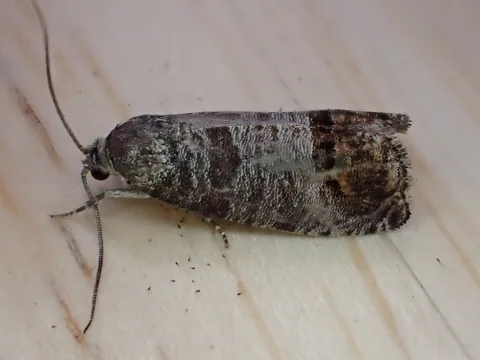 Codling Moth
Cydia pomonella
Codling moth is the infamous worm in the apple. Its caterpillars bore into apples, pears and English walnuts soon after hatching and tunnel toward the core, leaving holes packed with reddish-brown droppings.
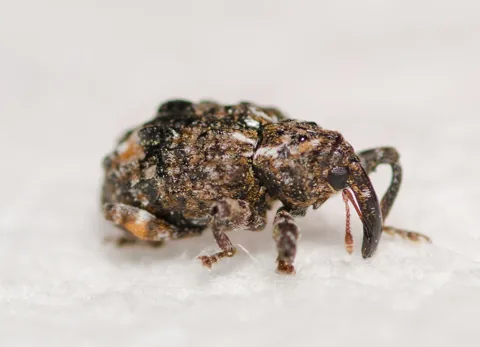 Plum Curculio
Conotrachelus nenuphar
The plum curculio is a small native snout beetle and one of the most destructive pests of apples and peaches. Females cut crescent-shaped scars into young fruit to lay eggs, and the grubs that hatch feed inside, often making the fruit drop.
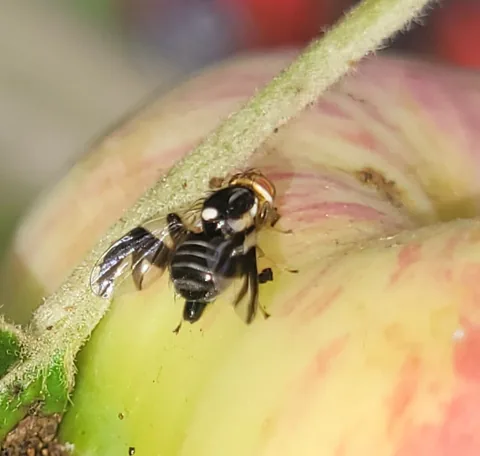 Apple Maggot
Rhagoletis pomonella
The apple maggot is a small fruit fly whose larvae tunnel through apples and leave brown, rotting trails. Minnesota Extension calls it the most important insect pest of Minnesota-grown apples, and Wisconsin's fruit specialists say few pests are as damaging to home apple growing.
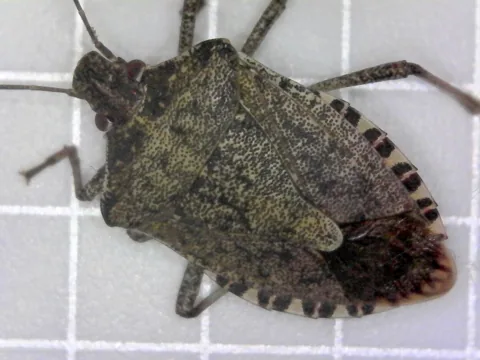 Brown Marmorated Stink Bug
Halyomorpha halys
The brown marmorated stink bug is an invasive insect from east Asia that damages fruit and vegetable crops and invades homes in fall looking for overwintering sites. Minnesota Extension says it feeds on about 200 plant species and, unlike the native stink bugs there, prefers to spend the winter in homes. Clemson notes that the bugs gather on outside walls before they move in.
The pests you're planning around
Apple maggot, codling moth, plum curculio and stink bugs are among the insects that damage home-grown apples, along with fungal diseases. Many of the insects lay eggs in the developing fruit, and their larvae tunnel through it. Clemson Extension adds tarnished plant bugs, which, like stink bugs, feed on young fruit and suck out the juices.[3][11][10]
Codling moth, the classic worm in the apple, bores into apples, pears and walnuts. It has two to four generations a year depending on climate, and late-maturing varieties are more likely to be badly damaged than early ones. The count depends on where you live: Minnesota Extension says there are two generations in Minnesota, Clemson's fact sheet describes a third in August, and Colorado State says a third may be produced in some locations. Colorado State also notes that later-maturing varieties stay on the tree long enough to be exposed to that third generation.[4][7][11][10]
Plum curculio is a native weevil of the eastern and midwestern United States and Canada that also lives in wild plum, native crabapple and hawthorn. Its larvae usually die in the firm flesh of young apples and pears, except in dropped fruit, but they complete development inside hanging stone fruit. Clemson and Utah State say the same about apples: the larva is usually killed by the growing fruit, though the egg scar still shows at harvest. UMass lists plum, pear, cherry and apricot as other hosts and calls the weevil one of the most destructive insect pests of peaches in New England.[1][11][14][12]
In the West, plum curculio is a quarantine pest. Utah State says a population found in Box Elder County, Utah, in the early 1980s is the only known infestation in western North America, where it's occasionally found in residential and wild fruit trees, and that no economic damage has occurred on apples or pears in Utah.[14]
Apple maggot is a fly that attacks in mid to late summer, after the early-season pests. It prefers earlier, softer, sweeter apple varieties and also infests pear, crabapple and stone fruits. Minnesota Extension says the flies appear in early July and stay active until September, with peak activity from late July through early August.[2][8]
Neglected trees nearby can keep supplying pests. UW–Madison advises removing unmanaged hosts, especially unmanaged apples, within 200 yards when possible, though plum curculio can travel more than a quarter mile, so removing wild hosts may not be enough where populations are high. Clemson, UMass and Utah State likewise suggest removing wild plums and other wild or untended fruit trees nearby. Codling moth travels too: Minnesota Extension says the adults can fly as far as a mile, so where they're common, keeping your own yard clean won't be enough on its own.[2][1][11][12][14][7]
Late winter: the dormant season
- Prune while trees are dormant. Opening up the canopy lets in light and reduces moisture, which makes the tree less favorable to plum curculio. UMass gives the same advice for orchards: dormant pruning keeps the canopy open, which helps air circulation and spray coverage.[1][12]
- Keep the canopy low enough that you can reach it easily. UC IPM notes this makes codling moth easier to manage. Minnesota Extension makes the same point about tall trees: the height makes pruning, fruit thinning and pest management harder, while trees on dwarfing rootstocks are easier to prune, thin, harvest and protect.[4][9]
- Skip the dormant oil unless you have a reason for it. The UC Master Gardener calendar says dormant oil sprays reduce overwintering insects but most backyard fruit trees won't need them.[5]
- When there is a reason: Clemson Extension uses a horticultural oil spray on the trunk and limbs in late winter or early spring, before the leaf buds open, against scale insects, and an oil spray between green tip and tight cluster, before the blooms open, against European red mite eggs and newly hatched mites. It warns against spraying captan or sulfur within 14 days before or after a horticultural oil spray, because the combination may burn leaves or developing fruit.[11]
- Codling moth spends the winter as full-grown larvae in silken cocoons under loose bark and in soil or debris at the base of the tree, then pupates in early spring.[4][10][11]
- Take away the hiding places. Colorado State suggests clearing debris from around the base of the tree and removing the flaps of loose bark that develop on older trees, since both give the larvae places to pupate.[10]
- UC IPM uses codling moth pheromone traps to track moth flights so sprays can be timed. In California it hangs one trap as high in the canopy as possible by mid- to late March and checks it every few days. Other regions start later: Colorado State says to put traps out before first bloom, and Minnesota Extension hangs one at about eye level on the outside of the canopy in early May and checks it weekly from mid-May. The two disagree on how long a lure lasts, about 3 to 4 weeks according to Colorado State and one or two months according to Minnesota. Both treat the trap as a timing tool; Colorado State says pheromone traps alone are not useful for control, and Minnesota says that if you catch no codling moths you might not need to spray for them.[4][10][7]
Bloom: keep insecticides off the flowers
- Don't spray insecticides during bloom, to protect pollinators. UMass says not to apply insecticides until bloom is completely finished.[1][12][7]
- Avoid applying any pesticide to flowering plants, especially insecticides and miticides, and keep drift off nearby blooming plants, weeds included. Just before bloom, avoid insecticides with long residual or systemic activity.[6]
- Plum curculio females usually move into fruit trees about the time they bloom, but cold, windy or dry weather can delay them 2 to 3 weeks. Penn State says the adults first appear during apple bloom but are most active during the first warm period after petal fall, when the high reaches 70°F or more.[1][13]
- On small trees with low numbers of plum curculio, knocking them down is an alternative or complement to spraying. Spread a white sheet under the tree and tap each branch with a stick, early in the morning when the beetles fall rather than fly, and kill the beetles that drop. UW–Madison says this has to be repeated almost every day for about 4 weeks beginning at bloom to give any control. Utah State describes the same method, shaking or beating limbs onto tarps and destroying the weevils, and calls it labor-intensive and best suited to small-scale and organic orchards.[1][14]
After petal fall: thinning and bagging
Plum curculios lay eggs for 3 to 5 weeks after the end of bloom, leaving crescent-shaped scars on young fruit, and the eggs hatch in about a week. Codling moth eggs hatch on a schedule set by temperature; UC IPM suggests checking fruit at least twice a week, starting three to four weeks after bloom, for the first stings, tiny mounds of reddish-brown frass. UNH gives a wider egg-hatch range of 2 to 12 days and says attacks on apple begin when the fruit is about 1/4 inch across. Colorado State says codling moth eggs hatch in six to 14 days depending on temperature and the larvae burrow into the fruit within 24 hours; the entry point, or sting, shows as a light red ring, sometimes with a little brownish frass.[1][4][15][10]
- Thin the fruit to one per cluster, keeping the largest, best-shaped fruit. Thinning out infested fruit also helps the rest grow larger and may improve spray coverage if you spray. Colorado State explains why it helps: codling moth larvae often get in where two fruits touch.[3][4][10]
- Bag apples while they're small. UW–Madison starts when fruit is about 1/2 to 3/4 inch across, usually about two weeks after petal fall; UC IPM says about four to six weeks after bloom, when fruit is 1/2 to 1 inch. Bag only fruit that isn't already damaged. Colorado State also says to cover fruit at about 1/2 to 1 inch, and Minnesota Extension bags after thinning, sometime between early and mid-June.[3][4][10][8]
- With a zip-type sandwich bag, close the seal to within an inch of the stem on each side, staple it on both sides of the stem, and snip about half an inch off a bottom corner so condensation drains. Plastic bags can stay on all summer.[3][8]
- With a paper lunch bag, cut a 2-inch slit in the bottom fold, slip the thinned fruit through so the slit closes around the stem, and staple it shut. Paper bags can wear out in a wet season and keep red varieties from coloring fully; opening them a week or two before harvest helps color, but the fruit can still be attacked if codling moth is laying eggs. UW–Madison's advice is to take paper bags off a few weeks before harvest so the color develops.[4][3][10]
- Bagging protects fruit without sprays, even when codling moth is severe, and also keeps out apple maggot and plum curculio. The apples mature normally and taste normal. Minnesota Extension says bagged apples stay protected from apple maggots for the rest of the season, and Clemson has tested fruit bags for apples and peaches.[4][2][1][8][11]
- Kaolin clay is a fine mineral powder mixed with water and sprayed on as a particle film that insects avoid; it doesn't kill them. It has to be reapplied often as the fruit grows and after rain, it isn't 100% effective, and the white residue has to be scrubbed off at harvest. Minnesota Extension says the clay washes off easily even in moderate rain and that a well-maintained coating can protect 90 percent of fruit from apple maggots, though it takes more effort than other methods. UMass starts kaolin at petal fall against plum curculio and reapplies it weekly.[2][1][8][12]
Summer: sanitation and monitoring
- Starting six to eight weeks after bloom, check the fruit every week or two and remove and destroy any with frass-filled holes, before the codling moth larvae can crawl out and start the next generation. Colorado State says to take infested fruit off the property, because the larvae keep developing normally in fruit that is just dropped on the ground.[4][10]
- Pick up dropped fruit as soon as it falls, before it rots and before apple maggot larvae leave it for the soil. UC IPM stresses May and June for codling moth. Throw dropped fruit away or bury it deeply.[4][2][1][11][14][7]
- UW–Madison says apple maggot flies stay in the soil until the end of June or early July, come out when the soil is moist enough, and can keep emerging into early September. It advises hanging traps in the trees about the last week of June. Minnesota Extension has the flies emerging around late June to early July and says to hang traps by the end of June, to catch the flies as they first try to lay eggs.[2][8]
- Baited yellow sticky cards catch feeding flies before they lay eggs; after the first catch you have about a week before control is needed. Baited red sticky spheres catch egg-laying flies and can control light to moderate populations: one in a tree under 8 feet tall, 2 to 4 in a medium tree, 6 to 8 in a 20- to 25-foot tree. Clean them every couple of weeks. Unbaited traps catch far fewer flies.[2]
- Minnesota Extension sizes traps by crop instead: about one red sphere per 100 fruits left after thinning, which works out to one or two on a small tree and five or more on a larger one. Hang them on the outer edge of the canopy, with at least one on the side facing woods or brush and another on the south side, use bright red spheres at least 3 inches across, and check and clean them weekly.[8]
- Learn to recognize the apple maggot fly. Many other insects stick to these traps too, and you need to know which catches count.[2]
- Late in summer, the new generation of plum curculio adults chews round holes about 3/16 inch across into fruit, often near the stem, until cool fall weather. UNH says these adults usually emerge in August, feed for a few days and head for winter shelter in late August to early September.[1][15]
Harvest and fall cleanup
- Remove blemished fruit, whether it's on the ground or still on the tree, and destroy it by burning where that's allowed, burying it deeply, or hot composting. Handle fallen diseased leaves the same way in autumn.[3]
- UW–Madison's plum curculio fact sheet adds that composting isn't enough to kill larvae in dropped fruit, so bury it or throw it away. Minnesota Extension's apple maggot page says to seal fallen apples in a container and put them in the trash or send them to a municipal composting site. Utah State notes that adult plum curculios overwinter in places including compost piles near host trees.[1][8][14]
- Check where you store apples. Minnesota Extension says larvae can leave harvested fruit and spin cocoons in crates, garages and barns, which can then release codling moths the next spring, so inspect wooden crates and storage areas and destroy any cocoons, and don't throw culled apples where you store fruit.[7]
- Wash kaolin clay residue off fruit with a fruit brush at harvest.[2]
- If you sprayed, check that the last application respected the label's preharvest interval, the required wait between spraying and picking.[2][1][7][8]
Weather cues that move the calendar
The months on this page shift with region and weather. Insect development follows temperature, which is why Colorado State times codling moth with degree-days, and Minnesota Extension advises against spraying by the calendar alone, to avoid killing beneficial insects. Watch the trees and the temperature as well as the date; the codling moth guide covers degree-day timing in more detail.[10][8]
- Codling moth: Colorado State says adults usually emerge within days of apple bloom, and UC IPM says they mate after sunset when temperatures are above 62°F.[10][4]
- Plum curculio: Utah State says adults become active once average temperatures stay above 50°F for at least 3 days and move into orchards when highs pass 70°F; Clemson says they return to the trees after three or four days above 70°F. Utah State's key monitoring window is petal fall on pome fruit and shuck-split on stone fruit, when temperatures reach 70°F or more.[14][11]
- Cool, wet weather slows plum curculio down and stretches out the period when it's active in the trees, according to UMass and Penn State.[12][13]
- Apple maggot: the flies wait for moist soil. UW–Madison and Minnesota Extension both put first emergence around the end of June or early July.[2][8]
If you decide to spray
Where codling moth numbers are moderate to high and many infested trees are nearby, insecticides may be needed. Timing is critical, several applications are needed, especially with the newer, less toxic products, and in most backyard situations UC IPM suggests combining nonchemical methods with low-toxicity products.[4]
Minnesota Extension times backyard codling moth sprays to the first flight: if your trap is catching moths, spray when most or all of the petals have fallen, then again 7 to 10 days later. Colorado State says the timing can be refined with degree-days counted from a base of 50°F, starting from the first trap catch, which is often set as the capture of at least two moths on two nights in a row.[7][10]
Use only an insecticide registered for the fruit you're treating. Rates, protective equipment and preharvest intervals are on the label and must be followed by law. Minnesota Extension adds that the fruit you're treating must be listed on the label.[2][1][7]
For plum curculio, fruit typically needs protection starting right after bloom and about every 7 to 10 days for the next few weeks. Sprays aimed at other summer pests often keep later plum curculio damage down too. Clemson also says sprays applied right after bloom may reduce plum curculio damage, and Penn State says the critical period is the first few days of warm, humid weather after petal fall, when highs stay around 70°F; rain washes spray deposits off, and cool weather stretches out the period when the weevils are active.[1][11][13]
Choose carefully. Pyrethroid and carbamate insecticides can kill the predators that keep mites in check and lead to mite outbreaks; UC IPM says carbaryl works against codling moth but is very disruptive to natural enemies and honey bees. A granulosis virus product affects only codling moth larvae, and spinosad is lower in toxicity. Colorado State notes that on unsprayed trees, or trees treated only with selective products such as the granulosis virus, natural enemies including parasitic wasps, assassin bugs, minute pirate bugs and green lacewing larvae can add to codling moth control.[1][4][10]
Rotate insecticides with different modes of action, checking the active ingredients, because several products can contain the same chemical.[1]
What doesn't help much
- Cardboard trunk bands for codling moth: they catch only a small share of the larvae, and bands not removed and destroyed in time can increase the population. UC IPM no longer recommends them for home gardens. Not every source has dropped them: Colorado State's home-planting fact sheet still describes banding, with the bands checked every week or two at the end of each generation and the larvae crushed or the bands replaced.[4][10]
- Traps for plum curculio: trapping adults to stop egg-laying hasn't been successful, and few natural enemies attack this weevil. Utah State and UMass describe baited traps and a baited 'trap tree', but as ways to monitor commercial orchards, not to control the weevil.[1][14][12]
- Unbaited apple maggot traps: they're available but much less effective than baited ones.[2]
- Pheromone mating disruption in a backyard: Colorado State says it's generally ineffective and not recommended for backyard growers or plantings under 10 acres, because mated females fly in from outside the treated area.[10]
- Bug zappers and light traps: Colorado State says one placed high in the canopy may reduce codling moths somewhat but will also kill large numbers of beneficial insects.[10]
Common questions
- Do my fruit trees need a dormant oil spray every winter?
- Usually not. The UC Master Gardener calendar notes that dormant oils reduce overwintering insects, but most backyard fruit trees won't need them. Clemson Extension uses horticultural oil before bloom where European red mites or scale insects are a problem.[5][11]
- When should I put bags on my apples?
- When the fruit is about 1/2 to 1 inch across, after thinning to one fruit per cluster. UW–Madison puts that about two weeks after petal fall; UC IPM, about four to six weeks after bloom. Minnesota Extension says between early and mid-June.[3][4][8][10]
- Can traps alone protect apples from apple maggot?
- Baited red sticky spheres can give fairly successful control where the fly population is low to moderate, but trapping alone may not be enough where it's high. Minnesota Extension recommends hanging about one sphere per 100 fruits.[2][8]
- Can I compost dropped fruit?
- Not ordinary composting. UW–Madison says it doesn't kill plum curculio larvae; burying the fruit deeply, throwing it away, or hot composting is safer.[1][3][8]
- Do I need to spray for codling moth if I don't catch any in my trap?
- Maybe not. Minnesota Extension says that if you don't catch any codling moth adults, you might not need sprays for them. Colorado State points out that standard pheromone lures attract only males and that the traps alone are not useful for control.[7][10]
Photo credits
- Codling Moth: Stephen James McWilliam, public domain (CC0), via iNaturalist
- Plum Curculio: (c) Justin Williams, some rights reserved (CC BY) — via iNaturalist, CC BY 4.0
- Apple Maggot: (c) Bex Goreham, some rights reserved (CC BY) — via iNaturalist, CC BY 4.0
- Brown Marmorated Stink Bug: (c) Stan Rullman, some rights reserved (CC BY) — via iNaturalist, CC BY 4.0
Sources
- University of Wisconsin–Madison Division of Extension (Wisconsin Horticulture), “Plum Curculio (Annie Deutsch and Christelle Guédot, revised July 22, 2026).” hort.extension.wisc.edu/articles/plum-curculio/ (accessed 2026-11-10)
- University of Wisconsin–Madison Division of Extension (Wisconsin Horticulture), “Apple Maggot: Scourge of Home Apple Production.” hort.extension.wisc.edu/articles/apple-maggot-scourge-of-home-apple-production/ (accessed 2026-11-10)
- University of Wisconsin–Madison Division of Extension (Wisconsin Horticulture), “Bagging Apples for Insect and Disease Control, XHT1268 (Diana Alfuth, revised April 17, 2019).” hort.extension.wisc.edu/articles/bagging-apples-for-insect-and-disease-control/ (accessed 2026-11-10)
- University of California Statewide IPM Program, “Pest Notes: Codling Moth, UC ANR Publication 7412.” ipm.ucanr.edu/home-and-landscape/codling-moth/ (accessed 2026-11-10)
- University of California Cooperative Extension Master Gardener Program of Santa Clara County, “Fruit Tree and Vine Care Calendar (updated January 2020).” ccfruitandnuts.ucanr.edu/sites/default/files/2025-03/Fruit%20Tree%20and%20Vine%20Care%20Calendar.pdf (accessed 2026-11-10)
- University of California Statewide IPM Program, “Best Management Practices to Protect Bees From Pesticides.” ipm.ucanr.edu/mitigation/protect_bees.html (accessed 2026-11-10)
- University of Minnesota Extension, “Codling moths in home orchards (Jeffrey Hahn, reviewed 2019).” extension.umn.edu/yard-and-garden-insects/codling-moths (accessed 2026-11-10)
- University of Minnesota Extension, “Apple maggots.” extension.umn.edu/yard-and-garden-insects/apple-maggot (accessed 2026-11-10)
- University of Minnesota Extension, “Growing apples in the home garden.” extension.umn.edu/fruit/growing-apples (accessed 2026-11-10)
- Colorado State University Extension, “Codling Moth: Control in Home Plantings, Fact Sheet 5.613.” extension.colostate.edu/topic-areas/insects/codling-moth-control-in-home-plantings-5-613/ (accessed 2026-11-10)
- Clemson Cooperative Extension Home & Garden Information Center, “Apple & Crabapple Insects, HGIC 2001 (revised May 23, 2025).” hgic.clemson.edu/factsheet/apple-crabapple-insects/ (accessed 2026-11-10)
- UMass Amherst Center for Agriculture, Food, and the Environment, “Apple IPM: Plum Curculio.” www.umass.edu/agriculture-food-environment/fruit/fact-sheets/apple-ipm-plum-curculio (accessed 2026-11-10)
- Penn State Extension, “Tree Fruit Insect Pest: Plum Curculio.” extension.psu.edu/tree-fruit-insect-pest-plum-curculio (accessed 2026-11-10)
- Utah State University Extension, “Plum Curculio.” extension.usu.edu/planthealth/research/plum-curculio (accessed 2026-11-10)
- University of New Hampshire Cooperative Extension, “Plum Curculio [fact sheet].” extension.unh.edu/resource/plum-curculio-fact-sheet (accessed 2026-11-10)