The short answer
- Gummy ooze mixed with sawdust-like frass at the base of a peach, cherry or plum trunk, from a few inches below the soil to about a foot above it, is the classic sign of peachtree borer.[3][1][4]
- Pull back soil and mulch at the trunk base and look for fresh gum or frass. Probe each active tunnel with a knife or stiff wire to kill the larva, then check again a week later for fresh gum.[6][7][1]
- Beneficial nematodes (Steinernema carpocapsae) squirted into tunnels or drenched on the trunk base can kill larvae already in the tree; in USDA orchard trials they gave more than 80% control.[6][16][15]
- Prevent new attacks: avoid mower and trimmer wounds, water during drought, keep mulch and weeds away from the trunk, and paint young trunks with white latex paint diluted half and half with water.[6][3][2]
- If you spray, it has to be a trunk spray timed to egg hatch, usually 7 to 14 days after the first moths turn up in a pheromone trap. Sprays don't kill larvae already under the bark.[8][7][6]
Fruit tree borers
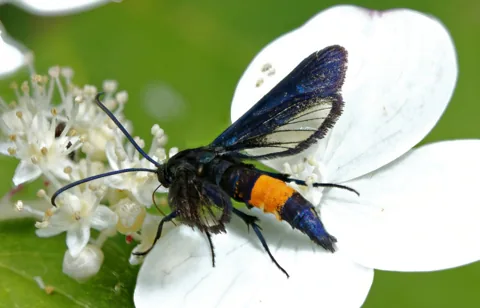 Peachtree Borer
Synanthedon exitiosa
The peachtree borer is a native clearwing moth whose larvae bore into the lower trunk and roots of peach, cherry, plum, apricot and other Prunus trees. The first sign is usually a mass of gum mixed with sawdust at the base of the trunk.
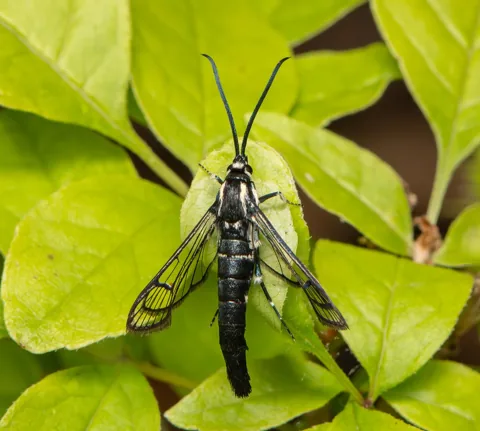 Lesser Peachtree Borer
Synanthedon pictipes
Lesser peachtree borers attack older stone fruit trees, usually entering through bark wounds.
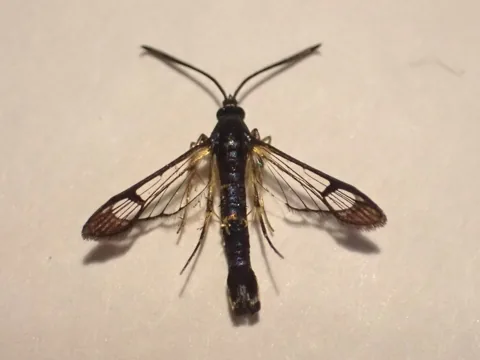 Dogwood Borer
Synanthedon scitula
Dogwood borer caterpillars can only get established where there is a wound or opening in the bark (or, on apple trees, a burr knot), so preventing mower and string-trimmer injury is the main defense for landscape dogwoods.
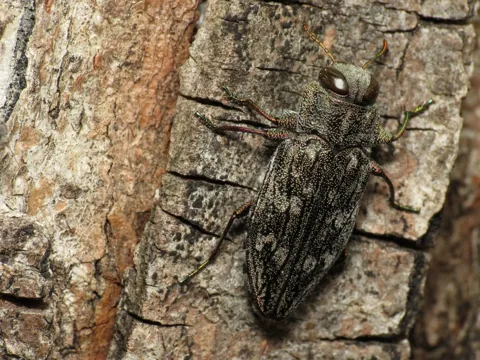 Flatheaded Appletree Borer
Chrysobothris femorata
The flatheaded appletree borer is a native metallic wood-boring beetle. Its larvae tunnel under the bark of the trunk and main branches of young, newly planted or stressed trees, apples and many shade trees alike, and can girdle and kill them.
 Roundheaded Appletree Borer
Saperda candida
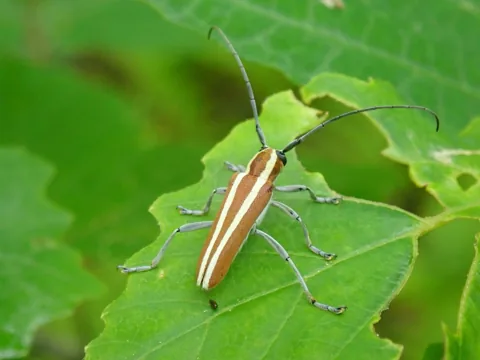
The roundheaded appletree borer is a native longhorned beetle whose larvae tunnel in the lower trunks of apple and its relatives.
 Shothole Borer
Scolytus rugulosus
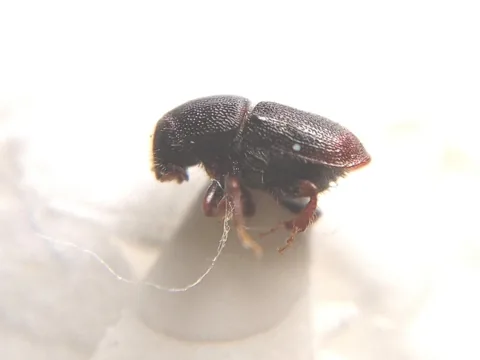
The shothole borer is a tiny, dark bark beetle that riddles the bark of stressed or damaged fruit and ornamental trees with clusters of small round holes that often ooze gum; it rarely kills healthy trees on its own.
 Pacific Flatheaded Borer
Chrysobothris mali
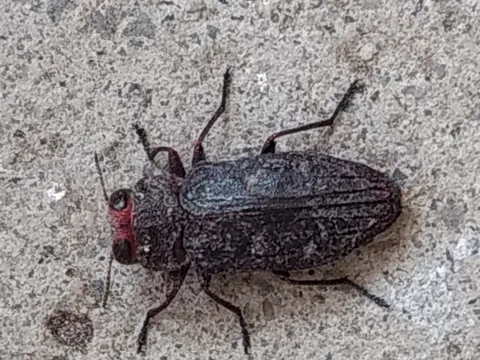
Pacific flatheaded borers lay eggs on stressed, sunburned or wounded trees, so good care and trunk protection are the best defense.
 American Plum Borer
Euzophera semifuneralis
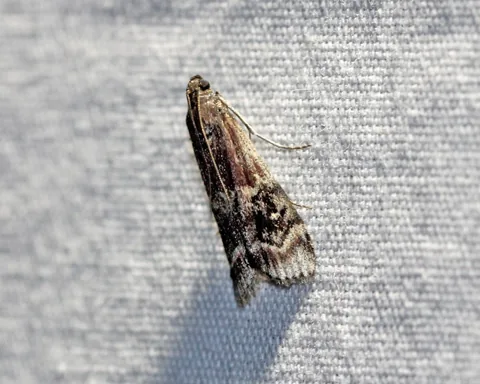
American plum borer larvae feed in the cambium around branch crotches and the lower trunk, but they can only get in through fresh bark wounds.
Which borer is it? Read the damage
Several unrelated insects bore into fruit trees, and the right treatment depends on the species. Three are clearwing moths whose caterpillars feed under the bark (peachtree borer, lesser peachtree borer and dogwood borer); the others are beetle grubs. Where the damage sits on the tree, what the frass looks like and the shape of the holes narrow it down.[6][1][2]
Many tiny holes point to bark beetles such as shothole borer; open tunnels with sawdust-like frass point to clearwing moths; flatheaded and roundheaded borers leave wet spots, dark stains and D- or oval-shaped or round exit holes. UC IPM stresses that confirming the species means finding the insect itself.[6][2]
- Peachtree borer (stone fruit: peach, cherry, plum, apricot, nectarine): a mass of gum full of frass and sawdust at the trunk base, about 3 inches below to 12 inches above the soil. Nearly all tunneling is within a few inches of the ground. Larvae are white or cream with a brown head, 1 1/4 inches (NC State) to 1.5 inches (Missouri, Penn State) long.[1][3][4][6]
- Lesser peachtree borer (stone fruit, eastern United States): gum mixed with reddish-brown frass oozing from cankers, pruning wounds, winter injury and other damaged spots on the trunk and scaffold limbs, often well above the ground. Empty brown pupal cases stick out of the tunnel holes after moths emerge. Older, more scarred trees are hit hardest.[7][1][8][6]
- Dogwood borer (mainly dwarf and semidwarf apples): larvae feed in the burr knots, the lumpy root tissue that forms on the rootstock just below the graft union. Look for small pellets of reddish or orange-brown frass held together with silk, and empty pupal cases sticking out of the burr knots. Mature larvae are about 0.6 inch long (Missouri); New Hampshire says ½ inch or longer.[1][2]
- Flatheaded appletree borer (apple, pear and many shade trees, mostly young, newly planted or stressed trees): dead, dark or cracked bark that may ooze sap, on the sunny south and west sides of the trunk and larger branches. Tunnels are packed with fine frass. The legless larva has a broad, flat swelling just behind the head.[1][10][9][2]
- Roundheaded appletree borer (apple, pear, quince, hawthorn, mountain-ash, serviceberry): coils or "pigtails" of fibrous frass and wood shavings at the base of the trunk, darkened sap stains on the bark, and round exit holes about the width of a pencil. It attacks healthy trees as well as weak ones.[1][2][12]
- Shothole borer (most fruit trees, mainly weak or declining ones): many tiny round holes, as if the bark had been hit with birdshot. On stone fruit, gum often oozes from the holes. The adult beetle is only about 1/10 inch (3 mm) long.[1][13][14]
- In California, Pacific flatheaded borer does the same kind of damage as flatheaded appletree borer, and American plum borer and carpenterworm leave pupal cases that look like clearwing pupal cases. See the profiles linked below.[11][6]
Peachtree, lesser peachtree and dogwood borers
The adults of all three are day-flying moths that look like wasps: dark blue-black bodies with yellow or orange bands and mostly clear wings. Peachtree borer females have a broad orange band; males are smaller with narrow yellow bands. Lesser peachtree and dogwood borer adults look alike, with yellow bands on the second and fourth abdominal segments.[1][3][6][7]
Peachtree borer has one generation a year. Larvae spend the winter under the bark, finish feeding in spring and pupate in the soil next to the trunk. The flight period differs by region: early June peaking in late July or August in Missouri, late June through early September in Pennsylvania, and May to September in California's peach guidelines. A female can lay 200 to 800 eggs (Penn State, NC State; Missouri says 400 to 500) on the lower trunk, in bark cracks and on the soil. Eggs hatch in about seven days (Penn State) or 9 to 10 days (NC State).[1][3][4][5]
Penn State says attacks usually occur on trees more than two inches in diameter, while Kentucky says peachtree borer mainly attacks young non-bearing or unmanaged trees. Young trees can be girdled and killed; older trees usually survive but lose vigor.[3][7][1]
Lesser peachtree borer usually has two generations a year, with moths in May and June and again in August and September in Kentucky. Females lay an average of 400 eggs in cracks near wounds anywhere from ground level to eight feet up, and larvae enter through winter injury, pruning scars and machinery wounds. UC IPM notes it occurs only in the eastern United States.[7][8][1][6]
Dogwood borer became more of a problem as growers switched to dwarfing rootstocks that form burr knots. There is usually one generation a year. Missouri puts the flight from early June into September; New Hampshire sees a few moths in June and most in July and August. Heavy infestations can girdle a tree; years of lighter ones slowly reduce vigor and yield.[2][1]
Flatheaded, roundheaded and shothole borers
Flatheaded appletree borer is a metallic wood-boring beetle about 1/2 inch long (NC State says 1/2 to 3/4 inch). Adults like sun and lay eggs in bark crevices on the sunny side of trunks and branches. There is one generation a year. Newly planted trees and trees stressed by drought, injury or leaning are the usual targets, and a single larva can sometimes girdle a young tree. Clemson notes that vigorous trees often produce enough sap to drown the larvae.[1][9][2][10]
Roundheaded appletree borer is a white beetle with three brown stripes down its back, about 3/4 to almost an inch long. Its life cycle takes two years (Missouri) or two to three years (New Hampshire, UMass). Females lay eggs from June through August in slits in the bark near the ground, and UMass says most damage is within about 6 inches above and 4 inches below the soil. One or two borers can kill a young tree, and older trees weakened by earlier tunneling may snap off at the ground. New Hampshire Extension calls it the most serious borer of apple trees there, worst in backyard, young and organic trees.[1][2][12]
Shothole borer is a small bark beetle, native to Europe, that usually attacks only weakened trees and speeds the death of limbs or whole trees that are already declining. When numbers build up it may bore into healthy twigs and buds nearby. Larvae overwinter under the bark and adults emerge in April and May. Missouri says two or more generations a year, Utah State two to three in Utah, and in Utah adults fly almost continuously from spring to fall.[13][1][14]
How to inspect a fruit tree trunk
Check stone fruit trees at the base of the trunk. Pull mulch and loose soil away from the trunk and look for gum mixed with frass, sawdust and soil. UC IPM suggests keeping the ground around trunks bare, which makes new tunneling easier to spot. Pupal cases are seldom seen with peachtree borer because the larvae leave the tree to pupate in the soil.[3][4][6]
For lesser peachtree borer, check wounds on the trunk and scaffold limbs for gum and frass and for brown pupal cases left behind by emerging moths. UC IPM suggests checking damaged bark once a week before adults are expected and removing old pupal cases as you find them, since they can persist for months.[8][7][6]
On dwarf apples, look closely at burr knots below the graft union for fine orange-brown frass. On young apple trees, check the lower trunk in August and September for brown sap stains, the first sign of newly hatched roundheaded borer larvae. For flatheaded borer, look on the sunny side for dark, sunken or cracked bark and winding raised trails under it.[2][1][12][10]
A round hole with nothing coming out of it usually means the insect has already left. New Hampshire Extension notes there is no point poking a wire into a roundheaded borer exit hole.[2]
Digging and wiring out larvae (worming)
Before modern insecticides, growers controlled peach borers by cutting them out by hand, and Kentucky Extension calls it still an alternative for backyard gardeners. It is slow and can hurt the tree, so it works best on a few trees.[7][1]
- Peachtree and lesser peachtree borers: in spring or fall, probe the bark where gummy frass comes out with a knife or stiff wire to crush or remove the larva. Kentucky suggests doing it around bud break.[6][7]
- Cut lengthwise (vertically) and no more than needed. Kentucky warns that careless worming can do more damage than the borers would have, and UC IPM says to avoid large wounds in the cambium.[7][6][1]
- Reinspect a week later. Fresh gum means a larva is still alive, so probe that tunnel again.[6]
- Roundheaded appletree borer: in August and September, make a shallow slice in the bark at each sap stain to expose and kill the young larva; a flexible wire pushed into a tunnel can reach an older one. Missouri says to worm trees every year; New Hampshire growers who do it well go over trees two or three times a year, most often in April and early September.[1][12][2]
- Flatheaded borers: larvae can sometimes be cut out with a knife or killed with a sharp wire, though UC IPM says it is practical only for small infestations and it is hard to tell whether you got the larva.[1][11]
Beneficial nematodes for larvae already in the tree
UC IPM says the commercially sold nematodes Steinernema carpocapsae and S. feltiae kill at least some clearwing borer larvae, including peachtree borer, and are not hazardous to people, pets or plants. They are perishable, usually have to be mail-ordered, and are killed by light, heat and dry surfaces.[6]
Research on peachtree borer supports them. In a USDA field trial, S. carpocapsae gave 88% control of peachtree borer larvae; later spring trials in peach orchards found more than 80% corrected control with a handgun spray, while a standard insecticide trunk spray failed to reduce the infestation.[15][16]
- UC IPM's method: mix at least 1 million nematodes per ounce of distilled water, clear frass from the tunnel opening, inject the mix into the tunnel with a squeeze bottle until it fills, then plug the hole with putty or grafting wax. Drenching the bark is easier but may work less well because nematodes die on dry surfaces.[6]
- Apply in spring or fall when larvae are feeding and the weather is at least 60°F but not hot, preferably in the evening. A second application one or two weeks later improves the odds.[6]
- Infected larvae can keep feeding and pushing out frass for about a week before they die, so judge results after that.[6]
Preventing borer attacks
Most of these borers go after trees that are already stressed, wounded or neglected, so tree care is the main defense. Roundheaded appletree borer and peachtree borer are exceptions that can attack healthy trees, which is why physical barriers and inspection matter for them too.[1][6][5]
- Water during drought. Clemson says to water apple trees weekly during heat and drought, and Utah State suggests deep watering once a week in July and August for shothole borer. UC IPM recommends watering at the drip line, separately from the lawn.[10][14][6]
- Protect the bark. Keep mowers and string trimmers away from trunks, and protect trunks and limbs from sunburn. UC IPM suggests a ring of mulch or ground cover several feet wide so there is no need to mow next to the trunk (on stone fruit, keep the mulch pulled back from the trunk itself; see below).[6][3]
- Don't pile mulch against stone fruit trunks: Penn State says it makes trees more attractive to egg-laying peachtree borer females. UC IPM also suggests removing suckers and keeping vegetation away from the trunk base.[3][6]
- White trunk paint. Several sources suggest white latex paint diluted with an equal amount of water on young trunks; UC IPM specifies interior latex. New Hampshire says painting the lower two feet reduces roundheaded borer attacks but isn't 100% successful, and Missouri, Penn State and Utah State suggest it for shothole borer and dogwood borer.[2][6][11][1][13][14]
- Trunk wraps for new trees. Missouri suggests wrapping newly planted trees with burlap or several layers of paper from the ground to the lower branches in May, for the first season or two, to stop flatheaded borer egg-laying; NC State also suggests a tree wrap. UC IPM says to take wraps off now and then to check the bark underneath. Against roundheaded borer, Missouri says wraps have not been entirely successful.[1][9][11]
- Screening for roundheaded borer. New Hampshire suggests snug insect screening around the lower 2 to 3 feet of trunk for June, July and August, removed afterward, but admits it is hard to do well. UMass mentions mosquito netting around the trunk base during egg laying and keeping weeds away.[2][12]
- Burr knots on dwarf apples. Plant with the graft union no more than one to two inches above the ground, or mound soil in a wide cone up to the graft union to cover exposed burr knots. New Hampshire suggests avoiding rootstocks prone to burr knots, such as M26 and M9, and not using opaque wrap-around mouse guards.[2][1]
- Firewood and prunings. Don't stack freshly cut wood near fruit trees; New Hampshire says hundreds of flatheaded borer adults can emerge from it the summer after cutting. Destroy infested limbs and prunings before shothole borers emerge each April, and remove dying trees and unmanaged wild hosts nearby.[2][11][1][13][14]
Timing trunk sprays
Insecticides don't reach larvae under the bark. A spray only works if it is on the bark when adults lay eggs and larvae hatch, which is why the extension advice is all about timing. Pheromone traps that catch male moths are the usual way to time it for the three clearwing borers. UC IPM says to hang traps about shoulder high on two or more trees and replace lures as the maker directs.[6][5][8][1]
The recommended delay after the first moth catch varies: 7 to 10 days (Penn State, peachtree borer), 8 to 16 days (NC State, peachtree borer), 7 to 14 days (Kentucky and NC State, lesser peachtree borer) and about 10 to 14 days (UC IPM, clearwing borers in landscapes).[3][4][7][8][6]
- Peachtree borer: NC State says one well-timed spray is enough because there is one generation; UC IPM's peach guidelines call for a spray when adults emerge in May and another six weeks later. Wet the trunk from the lowest scaffold limbs down to the soil and let the spray soak the soil within a few inches of the trunk.[4][5][1][6]
- Lesser peachtree borer: Kentucky suggests one spray at the peak of the second flight (usually early September) for lightly affected trees, and two for problem trees, about 10 days after the first moths in mid-May and again in early September. Drench the trunk and scaffold limbs up to about eight feet.[7]
- Dogwood borer: Missouri puts peak flight from mid to late June through early July, with a second spray in August if needed. New Hampshire says early July is the most effective timing in commercial orchards. Wet the trunk below the graft union.[1][2]
- Roundheaded appletree borer: Missouri says two to three trunk applications may be needed in June and July. New Hampshire notes that sprays must be on before larvae hatch and that home-garden products don't last long or get through bark.[1][2]
- Flatheaded appletree borer: because egg-laying stretches over the summer, Missouri says monthly applications may be needed. UC IPM recommends an early May application only for especially valuable trees.[1][11]
- Shothole borer: Utah State generally doesn't recommend insecticides, Missouri calls sprays usually not very effective, and Penn State says a residual spray can prevent reinfestation but nothing controls beetles already in the tree.[14][1][13]
If you decide to spray
The sources disagree on how well home-garden products work. Missouri lists some formulations of carbaryl and permethrin as available to homeowners for the clearwing borers and roundheaded borer. UC IPM says a sufficiently concentrated permethrin bark spray can kill adults and hatching larvae, but for flatheaded borer it says homeowner products are not effective and a professional applicator is needed. New Hampshire says backyard products don't last long or penetrate bark.[1][6][11][2]
Systemic insecticides are another split. NC State suggests a soil-applied systemic for newly planted landscape trees against flatheaded borer, but UC IPM says soil or trunk systemics haven't been found to control clearwing borers, and Utah State says imidacloprid is not effective against shothole borer.[9][6][14]
Mating disruption with pheromone dispensers is used in commercial orchards. A three-year West Virginia study found peachtree borer infestation was no different under disruption than under insecticide trunk sprays, but noted it needs area-wide use, and UC IPM says it is probably not suited to protecting one or a few trees.[17][6]
- Use only a product whose label lists your kind of fruit tree, and follow the label's rate and harvest waiting period. Utah State points out that no products list shothole borer itself on the label.[1][14][5]
- Aim at the bark only. UC IPM says there is no need to treat foliage, and to keep spray from dripping onto pavement where it can run off into water.[6]
- Protect bees: don't spray when trees or weeds below them are blooming; UMass advises treating after bloom. UC IPM flags some trunk-spray insecticides as highly toxic to bees.[12][5]
- A heavily infested tree with large dead areas may not be worth saving. UC IPM says spraying then gives little or no benefit, and Penn State suggests removing and destroying severely infested trees.[6][3]
Common questions
- What does peachtree borer damage look like?
- A jelly-like mass of gum mixed with frass, sawdust and soil at the base of the trunk, from a few inches below the soil line to about a foot above it. Young trees can be girdled and die; older trees lose vigor.[3][1][4]
- Can I kill peach tree borers without spraying?
- Yes. Probe active tunnels at the trunk base with a knife or stiff wire in spring or fall and recheck a week later, or inject beneficial Steinernema nematodes into the tunnels. Keep mulch and weeds away from the trunk and avoid wounding the bark.[6][7][16]
- When should I spray for peachtree borer?
- On the trunk, timed to the start of egg hatch: Penn State says 7 to 10 days after a pheromone trap catches the first male, NC State 8 to 16 days. UC IPM's peach guidelines suggest when adults emerge in May and again six weeks later. Sprays won't kill larvae already in the tree.[3][4][5]
- What is the difference between peachtree borer and lesser peachtree borer?
- Peachtree borer feeds at the trunk base near the soil line and pupates in the soil. Lesser peachtree borer feeds at wounds and cankers anywhere on the trunk and scaffold limbs, leaves pupal cases sticking out of the bark, and usually has two generations a year.[7][8][6]
- Do white paint and trunk wraps really keep borers out?
- They help but don't stop every attack. New Hampshire says diluted white latex paint reduces roundheaded borer attacks, and Missouri says wraps help keep flatheaded borers off newly planted trees but have not been entirely successful against roundheaded borer.[2][1]
Photo credits
- Peachtree Borer: (c) Christian Back, some rights reserved (CC BY) — via iNaturalist, CC BY 4.0
- Lesser Peachtree Borer: (c) Patrick O'Brien, some rights reserved (CC BY) — via iNaturalist, CC BY 4.0
- Dogwood Borer: (c) Louis Imbeau, some rights reserved (CC BY) — via iNaturalist, CC BY 4.0
- Flatheaded Appletree Borer: (c) Katja Schulz, some rights reserved (CC BY) — via iNaturalist, CC BY 4.0
- Roundheaded Appletree Borer: Lynn Harper, public domain (CC0), via iNaturalist
- Shothole Borer: (c) Борис Георги, some rights reserved (CC BY) — via iNaturalist, CC BY 4.0
- Pacific Flatheaded Borer: (c) Michele Jones, some rights reserved (CC BY) — via iNaturalist, CC BY 4.0
- American Plum Borer: Trix Niernberger, public domain (CC0), via iNaturalist
Sources
- University of Missouri Extension, “Insect Borers of Fruit Trees, G7190 (reviewed March 2026).” extension.missouri.edu/publications/g7190 (accessed 2026-11-10)
- University of New Hampshire Cooperative Extension, “Borers in New Hampshire Apple Trees (fact sheet).” extension.unh.edu/resource/borers-new-hampshire-apple-trees-fact-sheet-0 (accessed 2026-11-10)
- Penn State Extension, “Peachtree Borer.” extension.psu.edu/peachtree-borer (accessed 2026-11-10)
- NC State Extension, “Peachtree Borer.” content.ces.ncsu.edu/peachtree-borer (accessed 2026-11-10)
- University of California Statewide IPM Program, “Peachtree Borer, Peach Pest Management Guidelines.” ipm.ucanr.edu/agriculture/peach/peachtree-borer/ (accessed 2026-11-10)
- University of California Statewide IPM Program, “Pest Notes: Clearwing Moths, UC ANR Publication 7477.” ipm.ucanr.edu/PMG/PESTNOTES/pn7477.html (accessed 2026-11-10)
- University of Kentucky Entomology, “ENTFACT-213: Lesser Peachtree Borer (R. Bessin).” entomology.mgcafe.uky.edu/ef213 (accessed 2026-11-10)
- NC State Extension, “Lesser Peachtree Borer.” content.ces.ncsu.edu/lesser-peachtree-borer (accessed 2026-11-10)
- NC State Extension, Plant Disease and Insect Clinic, “Flatheaded Appletree Borer (J. Baker).” content.ces.ncsu.edu/flatheaded-appletree-borer (accessed 2026-11-10)
- Clemson Cooperative Extension, Home and Garden Information Center, “Apple and Crabapple Insects.” hgic.clemson.edu/factsheet/apple-crabapple-insects/ (accessed 2026-11-10)
- University of California Statewide IPM Program, “Pacific Flatheaded Borer (home and landscape).” ipm.ucanr.edu/PMG/GARDEN/FRUIT/PESTS/pacfltheadbor.html (accessed 2026-11-10)
- UMass Amherst Center for Agriculture, Food, and the Environment, “Saperda candida, roundheaded apple tree borer (Insect and Mite Guide).” www.umass.edu/agriculture-food-environment/landscape/publications-resources/insect-mite-guide/saperda-candida (accessed 2026-11-10)
- Penn State Extension, “Tree Fruit Insect Pest: Shothole Borer (G. Krawczyk).” extension.psu.edu/tree-fruit-insect-pest-shothole-borer (accessed 2026-11-10)
- Utah State University Extension, “Shothole Borer.” extension.usu.edu/planthealth/ipm/notes_orn/list-treeshrubs/shothole-borer.php (accessed 2026-11-10)
- Journal of Invertebrate Pathology, abstract via PubMed, “Cottrell and Shapiro-Ilan 2006, Susceptibility of the peachtree borer, Synanthedon exitiosa, to Steinernema carpocapsae and Steinernema riobrave in laboratory and field trials.” pubmed.ncbi.nlm.nih.gov/16707138/ (accessed 2026-11-10)
- Journal of Nematology, abstract via PubMed, “Shapiro-Ilan et al. 2016, Curative control of the peachtree borer using entomopathogenic nematodes.” pubmed.ncbi.nlm.nih.gov/27765990/ (accessed 2026-11-10)
- Insects, abstract via PubMed, “Frank, Starcher and Chandran 2020, Comparison of mating disruption and insecticide application for control of peachtree borer and lesser peachtree borer in peach.” pubmed.ncbi.nlm.nih.gov/32992791/ (accessed 2026-11-10)