On this page
How to identify it
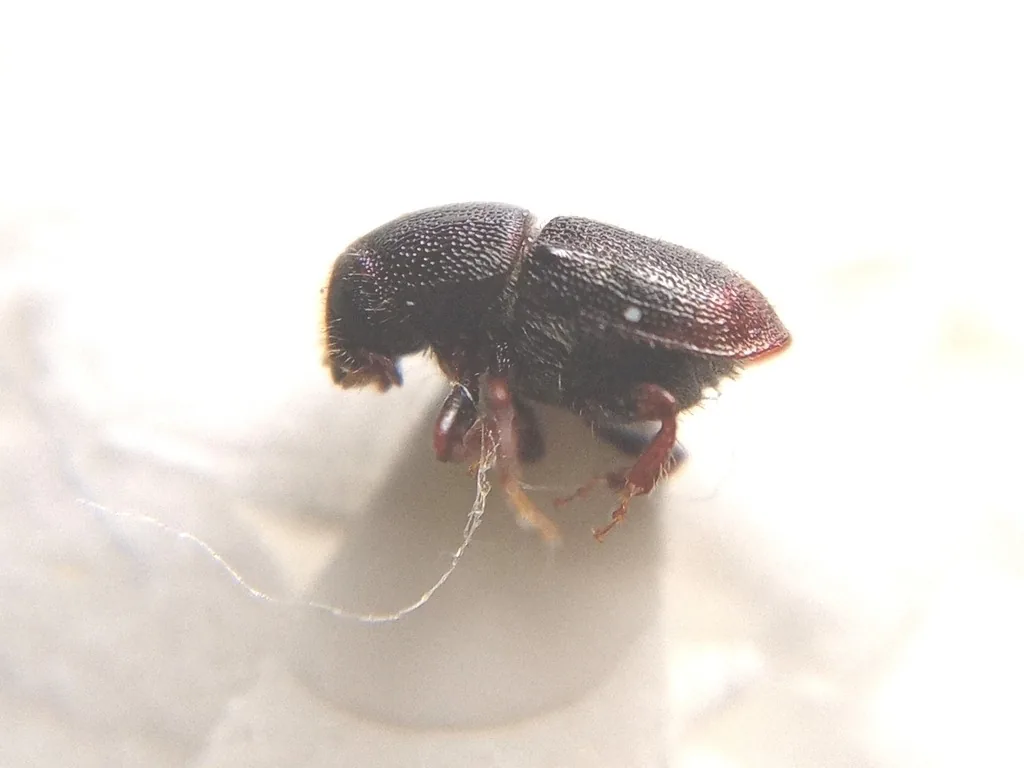
- Adults are dark brown to black, blunt at both ends and about 1/16 to 1/10 inch (about 3 mm) long, with reddish-brown tips on the antennae, legs and wing covers.[1][2]
- Larvae are white, legless grubs with a reddish or brown head, about 1/8 inch long when grown.[1][2]
- Signs are clusters of tiny, round 'shot' holes, clear gum oozing from holes, and boring dust in bark crevices.[1][2]
Look-alikes
| Look-alike | How to tell them apart |
|---|---|
| Elm bark beetles | Utah State groups it with other Scolytus bark beetles; they share the thumbnail-like rear end and attack stressed trees.[2] |
Where it lives
Native to Europe; now found throughout the United States.[1][2]
Biology and life cycle
It overwinters as larvae under the bark; adults emerge in April and May and fly considerable distances to weakened trees.[1][2]
Females bore through the bark and make short egg galleries running with the grain; larvae tunnel across the grain in the sapwood.[1][2]
Utah has two to three generations a year, with adults flying almost continuously from spring to fall.[2]
Damage and signs
- Hosts include most fruit trees (crabapple, cherry, quince and others), hawthorn and elm.[1][2]
- It mostly attacks weak, declining, cut or broken limbs and stems and hastens their death; when abundant it may bore into buds and twigs of nearby healthy trees, and it can introduce fungal pathogens.[1][2]
- Infested trees may show yellowing and wilting foliage.[2]
Health risk
Control
Prevention
Keep trees healthy and vigorous; the beetles target stressed trees.[1][2]
Keep them out
Painting trunks of young trees with whitewash or white water-based latex paint can help repel adults.[1]
Sanitation
Remove and destroy infested trees, limbs and prunings before adults emerge each April, and remove nearby wild fruit trees that serve as breeding sites.[1]
Pesticides
A residual insecticide can protect infested trees from reinfestation, but nothing controls beetles already inside.[1]
Common questions
Sources
- Penn State Extension, “Tree Fruit Insect Pest - Shothole Borer (updated October 12, 2026).” extension.psu.edu/tree-fruit-insect-pest-shothole-borer/ (accessed 2026-10-16)
- Utah State University Extension (Integrated Pest Management), “Shothole Borer (Ornamental Pest Guide and fact sheet).” extension.usu.edu/planthealth/ipm/notes_orn/list-treeshrubs/shothole-borer.php (accessed 2026-10-16)
- iNaturalist, “Scolytus rugulosus taxon page (order and family).” www.inaturalist.org/taxa/230655 (accessed 2026-10-06)