On this page
How to identify it
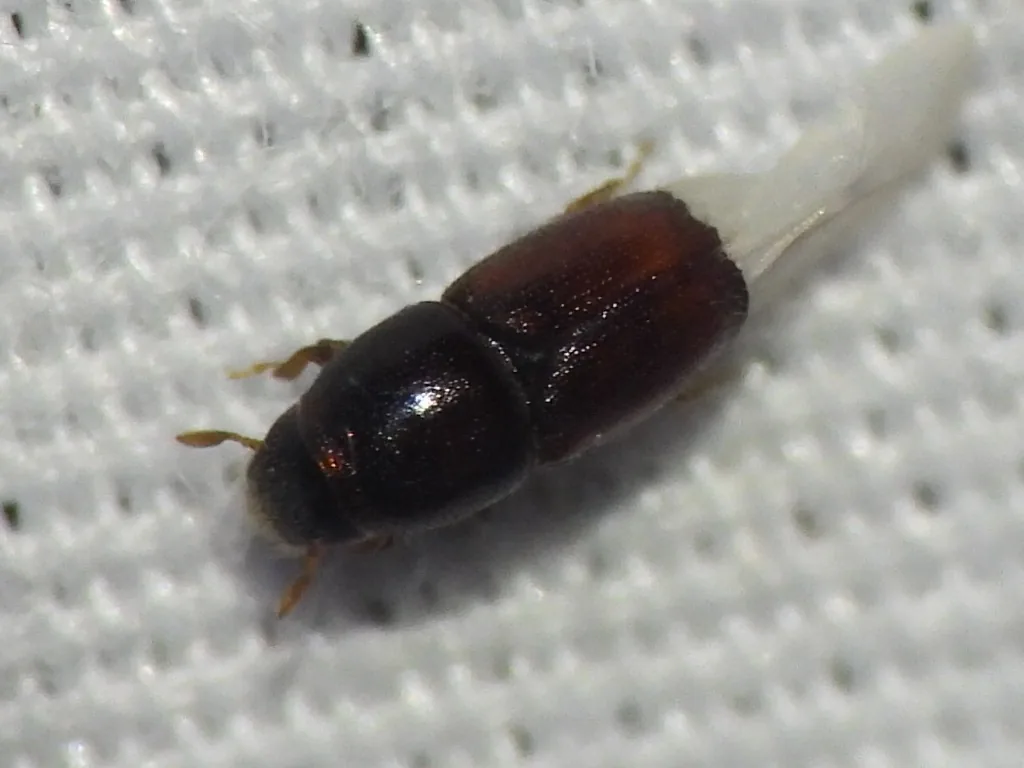
- The smaller European elm bark beetle is shiny dark reddish brown, about 1/8 inch long, with a concave rear underside bearing a spine.[1][3]
- The banded elm bark beetle is slightly larger, 1/9 to 1/6 inch, reddish brown with a black band across the wing covers.[3]
- The native elm bark beetle is brown to dark brown, rough, and covered with short, stiff yellow hairs.[2]
- Larvae are small, white, legless grubs with a brown head under the bark.[1][3]
- Galleries differ: smaller European egg galleries run with the grain and larval tunnels across it; native elm bark beetle egg galleries run across the grain and larval tunnels follow it.[1][2]
Look-alikes
| Look-alike | How to tell them apart |
|---|---|
| Ash and other bark beetles | Elm bark beetles breed only in elms; elms are the only host of the native elm bark beetle.[2][3] |
Where it lives
The smaller European and native elm bark beetles occur where elms grow in the East; the banded elm bark beetle is very common in Utah.[1][2][3]
Biology and life cycle
Beetles overwinter as larvae under bark; adults emerge from April to mid-May and through summer, with two or three generations a year (smaller European and banded).[1][3]
New adults fly to healthy elms to feed in twig crotches, then to dying or dead elms to breed; they cannot breed in healthy trees.[1]
Native elm bark beetles overwinter in the outer bark near the base of living elms and as grubs in dead elms, and breed even in elm firewood.[2]
Damage and signs
- Larval feeding can girdle branches or trees, but without Dutch elm disease neither species usually kills trees.[3]
- Beetles emerging from diseased brood trees usually carry Dutch elm disease, which plugs the water-conducting vessels; American elm is the most susceptible and Siberian elm is tolerant but not resistant.[1][2]
- Drought stress makes exotic elms more likely to be infested.[1]
Health risk
Control
Prevention
Keep elms watered and healthy, and don't prune healthy elms between April 1 and August 31, when beetles are drawn to fresh wounds.[2][3]
Where elms are planned, choose cultivars resistant to Dutch elm disease.[2]
Sanitation
Remove and destroy dead and dying elms, dying branches and elm firewood, which are breeding sites.[2][3]
Pesticides
Where Dutch elm disease is a concern, a labeled systemic fungicide can protect susceptible trees; a pyrethroid trunk spray in April and May aimed at native elm bark beetles does not stop smaller European elm bark beetles, which feed high in the canopy.[2][3]
When to call a professional
Utah State notes these beetles rarely damage common Siberian elms there and can be tolerated.[3]
Common questions
- What are the tiny holes in my elm's bark?
- Often exit holes of elm bark beetles; peel bark to find their galleries.[1][3]
- Do elm bark beetles kill trees?
- Mostly by spreading Dutch elm disease; without it they seldom kill trees.[1][3]
- Can I keep elm firewood?
- Elm firewood is a breeding site for native elm bark beetles; removing it reduces them.[2]
- When should I prune elms?
- Avoid pruning healthy elms April 1 to August 31.[2]
Sources
- NC State Extension, “Smaller European Elm Bark Beetle (PDIC Factsheet).” content.ces.ncsu.edu/smaller-european-elm-bark-beetle-scolytus-multistriatus (accessed 2026-10-16)
- NC State Extension, “Native Elm Bark Beetle (PDIC Factsheet).” content.ces.ncsu.edu/native-elm-bark-beetle (accessed 2026-10-16)
- Utah State University Extension (Integrated Pest Management), “Elm Bark Beetles (Ornamental Pest Guide).” extension.usu.edu/planthealth/ipm/ornamental-pest-guide/arthopods/bark-beetles/elm-bark-beetles.php (accessed 2026-10-16)
- iNaturalist, “Scolytus multistriatus taxon page (order and family).” www.inaturalist.org/taxa/209112 (accessed 2026-10-06)