On this page
How to identify it
- Nymphs are light brown with a white band across the body behind the thorax, which gives the species its name.[1]
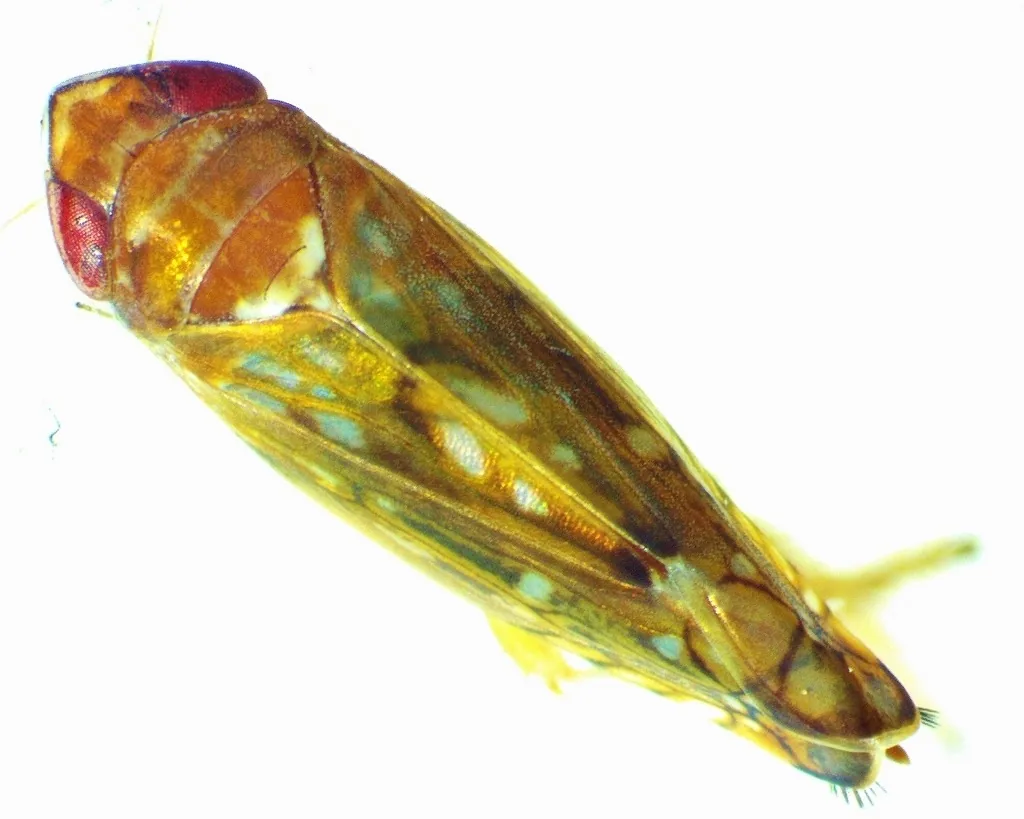
- Like other leafhoppers it is narrow and wedge-shaped; adults have full wings and fly between trees, and they are found most often in the inner crown.[2][1]
- It feeds on the undersides of elm leaves near the midrib and larger veins, and its feeding can kill leaf tips (hopperburn).[1]
Look-alikes
| Look-alike | How to tell them apart |
|---|---|
| Maple leafhopper | Another leafhopper found on elm, as well as basswood, beech, cherry, hawthorn and oak; the Connecticut station names the white-banded elm leafhopper, not this one, as the elm yellows carrier.[2] |
Where it lives
Elm yellows, which this leafhopper spreads, occurs in the eastern half of the United States, and the disease has killed many elms in the Northeast.[3][2]
Biology and life cycle
It overwinters as eggs in the bark or other tissue of its host, and the eggs hatch in spring around bud break.[1][2]
Nymphs pass through five stages over about 5 to 6 weeks and become adults by late summer, and the insects can be present until the first hard fall frost.[1][2]
The elm yellows pathogen incubates in the insect for about 3 weeks before it can be passed on; after that the leafhopper can infect elms whenever it feeds, and it isn't passed through the eggs.[1][3]
Damage and signs
- Its feeding alone does little or no damage; the danger is elm yellows, which makes the leaves of infected American elms droop, yellow and drop, kills the roots, and usually kills the tree within 1 to 2 years.[1][3]
- The peeled inner bark of an infected elm turns yellow to butterscotch, often with darker flecks, and diseased twigs of American and winged elm can smell of wintergreen (red or slippery elm smells like maple syrup).[1][3]
- Symptoms take months to appear after infection (3 to 6 months according to UMass, at least 3 to 10 months according to the Maryland article) and usually show from mid-July to mid-September.[1][3]
- Susceptible elms include American elm and its hybrids and cultivars, plus winged, cedar, Chinese, September and red (slippery) elm.[3]
Health risk
It feeds only on plants; none of the sources reports any harm to people or pets.[1][2]
Control
Prevention
Where elm yellows is present, plant resistant elms: UMass lists Asian and European species and the hybrid 'Homestead' as resistant, and 'Frontier', 'Pathfinder' and 'Patriot' as tolerant.[1]
Yellow sticky cards and tapping foliage over a light-colored sheet help detect leafhoppers, though this species usually occurs in low numbers and is hard to spot.[2][1]
Sanitation
There is no cure; once an elm has elm yellows, UMass recommends removing and destroying the tree.[1][3]
Pesticides
No chemical treatment is proven to prevent elm yellows; the Maryland article notes that insecticides used against the bark beetles that spread Dutch elm disease may also suppress leafhoppers.[3]
Common questions
- Does the white-banded elm leafhopper hurt elms by feeding?
- Hardly; its feeding causes little or no damage. The concern is that it carries elm yellows, which kills American elms.[1][2]
- How can I tell elm yellows from Dutch elm disease?
- Peel the bark of a dying branch: elm yellows turns the inner bark yellow to butterscotch, while Dutch elm disease leaves brown streaks in the wood.[3]
Sources
- UMass Extension Landscape, Nursery and Urban Forestry Program (Landscape Insect & Mite Guide), “Scaphoideus luteolus (White-banded Elm Leafhopper).” www.umass.edu/agriculture-food-environment/landscape/publications-resources/insect-mite-guide/scaphoideus-luteolus (accessed 2026-10-17)
- Connecticut Agricultural Experiment Station, “Leafhopper Pests of Connecticut Nurseries and Landscapes (H. Smith).” portal.ct.gov/-/media/caes/documents/publications/fact_sheets/entomology/leafhopperpestsofconnecticutnurseriesandlandscapespdf.pdf (accessed 2026-10-17)
- Maryland Invasive Species Council, “Dem “Yellows” Give Me the Blues: elm yellows (Invader of the Month, October 2009).” mdinvasives.org/iotm/oct-2009/ (accessed 2026-10-17)
- iNaturalist, “Scaphoideus luteolus taxon page (order and family).” www.inaturalist.org/taxa/928009 (accessed 2026-10-06)