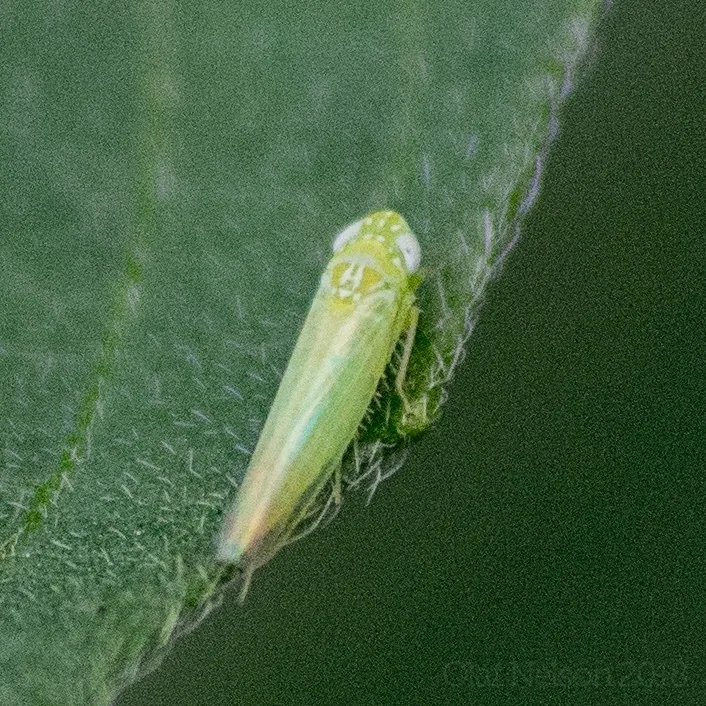
How to identify it
- Adults are long and narrow, wedge-shaped and usually under 1/4 inch, in brown, gray, green, yellow or mottled colors.[1]
- One or more long rows of small spines run the full length of the hind legs, which separates leafhoppers from similar sap feeders.[1]
- They walk quickly sideways or jump when disturbed; adults, nymphs and pale cast skins sit on leaf undersides.[1]
- The potato leafhopper, used as the example here, is about 1/8 inch, bright green, widest at the head, typically with six white spots just behind the head.[2]
Look-alikes
| Look-alike | How to tell them apart |
|---|---|
| Spittlebugs | Adults look similar but lack the long rows of spines on the hind legs, and their nymphs hide in white froth.[4] |
| Thrips | Thrips also stipple leaves, so check leaf undersides for the insects themselves to tell which is responsible.[1] |
| Aster leafhopper | Resembles the potato leafhopper but is a drabber olive green; it spreads aster yellows to carrots, celery, lettuce and flowers.[3][1] |
Where it lives
Potato leafhoppers overwinter in the southern United States and ride spring storm winds north each year, reaching Wisconsin and New England from late May to June.[2][3]
Biology and life cycle
Females insert eggs into tender plant tissue; nymphs molt about five times and become adults without a pupal stage.[1][2]
Many leafhoppers overwinter as eggs, though some overwinter as adults; most species have two or more generations a year.[1]
Potato leafhopper females live about a month and lay two to three eggs a day in stems and large leaf veins.[2]
Mowing or harvesting nearby alfalfa can send potato leafhoppers swarming into gardens.[2][3]
Damage and signs
- Feeding leaves pale specks (stippling); heavily fed leaves and shoot tips can yellow, brown, curl and die.[1]
- Many leafhoppers excrete honeydew that grows black sooty mold, and nymphs leave whitish cast skins under leaves.[1]
- Potato leafhopper saliva is toxic and causes hopperburn: yellowing and browning that starts at leaf tips and edges, mainly on potatoes, beans and eggplant.[2][3]
- Some species spread plant diseases, such as Xylella fastidiosa (sharpshooters), aster yellows (aster leafhopper) and curly top virus (beet leafhopper).[1]
Health risk
Leafhoppers feed on plant sap; their harm is to plants, through feeding, toxic saliva and the plant diseases some species spread.[1][2]
Control
Prevention
In most gardens and landscapes leafhoppers are an annoyance and need no control.[1]
Keep them out
Row covers on snap beans until flowering, and on young eggplant, delay potato leafhopper attacks.[3]
Sanitation
Remove weeds and other alternate hosts nearby, and avoid planting beans or potatoes next to alfalfa.[1][2]
Biological control
Assassin bugs, lacewings, damsel bugs, lady beetles, minute pirate bugs, spiders and tiny egg-parasitic wasps all attack leafhoppers.[1]
Pesticides
If nymphs are abundant early in the season, thoroughly spray shoots and leaf undersides with horticultural oil, insecticidal soap or neem oil.[1]
For potato leafhopper, pyrethrin is the most effective organic option; it breaks down fast in sunlight, so cover leaf undersides and spray late in the day.[3]
Sprays don't stop leafhopper-spread diseases
Insecticides generally don't prevent leafhopper-spread plant diseases in gardens, because the insects pass on the pathogen before the spray kills them.[1]
Common questions
- Why are the edges of my bean and potato leaves turning yellow and brown?
- It may be hopperburn from potato leafhoppers, which starts as triangular yellowing at leaf tips and spreads inward; it is easily mistaken for a disease.[2][3]
- Do I need to spray for leafhoppers?
- Usually not. Most leafhoppers only speckle leaves, though potato leafhoppers on beans and potatoes may need protection early.[1][3]
Sources
- University of California Statewide IPM Program, “Leafhoppers (Pest Notes, Home and Landscape).” ipm.ucanr.edu/home-and-landscape/leafhoppers/ (accessed 2026-10-06)
- University of Wisconsin-Madison Division of Extension, Wisconsin Horticulture, “Potato Leafhopper (XHT1132, revised 2020).” hort.extension.wisc.edu/articles/potato-leafhopper/ (accessed 2026-10-06)
- UMass Amherst Extension Vegetable Program, “Potato Leafhopper (vegetable fact sheet).” www.umass.edu/agriculture-food-environment/vegetable/fact-sheets/potato-leafhopper (accessed 2026-10-06)
- University of California Statewide IPM Program, “Spittlebugs (Pest Notes, Home and Landscape).” ipm.ucanr.edu/home-and-landscape/spittlebugs/ (accessed 2026-10-06)
- iNaturalist, “Empoasca fabae taxon page (order and family).” www.inaturalist.org/taxa/203303 (accessed 2026-10-06)