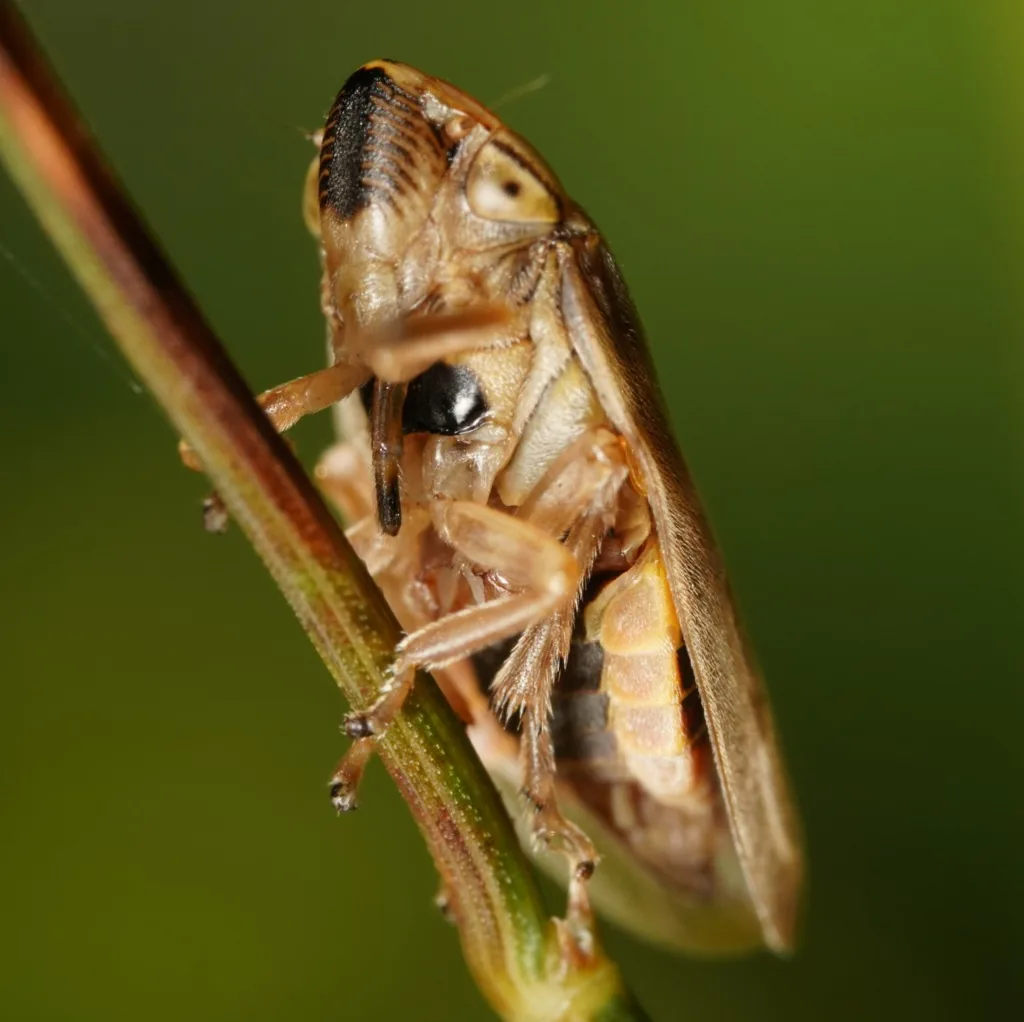
How to identify it
- Nymphs are stout, commonly pale green, orange or yellow, and hidden inside a mass of white froth; one mass can hold one or more nymphs.[1]
- Adults are stout, brownish, gray or tan, about 1/3 inch long or less, and fly or jump readily; they are also called froghoppers.[1]
- The meadow spittlebug, used as the example here, has adults that are blackish, brown, tan, yellow or mottled, and feeds on at least 400 kinds of plants.[1]
- The twolined spittlebug of southern lawns is dark brown to black, about 3/8 inch, with red eyes and legs and usually two red or orange bands across the wings.[2]
Look-alikes
| Look-alike | How to tell them apart |
|---|---|
| Leafhoppers | Leafhoppers have long, continuous rows of spines along the hind legs; spittlebugs have just two stout spines plus a ring of spines at the leg tip.[1][3] |
Where it lives
Spittlebugs turn up on almost any plant; the meadow spittlebug favors cool, moist areas such as coastal California, while the twolined spittlebug is a turf and holly pest in the Southeast.[1][2]
Biology and life cycle
Females lay eggs in thin-barked branches, green shoots or plant crevices, and the insects usually spend winter as eggs.[1][2]
Nymphs start making spittle in their second stage, feed on xylem sap for one to three months, and can move to a new feeding spot.[1]
Adults live long, feeding and moving among plants for up to six months; there are usually one or two generations a year.[1][2]
Twolined spittlebug eggs hatch in March and April in South Carolina; second-generation adults peak in August and September and do more damage.[2]
Damage and signs
- Heavy feeding can distort plant tissue and slow growth, mainly on herbaceous plants; on pines, egg-laying wounds can kill shoot tips.[1]
- Twolined spittlebug nymphs suck sap from grass stems, especially centipedegrass and St. Augustinegrass, making the lawn look unhealthy; adults also damage holly leaves.[2]
- Spittlebugs can carry the plant-disease bacterium Xylella fastidiosa, though leafhoppers such as the glassy-winged sharpshooter are its main carriers.[1]
Health risk
Spittlebugs feed on plant sap; the foam is their own excrement and the harm they do is to plants.[1]
Control
Prevention
In lawns, twolined spittlebug damage is worst under thick thatch, so dethatch and topdress when appropriate and watch susceptible turf closely in July.[2]
Sanitation
Cut infested weeds in spring before the insects mature, since spittlebugs often move onto woody plants from nearby herbaceous hosts.[1]
Traps and physical control
Ignore spittlebugs on most plants, or wash nymphs off with a forceful stream of water.[1]
Biological control
Birds eat adults, while assassin bugs, minute pirate bugs, syrphid larvae, harvestmen, spiders and parasitic wasps attack nymphs and eggs.[1]
Pesticides
If lawn treatment is needed, target the nymphs late in the day with an insecticide labeled for spittlebugs on turf; mowing and watering a few hours beforehand improves results.[2]
Twolined spittlebug in southern lawns
Nymphs stay near the base of grass plants, then climb to the blade tips to molt inside the drying spittle.[2]
Adults hide in hollies and shrubs by day, are most active at night, and may come to lights.[2]
Overwintering eggs sit in hollow stems, under leaf sheaths and in moist litter at the base of plants.[2]
Common questions
- What is the white foam on my plants?
- It is spittle made by spittlebug nymphs, which hide inside the froth while they feed on plant sap.[1]
- Should I spray spittlebugs?
- Usually not on garden plants and shrubs; the foam is mostly cosmetic. Twolined spittlebugs damaging centipedegrass or St. Augustinegrass lawns are the main exception.[1][2]
Sources
- University of California Statewide IPM Program, “Spittlebugs (Pest Notes, Home and Landscape).” ipm.ucanr.edu/home-and-landscape/spittlebugs/ (accessed 2026-10-06)
- Clemson Cooperative Extension, Home & Garden Information Center, “Two-Lined Spittlebug, HGIC 2488.” hgic.clemson.edu/factsheet/two-lined-spittlebug/ (accessed 2026-10-06)
- University of California Statewide IPM Program, “Leafhoppers (Pest Notes, Home and Landscape).” ipm.ucanr.edu/home-and-landscape/leafhoppers/ (accessed 2026-10-06)
- iNaturalist, “Philaenus spumarius taxon page (order and family).” www.inaturalist.org/taxa/56189 (accessed 2026-10-06)