On this page
How to identify it
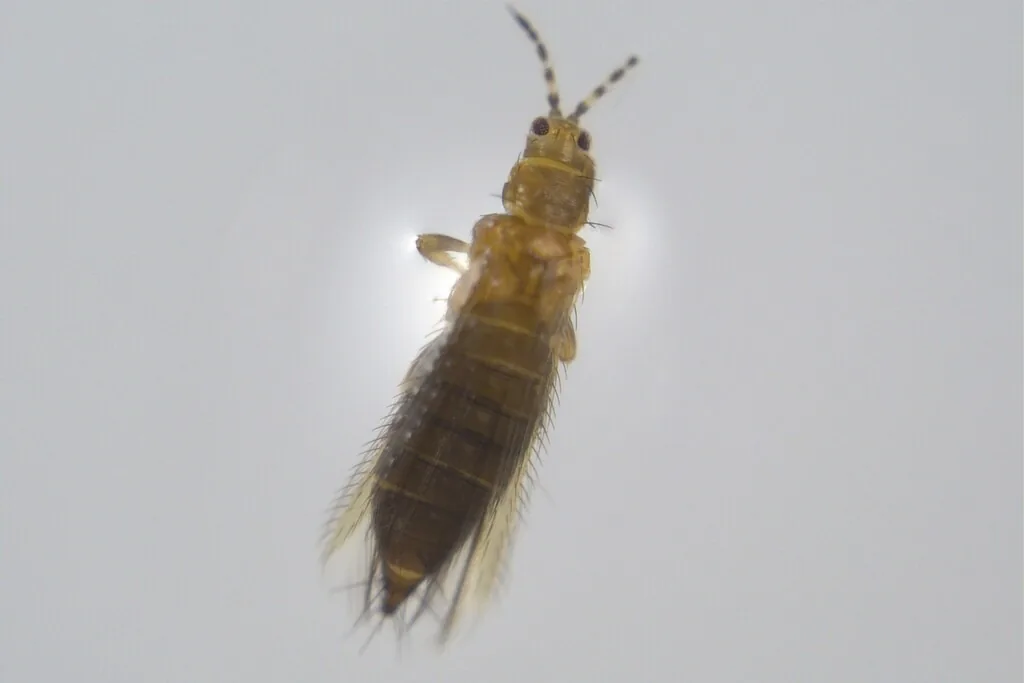
- Most adults are slender and less than 1/20 inch long, with long fringes of hairs along the edges of their narrow wings.[1][2]
- Color runs from translucent white or yellowish to dark brown or black, and young thrips (larvae) are wingless.[1]
- Western flower thrips females are about 1/16 inch long and hold their fringed wings over the back; males are about two-thirds that size and paler. Adult color varies from all black, orange, yellow or whitish to a pale head and thorax with a dark abdomen.[3][4]
- Only an expert with a microscope can name the species; this profile uses western flower thrips, the most economically important pest thrips, as the example.[1][4]
Look-alikes
| Look-alike | How to tell them apart |
|---|---|
| Spider mites | Mites also stipple leaves. Thrips feeding usually comes with black, varnish-like specks of excrement, so look on the undersides for the pests themselves before deciding which one is to blame.[1][4] |
| Lace bugs | Lace bugs also leave stippling and dark specks of excrement, but adults have broad, lacy wings and sit in groups under leaves.[1][5] |
Where it lives
Western flower thrips was once limited to western North America. It became an important invasive pest of many crops in the 1970s and 1980s, carried by the growth of international agricultural trade, and Penn State now calls it virtually cosmopolitan.[3][6]
Biology and life cycle
Thrips hatch from eggs and pass through two feeding larval stages, then two nonfeeding stages, the prepupa and pupa, before becoming adults.[1][4]
Most pest species pupate in soil or leaf litter, and there can be up to about eight generations a year, as short as two weeks from egg to adult in warm weather. For western flower thrips that runs from about 11 days at 77 to 87 °F to 44 days at 50 to 60 °F.[1][4]
Western flower thrips females insert their eggs into plant tissue. Unmated females lay only male eggs; mated females lay female eggs.[4]
Western flower thrips feeds in the flowers of virtually any broadleaf plant, often on pollen, and damages herbaceous ornamentals, cucurbits, pepper, grapes, strawberries, roses and stone fruit. It also eats spider mites.[4][1]
Thrips drift long distances on the wind and travel on infested plants. Large numbers build up on spring weeds and crops such as wheat, then fly off on the wind as those plants dry.[1][2]
In Pennsylvania, dark adult western flower thrips females spend the winter in leaf litter and come out in late April and May.[3]
Damage and signs
- Feeding punctures surface cells and leaves stippling, silvery flecks or scabby scars, usually with black, varnish-like specks of excrement.[1]
- Infested shoot tips can curl or distort, and flower buds may fail to open or show streaked, discolored petals.[1][7]
- Damage often appears only after tissue grows and expands, by which time the thrips may be gone.[1]
- Western flower thrips is the main vector of tospoviruses, including tomato spotted wilt virus and impatiens necrotic spot virus, which can badly damage or kill vegetables and flowers.[1][4][7][8]
- Light-colored roses, whites and yellows especially, usually suffer the worst bloom damage.[1][2][7]
Health risk
Thrips feed on plants and pollen, and their main harm is to plants. Now and then they bite people, leaving small, itchy pink bumps, mostly on the trunk and arms, that clear up on their own within a few days and are often mistaken for mosquito bites.[1][9][10]
Control
Prevention
Confirm thrips are actually present first: shake flowers or foliage over white paper, or hang blue or bright yellow sticky traps.[1]
Keep plants well watered, avoid heavy nitrogen fertilizer, control nearby weeds that host thrips, and prune off infested shoot tips and damaged buds.[1][7]
Silver or gray reflective mulch can repel flying thrips from young plants until the leaves cover about half the soil.[1][2]
Keep them out
Fine-mesh row covers over young vegetables are the most effective way to keep thrips, and the viruses they carry, off plants; commercial greenhouses use special thrips-proof screening.[1][2]
Biological control
Minute pirate bugs, predatory mites, green lacewings and predatory thrips feed on pest thrips; avoid persistent pesticides that kill them.[1]
Pesticides
Insecticidal soap, horticultural or neem oil, azadirachtin and pyrethrins give temporary control if they thoroughly cover buds and shoot tips. Spinosad is generally more effective but shouldn't be sprayed on plants in bloom.[1]
UC IPM advises against acephate and foliar sprays of malathion, carbaryl and pyrethroids, which harm natural enemies and pollinators, can set off spider mite outbreaks and work poorly on most thrips.[1]
Why sprays often disappoint
Thrips hide in buds and shoot tips, and their eggs and pupae are protected, so contact sprays miss many of them. Migrating adults keep arriving in spring even after a good spray.[1][2]
Western flower thrips has become resistant to many insecticides. Researchers blame heavy, repeated spraying and recommend using fewer sprays and rotating modes of action.[6][11][4]
Insecticides usually don't kill thrips fast enough to stop virus spread, and they can't undo scarring already on leaves or petals.[1][2]
Where sources disagree
Acephate and imidacloprid: Mississippi State lists both, with spinosad and acetamiprid, among the most effective treatments for thrips on roses, while UC IPM says to avoid acephate and that imidacloprid commonly fails against thrips.[2][1]
Buying natural enemies: UC IPM's home-garden guide says released predators are unlikely to give satisfactory control, while its nursery guide says commercial releases may work if done early and combined with other practices.[1][4]
Common questions
- What causes silvery streaks and black specks on my leaves?
- Silvery or bleached flecks with tiny black, varnish-like specks are a classic sign of thrips feeding.[1]
- Are thrips always a problem?
- No. Many thrips feed on pollen or fungal spores, some are predators, and healthy trees and shrubs usually tolerate pest thrips.[1]
- Do thrips bite people?
- Occasionally. The bites cause small, itchy bumps that go away on their own in a few days and are often taken for mosquito bites.[9][10]
Sources
- University of California Statewide IPM Program, “Thrips (Pest Notes, Home and Landscape).” ipm.ucanr.edu/home-and-landscape/thrips/ (accessed 2026-11-11)
- Mississippi State University Extension Service, “Thrips (Bug's Eye View, Vol. 4, No. 8, 2018).” extension.msstate.edu/newsletters/bugs-eye-view/2018/thrips-vol-4-no-8 (accessed 2026-11-11)
- Penn State Extension, “Tree Fruit Insect Pest - Western Flower Thrips.” extension.psu.edu/tree-fruit-insect-pest-western-flower-thrips/ (accessed 2026-11-11)
- University of California Statewide IPM Program, “Thrips (Floriculture and Ornamental Nurseries, Pest Management Guidelines).” ipm.ucanr.edu/agriculture/floriculture-and-ornamental-nurseries/thrips/ (accessed 2026-11-11)
- University of California Statewide IPM Program, “Lace Bugs (Pest Notes, Home and Landscape).” ipm.ucanr.edu/home-and-landscape/lace-bugs/ (accessed 2026-11-11)
- Annual Review of Entomology, via PubMed, “Reitz, Gao, Kirk, Hoddle, Leiss and Funderburk (2020), Invasion biology, ecology, and management of western flower thrips.” pubmed.ncbi.nlm.nih.gov/31536711/ (accessed 2026-11-11)
- NC State Extension, Department of Entomology, “Thrips: Biology and Rose Pests.” entomology.ces.ncsu.edu/thrips-2/ (accessed 2026-11-11)
- Current Opinion in Virology, via PubMed, “Rotenberg, Jacobson, Schneweis and Whitfield (2015), Thrips transmission of tospoviruses.” pubmed.ncbi.nlm.nih.gov/26340723/ (accessed 2026-11-11)
- Journal of the European Academy of Dermatology and Venereology, via PubMed, “Leigheb, Tiberio, Filosa, Bugatti and Ciattaglia (2005), Thysanoptera dermatitis.” pubmed.ncbi.nlm.nih.gov/16268878/ (accessed 2026-11-11)
- Cutis, via PubMed, “Carness, Winchester, Oras and Arora (2016), Night of the living thrips: an unusual outbreak of Thysanoptera dermatitis.” pubmed.ncbi.nlm.nih.gov/27023090/ (accessed 2026-11-11)
- Pest Management Science, via PubMed, “Bielza (2008), Insecticide resistance management strategies against the western flower thrips, Frankliniella occidentalis.” pubmed.ncbi.nlm.nih.gov/18561150/ (accessed 2026-11-11)
- iNaturalist, “Frankliniella occidentalis taxon page (order and family).” www.inaturalist.org/taxa/243760 (accessed 2026-10-06)