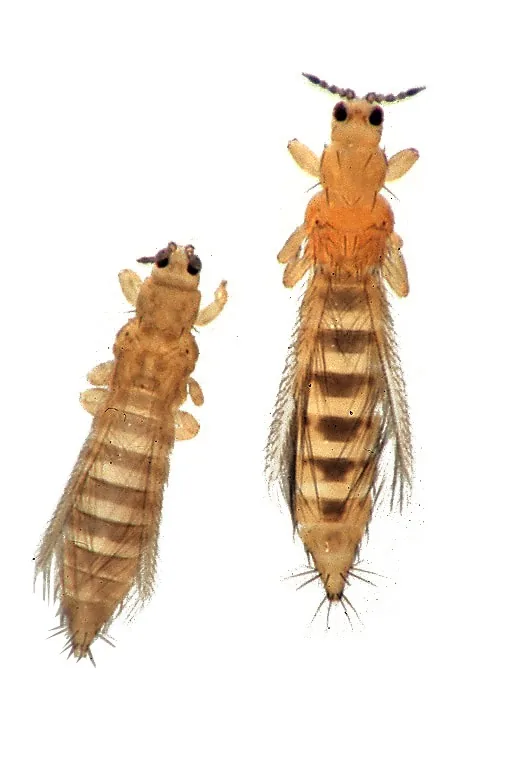
How to identify it
- Adults are about 1/12 inch (1.5 mm) long, thin, pale yellow to brown, with narrow wings fringed with long hairs.[1][2]
- Nymphs look like small, wingless adults, white to pale yellow.[1][2]
- Feeding leaves white to silver patches and streaks, and heavily fed-on leaves show tiny black spots of excrement.[1][2]
Look-alikes
| Look-alike | How to tell them apart |
|---|---|
| Western flower thrips | Adult females are slightly longer (about 2 mm), more yellow, with red eyes and eight-segmented antennae.[2] |
Where it lives
Wisconsin and Utah State Extension both cover it; it is the dominant thrips in Utah onion fields.[1][2]
Biology and life cycle
It overwinters in alfalfa and grain fields, weedy areas and onion bulbs left in the garden, and females can reproduce without mating.[1][2]
Eggs are inserted into leaves and hatch in 5 to 10 days; two feeding nymph stages are followed by two non-feeding stages in the soil, and adults develop in 15 to 30 days.[1][2]
There are five to eight generations a year, and outbreaks are most likely in hot, dry summer weather.[1][2]
Damage and signs
- On onions, thrips prefer the youngest leaves in the neck; severe feeding withers leaves and leads to smaller, distorted bulbs, and onions are most sensitive during rapid bulb growth in July and early August in northern Utah.[1][2]
- Red onions are particularly susceptible; open-necked varieties with glossy leaves are less attractive.[1][2]
- It can spread iris yellow spot, tomato spotted wilt and impatiens necrotic spot viruses; on cabbage and cauliflower it causes blistered leaves and streaked curds.[1]
Health risk
Control
Prevention
Scout July into early September with sticky traps and by checking plants at the garden edge; Wisconsin suggests considering treatment at about three thrips per onion leaf.[1]
Choose tolerant varieties such as 'Snow White' or 'Vega', fertilize nitrogen moderately, mulch the beds, and use overhead sprinklers, which wash thrips off plants.[1][2]
Sanitation
Remove volunteer onions and plant debris from the garden and surrounding areas, and avoid planting onions next to alfalfa.[1][2]
Biological control
Predators such as minute pirate bugs, bigeyed bugs, lacewing larvae and predatory mites eat onion thrips, though they usually build up late in summer.[2]
Pesticides
If spraying, direct it down into the center of the plants and alternate active ingredients to slow resistance.[1]
Common questions
- Why do my onion leaves have silvery streaks?
- Onion thrips feeding removes chlorophyll and leaves white to silver patches and streaks.[1][2]
- When do onion thrips do the most damage?
- In hot, dry weather, especially during rapid bulb growth in mid to late summer.[1][2]
- Which onions resist thrips?
- Open-necked varieties with dark, glossy leaves; red onions are particularly susceptible.[1][2]
Sources
- University of Wisconsin-Madison Extension (Wisconsin Horticulture), “Onion Thrips.” hort.extension.wisc.edu/articles/onion-thrips/ (accessed 2026-10-15)
- Utah State University Extension, “Onion Thrips (Utah Vegetable Production and Pest Management Guide).” extension.usu.edu/vegetableguide/onion/onion-thrips.php (accessed 2026-10-15)
- iNaturalist, “Thrips tabaci taxon page (order and family).” www.inaturalist.org/taxa/271262 (accessed 2026-10-06)