On this page
How to identify it
- Affected leaves look grayish or dusty from many tiny pale spots; the insects themselves need magnification to see.[1]
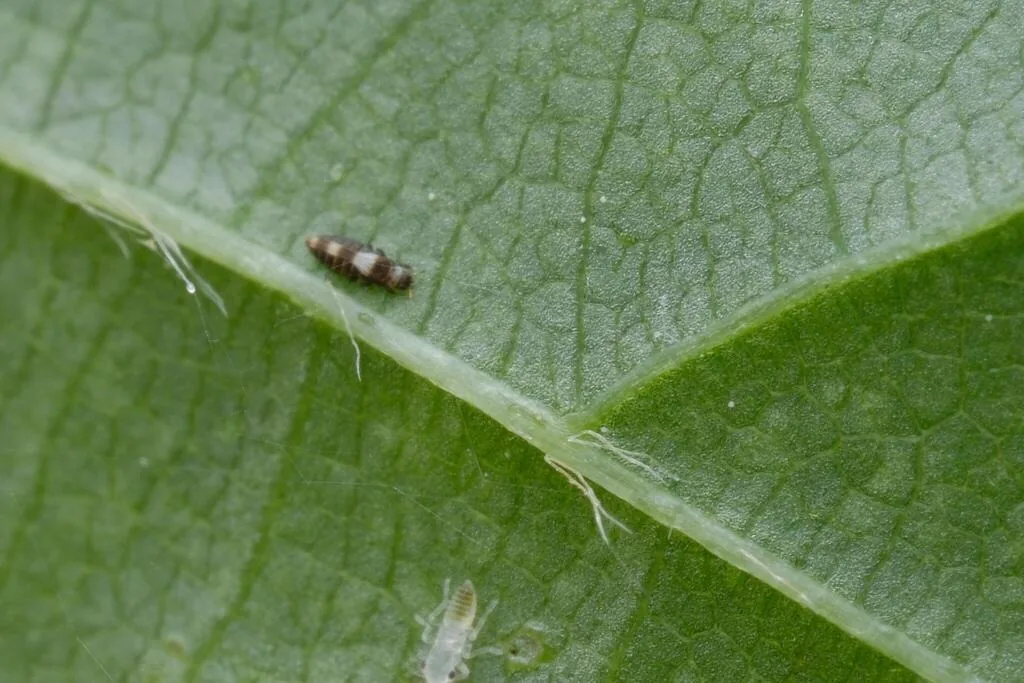
- Adults are about 1 mm long and fully winged, with a brown body, yellow markings behind the head and front wings banded with two dark and three white bands.[1][2]
- Immature thrips are slender and wingless and are found mainly on the leaf undersides; when numbers are high, 20 to 30 may be found on a single leaf.[1]
Where it lives
Probably native to southern Europe and widespread there; it was introduced to North America, and the California key notes only a few records from that state.[2][1]
Biology and life cycle
Its life history isn't completely understood; females lay eggs on the leaves in late spring, and several generations are possible through the summer.[1]
Larvae and adults feed on older leaves rather than on young buds, and the pupae can also be found on the leaves; adults are active fliers.[2][1]
Damage and signs
Health risk
It feeds only on plants; neither source reports any harm to people or pets.[1][2]
Control
Prevention
Check gray or yellowing leaves with a hand lens, especially the undersides; tapping foliage over white paper or hanging blue or yellow sticky cards nearby helps find the thrips.[1]
Sanitation
Removing weeds, old plants and debris can reduce thrips, especially in nurseries.[1]
Biological control
Predators, nematodes and insect-killing fungi are used against some thrips in greenhouses, but how well they work on privet thrips isn't yet known.[1]
Pesticides
UMass lists a range of insecticides for thrips on privet; follow the label of any product used.[1]
Common questions
- Why do my privet leaves look gray and dusty?
- Grayish leaves covered in tiny pale spots can be privet thrips feeding; look under the leaves with a hand lens for slender insects about 1 mm long.[1]
- Where did privet thrips come from?
- It probably originated in southern Europe and was introduced to North America.[2]
Sources
- UMass Extension Landscape, Nursery and Urban Forestry Program (Landscape Insect & Mite Guide), “Dendrothrips ornatus (Privet Thrips).” www.umass.edu/agriculture-food-environment/landscape/publications-resources/insect-mite-guide/dendrothrips-ornatus (accessed 2026-10-17)
- Thrips of California 2012 (Lucid identification key), “Dendrothrips ornatus (Thrips of California 2012, Lucid identification key).” keyserver.lucidcentral.org/key-server/data/07060c0e-0504-490a-8003-050004060f01/media/Html/browse_species/Dendrothrips_ornatus.htm (accessed 2026-10-17)
- iNaturalist, “Dendrothrips ornatus taxon page (order and family).” www.inaturalist.org/taxa/1089953 (accessed 2026-10-06)