On this page
How to identify it
- Adults are large for thrips, about 2.6-3.6 mm (up to 1/8 inch), slender and dark yellowish brown to black.[1][2]
- Larvae are translucent white to light yellow with red eyes; older larvae hold a dark tail tube pointing up.[1][2]
- Eggs are cylindrical, smooth and translucent white, laid in clusters inside the folded leaves.[1][2]
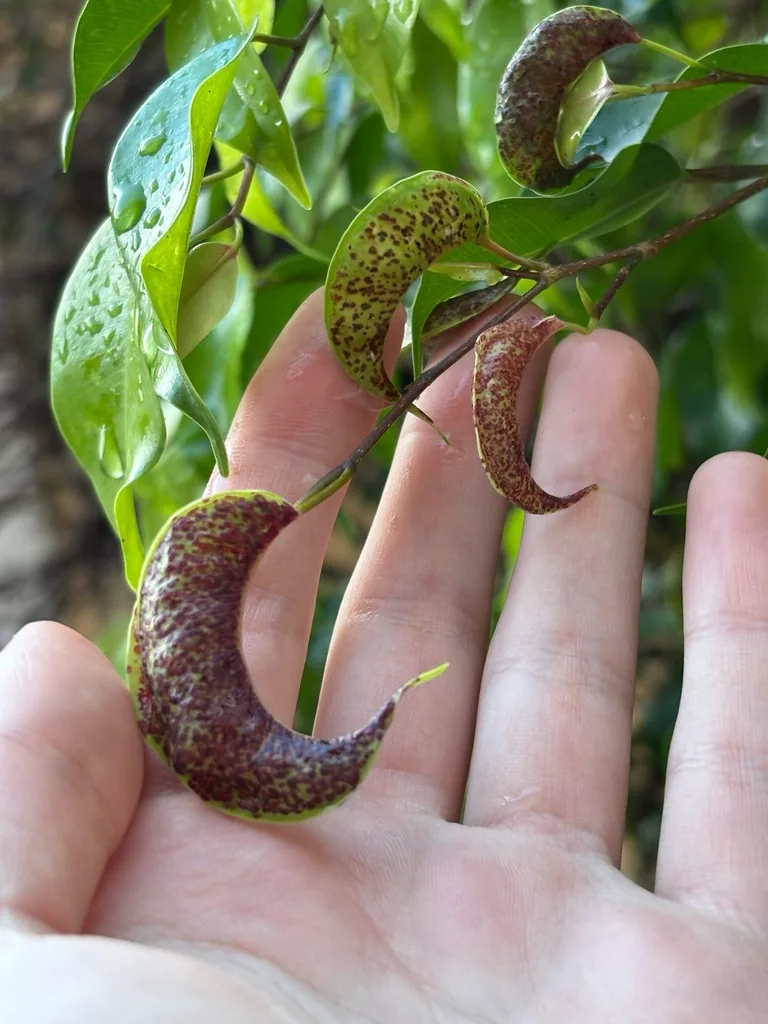
- Feeding leaves tiny sunken purplish-red spots on young leaves before they curl.[1][2]
Look-alikes
Where it lives
Native to Southeast Asia, it occurs wherever Indian laurel fig (Ficus microcarpa) is planted; UF lists U.S. records from California, Florida, Hawaii and Texas, and infested indoor figs can carry it elsewhere.[2]
Biology and life cycle
Adults settle on new terminal leaves and start folded-leaf galls within 2 to 3 days; mating, egg laying and a full generation happen inside one gall.[2]
The life cycle takes about 30 days, breeding is continuous, and new adults leave to start galls on fresh growth; they are active fliers on hot days.[2]
Damage and signs
Health risk
The thrips rarely bother people but occasionally bite.[2]
Control
Prevention
Replacing Indian laurel and weeping fig with a resistant Ficus is probably the best long-term fix.[2]
Traps and physical control
Clip off and destroy galled leaves and tender new growth; since the thrips can only use new growth, the remaining ones die before the plant flushes again.[1][2]
Biological control
In the Southeast the predatory bug Montandoniola confusa can cut populations by more than 95%, and UF calls relying on it the best option in landscapes; minute pirate bugs and lacewing larvae also feed on them.[2]
Pesticides
NC State suggests two or three thorough sprays of a product labeled for thrips on ornamentals about 5 to 7 days apart; UF trials found systemic soil drenches worked better than foliar sprays on thrips inside galls.[1][2]
Common questions
- Why are my ficus leaves curled and full of tiny black bugs?
- That's typical of Cuban laurel thrips, which fold new leaves into pocket galls and breed inside.[1][2]
- Do Cuban laurel thrips bite?
- Occasionally; they rarely bother people but can give a small nip.[2]
- Will the thrips kill my fig?
- No, but repeated galling and leaf drop make it unsightly.[1][2]
Sources
- NC State Extension, “Cuban Laurel Thrips (PDIC Factsheet).” content.ces.ncsu.edu/cuban-laurel-thrips (accessed 2026-10-15)
- University of Florida IFAS Extension (EDIS, Featured Creatures), “Leaf-Gall Thrips of Ficus, Gynaikothrips ficorum and G. uzeli (EENY-324/IN599).” ask.ifas.ufl.edu/publication/IN599 (accessed 2026-10-15)
- iNaturalist, “Gynaikothrips ficorum taxon page (order and family).” www.inaturalist.org/taxa/270786 (accessed 2026-10-06)