The short answer
- Confirm it's thrips first. Shake a flower or shoot over white paper and look for tiny, slender insects running around. Silvery patches with tiny dark specks of excrement are the classic leaf damage.[1][4]
- Houseplants: check leaf undersides, prune off infested parts, and spray insecticidal soap or horticultural oil so it wets the undersides. Repeat, because eggs inside the leaf and pupae in the soil escape the spray.[1][4]
- Roses: clip and throw away damaged buds and spent blooms, and keep weeds trimmed back. Thrips hide deep in the bud, which is why sprays often miss them.[2][7][8]
- Onions: thrips hide in the neck where new leaves emerge. Overhead watering and rain knock numbers down, straw mulch helps, and planting away from alfalfa and grain fields reduces the spring influx.[3][12][11]
- Use blue or yellow sticky cards to tell when thrips are flying, not to wipe them out. A card full of thrips doesn't by itself mean you need to spray.[1][4]
- Protect the lacewings, minute pirate bugs, predatory mites and predatory thrips that eat them, and skip broad-spectrum sprays that kill those predators.[1][3][11]
- If you do spray, spinosad is generally the most effective home option. UC IPM warns not to apply it to plants in bloom because it is toxic to bees for about a day.[1][6]
Thrips to know
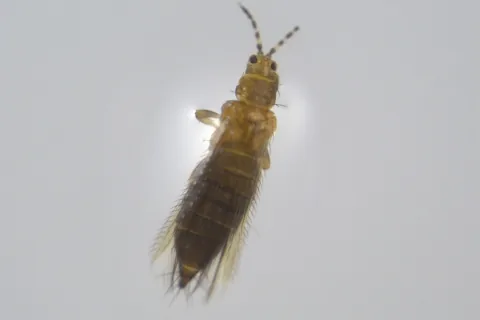 Thrips
Frankliniella occidentalis
Thrips are tiny, slender insects with fringed wings that scar and distort leaves, flowers and fruit. Woody plants usually tolerate them, but flowers, vegetables and young plants can be hurt badly, and thrips are hard to control.
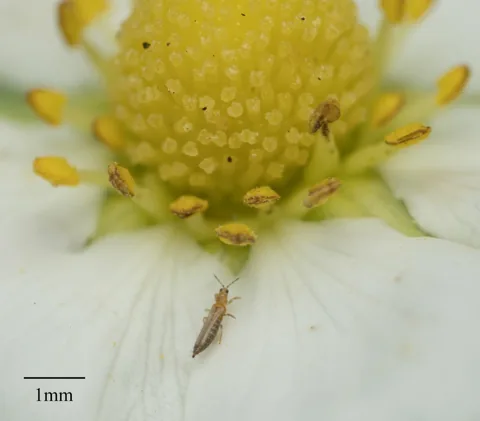 Western Flower Thrips
Frankliniella occidentalis
Western flower thrips are slender yellow to dark brown insects, about 1/16 inch long or smaller, that feed in flowers and buds and on fruit and leaves. Their feeding leaves silvery or pale scars and distorted growth, and they spread tospoviruses such as tomato spotted wilt and impatiens necrotic spot.
No photo yet
Onion Thrips
Thrips tabaci
Onion thrips are tiny insects that hide in the necks of onion plants and rasp the youngest leaves, leaving white to silvery patches and streaks and, when numbers are high, smaller bulbs.
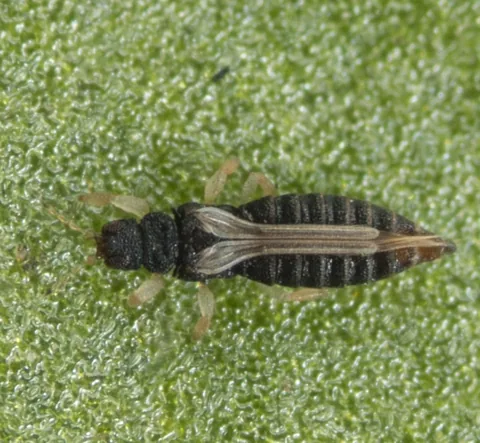 Greenhouse Thrips
Heliothrips haemorrhoidalis
The greenhouse thrips is a tiny, dark thrips that bleaches and silvers the foliage of greenhouse, house and landscape plants, mostly broadleaved evergreens, and scars avocado and citrus fruit.
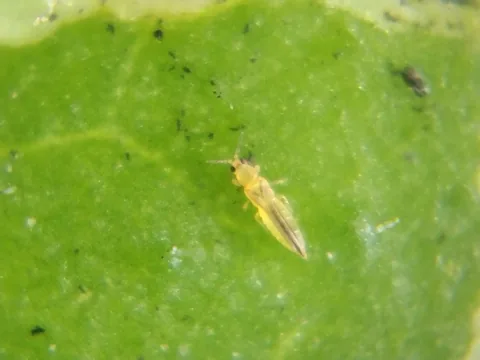 Chilli Thrips
Scirtothrips dorsalis
Chilli thrips are pale thrips under 2 mm long whose feeding curls, bronzes and scars the young leaves, buds and fruit of roses, peppers and many ornamentals. Damage is usually noticed before the insects are.
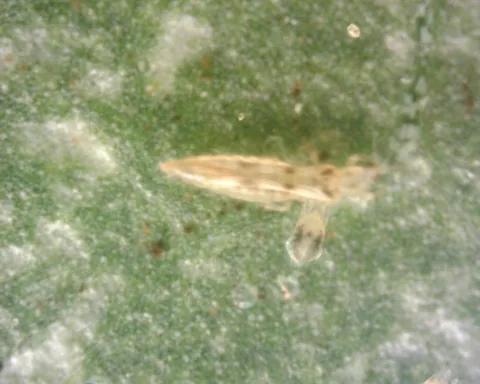 Sixspotted Thrips
Scolothrips sexmaculatus
Not all thrips are pests. The sixspotted thrips eats spider mites and their eggs and is common wherever mites are abundant.
Make sure it's thrips
Most people find the damage before they find the insect. Adult thrips are less than 1/20 inch long according to UC IPM; Colorado State and Mississippi State put full-grown thrips at up to about 1/16 inch. They are slender, with narrow wings edged in long fringes, and the young are wingless.[1][4][6]
- Leaves: light, irregular silvery areas around the feeding sites, with tiny dark spots of excrement. Colorado State notes this can look like spider mite damage, but thrips wounds are larger and more silvery.[4][1]
- Flowers and buds: streaked, scarred or distorted petals, and heavily infested buds that fail to open.[4][8][2]
- Shake test: tap flowers or foliage over a sheet of white or light-colored paper and watch for tiny moving insects.[1]
- Buds and shoot tips: UC IPM's method is to clip a few suspect parts into a jar of 70% alcohol, shake hard, and strain the liquid through filter paper so the thrips are easier to see.[1]
- On roses, NC State suggests picking a healthy-looking bloom, peeling back the outer petals and looking at the base for tiny brown to orange insects about 1/16 inch long. Blowing gently into the bloom can make them move.[7]
- The damage can outlast the insects. UC IPM says that by the time injury shows, often after buds open or leaves expand, the thrips may be gone. True bugs and mites also stipple leaves, so look for the insects themselves before treating.[1]
- Webbing points to spider mites rather than thrips. Colorado State says spider mites make webbing that can become very visible when they are numerous; if that's what you see, the spider mite guide is the better place to start.[4]
Why thrips are so hard to kill
Thrips can be difficult to control with insecticides, partly because of their mobility, feeding behavior and protected egg and pupal stages, UC IPM says. Most of the reasons a spray fails trace back to their life cycle.[1]
- Eggs inside the plant. Females insert their eggs into leaves, buds or other plant tissue, where sprays can't reach them.[1][4]
- Pupae in the soil. The nonfeeding prepupa and pupa stages of most species drop to the soil or leaf litter, out of reach of foliage sprays.[1][4][11]
- Hiding places. Thrips feed inside buds and flowers, on leaf undersides and in the tight necks of onions, where contact sprays don't get good coverage.[5][2][10]
- Fast generations. UC IPM says the life cycle can take as little as 2 weeks in warm weather, with up to about eight generations a year. Utah State gives 3 to 4 weeks per generation for onion thrips in summer and five to eight generations a year.[1][12]
- No males needed. Onion thrips females can reproduce without mating, and Utah State links this, with their high reproduction and short generation time, to how quickly they develop insecticide resistance.[10][12]
- Resistance. Colorado State says many strains are resistant to insecticides, and UC IPM's onion guidelines report that some populations have developed resistance even to spinosad.[4][3]
- Reinforcements. In late spring, large numbers of adults leave drying weeds and crops such as wheat and ride the wind to new plants. Mississippi State says that even after good control, more keep arriving.[5][6][1]
Thrips on houseplants
Thrips get indoors on plants brought into the house, through vents and doors, and on people and supplies. Colorado State adds that adults are small enough to get through most window screening.[9][4]
- Look closely at leaf undersides, buds and flowers. UC IPM says regular checks of leaf undersides on susceptible plants let you catch new infestations early.[1][4]
- Greenhouse thrips, a common species on broadleaved evergreens, is sluggish, rarely flies and spreads slowly from one part of the plant. UC IPM says pruning off colonies found early can be effective.[1]
- Spray the undersides. UC IPM says greenhouse thrips is readily controlled by thorough sprays of horticultural oil, insecticidal soap or pyrethrins on the undersides of infested leaves, repeated as needed. Colorado State agrees that the exposed stages are controlled with soaps or oils.[1][4]
- Plan on repeats. The eggs sit inside plant tissue and the pupae in the potting soil, so one spray won't catch them all.[4][1]
- Hang a yellow or pale blue sticky card near the plants to see whether adults are still flying.[4]
- Colorado State says pyrethroid insecticides control some thrips, such as onion thrips, but not the most common types.[4]
- The houseplant pests guide covers isolating, rinsing and swabbing plants and how soaps behave on indoor plants.[4]
Thrips on roses
Western flower thrips and madrone thrips feed inside rose blossoms, streaking the petals with brown and distorting them, and damage is worse when buds are attacked early. Mississippi State calls thrips some of the most important insect pests of roses. Even so, UC IPM says that in most home gardens and landscapes thrips on roses can be tolerated.[2][6]
- Variety matters. Fragrant, light-colored and white roses are attacked most, and cultivars whose sepals stay tightly wrapped around the bud until it opens have fewer problems. Mississippi State says dark blooms are less attractive to thrips.[2][6][9]
- Clip and dispose of damaged buds and spent blooms, away from the planting. UC IPM says frequent clipping may reduce thrips, though it also notes the benefit of removing spent flowers in landscapes is unknown and that old blossoms shelter predators of thrips too.[2][7][1]
- Trim back weeds and grass from the base of the roses, and remove debris around plants in fall to cut down overwintering adults.[7][8]
- Windbreaks: Mississippi State says natural or artificial windbreaks won't stop every wind-blown thrips but can reduce heavy pressure from late-spring migrations.[6]
- Crowded, constantly blooming rose beds tend to have worse thrips problems, UC IPM says.[2]
- Chilli thrips is different: it feeds mainly on leaves, in leaf axils, curled leaves and under flower calyxes, and can badly distort growth or defoliate roses. Mississippi State says its symptoms are sometimes mistaken for herbicide or disease injury, and that spinosad is one of the most effective treatments but takes several applications. Check leaf undersides with a hand lens.[2][6]
- Spraying roses: sources differ. WSU says to aim sprays directly into the bud or flower and test a bloom first to see whether it tolerates the product. Mississippi State says weekly sprays may be needed during heavy migration in late spring and early summer. UC IPM says control with insecticides is difficult because thrips feed deep in buds where sprays can't reach.[8][6][2]
Thrips on onions, garlic and leeks
Onion thrips hide in the neck of the plant and rasp the youngest leaves, leaving white blotches and silvery streaks, browned tips and, when numbers are high, smaller bulbs. Plants are most sensitive while bulbs are forming. Populations climb fast in hot, dry weather.[10][11][12][3]
- Check the neck. Part the leaves and look between the leaf blades, low in the center of the plant, for light yellow young and darker adults. Leaf-only checks often miss thrips hidden near the bulb.[11][3][12]
- When to act, three versions: UW-Madison says consider treating at three thrips per leaf, UMass says treat at 1 to 3 per leaf, and UC IPM's California guideline uses 30 thrips per plant mid-season, lower for young plants. These were built for commercial fields; home growers can use them as a rough guide.[10][11][3]
- Water from above. UC IPM and Utah State say overhead sprinkler irrigation and rain suppress thrips; water washes them off and droplets on the leaves discourage them.[3][12]
- Mulch with straw. UMass recommends straw mulch to deter thrips, and Utah State says straw or other mulch has been shown to reduce populations.[11][12]
- Plant away from alfalfa, wheat and other grains or clover. Thrips build up there and move to onions when those crops dry or are cut.[11][3][12]
- Start clean. Inspect transplants and discard infested ones, don't use last year's onions for sets, and clear crop debris and volunteer onions at the end of the season.[12][11][10]
- Choose varieties with open necks and dark, glossy leaves. UW-Madison says red onions are particularly susceptible and Spanish onions somewhat more tolerant.[12][10]
- Don't overfeed. Utah State ties moderate, steady nitrogen to healthier onions and fewer thrips.[12]
- If you spray, direct it down into the center of the plant with enough water to penetrate, and alternate products with different active ingredients or modes of action, since onion thrips readily become resistant.[10][12][3]
Sticky cards: yellow, blue or white
Sticky cards tell you when adult thrips are flying and whether numbers are rising. Sources name slightly different colors: UC IPM says blue or bright yellow, Colorado State says yellow or pale blue, and UW-Madison suggests yellow or white cards at the edge of an onion bed early in the season.[1][4][10]
- Hang them in or near the plants you're watching. UC IPM's detailed guidance uses bright yellow cards for adults.[1]
- Expect spikes. Mississippi State says that during heavy migrations, sticky cards placed in rose gardens are quickly peppered with thrips.[5]
- Cards are for monitoring. UC IPM says large numbers of thrips on traps, or adults feeding on pollen in flowers, don't necessarily mean control is needed.[1]
- They catch only flying adults. Eggs inside leaves and pupae in the soil aren't affected, which is why cards alone won't clear an infestation.[1][4]
- For card placement and reading catches indoors, see the sticky traps guide; the same cards catch fungus gnats, whiteflies and winged aphids.[4]
Natural enemies that eat thrips
UC IPM lists predatory thrips, green lacewings, minute pirate bugs, predatory mites and certain parasitic wasps as natural enemies that help control plant-feeding thrips. UMass names lacewing larvae, pirate bugs and predatory thrips as important natural enemies of onion thrips, and WSU adds lady beetle larvae.[1][11][8]
- Keep them alive. UC IPM says to avoid persistent pesticides, avoid creating dust (rinsing dust off small plants now and then helps) and grow a variety of plants.[1]
- Broad-spectrum sprays undo them. UC IPM's onion guidelines say pyrethroids and similar sprays kill predaceous mites, minute pirate bugs and lacewings, making them unreliable where those sprays have been used.[3][1]
- Egg parasites: in Southern California, UC IPM says a tiny wasp kills up to 50% of greenhouse thrips eggs.[1]
- Not every thrips is a pest. Sixspotted thrips and some other thrips prey on mites and pest thrips; UC IPM says predatory thrips are seldom seen in the high numbers typical of pest species. Even western flower thrips feeds on spider mites.[1][2]
- Minute pirate bugs are often among the first predators to show up in spring, feeding on mites, insect eggs and thrips.[2][1]
In the garden: keep thrips from building up
Thrips that feed on many plants often move into gardens when weedy areas or grasslands dry out in spring or summer. UC IPM suggests not putting susceptible plants next to those areas and controlling nearby weeds that host thrips.[1][5]
- Water well but don't overwater, and go easy on nitrogen. UC IPM says overwatering and nitrogen fertilizer can increase thrips numbers, while well-watered, vigorous plants tolerate damage better.[1]
- Prune and destroy injured, infested shoot tips on a few small plants, and avoid shearing hedges, which pushes out the tender new growth thrips prefer.[1]
- Cover young vegetables. Row covers and fine-mesh cages keep thrips off seedlings and young plants; remove them when plants grow larger or the weather gets hot.[1]
- Reflective mulch. Silver or gray mulch can delay thrips on young plants, but UC IPM says it stops working once the plant canopy covers more than about half the soil.[1][5]
What sprays can and can't do
UC IPM says thrips damage, though unsightly, does not usually warrant insecticides in gardens and landscapes, and that no pesticide will restore injured leaves, petals or fruit. The plant stays marked until the damaged tissue drops, is pruned off or new growth replaces it.[1]
- Contact sprays: insecticidal soap, horticultural oil, neem oil, azadirachtin and pyrethrins have low toxicity to people, pets and pollinators and leave no lasting residue, but they kill only thrips they touch. Coverage of buds, shoot tips and leaf undersides has to be thorough.[1][4]
- Spinosad: UC IPM says it is generally more effective against thrips than contact sprays, lasts a week or more and moves a short way into sprayed leaves. Mississippi State calls it one of the more effective foliar treatments on roses, especially for western flower thrips.[1][6][8]
- Spinosad and bees: UC IPM says it can be toxic to bees and to predatory mites when sprayed and for about a day afterward, and advises against applying it to plants that are flowering.[1]
- Systemics, where sources disagree. UC IPM says imidacloprid commonly fails to control thrips and generally isn't recommended for them, and advises avoiding acephate because it harms natural enemies and pollinators and can trigger spider mite outbreaks. Mississippi State lists imidacloprid and acephate among the most effective treatments for thrips on roses, and says soil drenches help with leaf-feeding thrips but not thrips in flowers.[1][5][6]
- Broad-spectrum sprays: UC IPM advises against foliar sprays of organophosphates, carbamates and pyrethroids in landscapes because they are highly toxic to natural enemies and pollinators.[1]
- Viruses: insecticides don't kill thrips fast enough to stop them from passing tomato spotted wilt and related viruses to plants. UC IPM says row covers that keep thrips off work best; Mississippi State points to disease-resistant varieties and reflective row covers for tomatoes.[1][5]
- Whatever you use, read the label, make sure the plant and site are listed, and follow it.[8][1]
Common questions
- Can I get rid of thrips for good?
- Rarely. Thrips fly in from weeds and nearby crops, especially in late spring, so the goal is to keep damage tolerable: monitor, protect predators, remove what feeds them and treat only when needed.[5][1]
- Do thrips bite people?
- Sometimes. A University of Minnesota sheet on flower thrips says they bite people, causing a noticeable stinging sensation.[9]
- Will damaged leaves and flowers recover?
- No. UC IPM says injured tissue stays marked until it drops, is pruned off or is replaced by new growth. Judge success by clean new leaves and blooms.[1]
- Are blue or yellow sticky traps better for thrips?
- The sources list both. UC IPM names blue or bright yellow and Colorado State names yellow or pale blue. Either works for monitoring; neither will clear an infestation alone.[1][4]
- Does neem oil kill thrips?
- Neem oil and azadirachtin are among the contact products UC IPM lists. They work only on thrips they touch, so they need thorough coverage and repeat applications.[1]
- Why do my white roses get thrips and my dark ones don't?
- Fragrant, light-colored and white roses are attacked most often, and damage shows more on pale petals. Mississippi State says dark-colored blooms are less attractive to thrips.[2][6]
Photo credits
- Thrips: (c) Julia Palmer, some rights reserved (CC BY) — via iNaturalist, CC BY 4.0
- Western Flower Thrips: Jesse Rorabaugh, public domain (CC0), via iNaturalist
- Greenhouse Thrips: Jesse Rorabaugh, public domain (CC0), via iNaturalist
- Chilli Thrips: 余世文, public domain (CC0), via iNaturalist
- Sixspotted Thrips: 余世文, public domain (CC0), via iNaturalist
Sources
- University of California Statewide IPM Program, “Pest Notes: Thrips (Publication 7429).” ipm.ucanr.edu/home-and-landscape/thrips/ (accessed 2026-11-10)
- University of California Statewide IPM Program, “Roses: Insects and Mites.” ipm.ucanr.edu/home-and-landscape/roses-insects-and-mites/ (accessed 2026-11-10)
- University of California Statewide IPM Program, “Onion and Garlic Pest Management Guidelines: Thrips.” ipm.ucanr.edu/agriculture/onion-and-garlic/thrips/ (accessed 2026-11-10)
- Colorado State University Extension, “Managing Houseplant Pests.” extension.colostate.edu/resource/managing-houseplant-pests/ (accessed 2026-11-10)
- Mississippi State University Extension Service, “Bug's Eye View: Thrips (Vol. 4, No. 8).” extension.msstate.edu/newsletters/bugs-eye-view/2018/thrips-vol-4-no-8 (accessed 2026-11-10)
- Mississippi State University Extension Service, “Insect Pests of Roses (Publication 2472).” extension.msstate.edu/sites/default/files/publications/P2472_web.pdf (accessed 2026-11-10)
- NC State Extension, Department of Entomology, “Thrips: Biology and Rose Pests.” entomology.ces.ncsu.edu/thrips-2/ (accessed 2026-11-10)
- Washington State University Extension, “Rose: Thrips (Hortsense).” hortsense.cahnrs.wsu.edu/fact-sheet/rose-thrips/ (accessed 2026-11-10)
- University of Minnesota, Department of Entomology, “Greenhouse & Nursery Insect Pest ID: Flower Thrips.” ncipmhort.cfans.umn.edu/sites/ncipmhort.cfans.umn.edu/files/2022-03/flower_thrips.pdf (accessed 2026-11-10)
- University of Wisconsin-Madison Division of Extension, “Onion Thrips (XHT1134).” hort.extension.wisc.edu/articles/onion-thrips/ (accessed 2026-11-10)
- UMass Amherst Center for Agriculture, Food, and the Environment, “Onion Thrips.” www.umass.edu/agriculture-food-environment/vegetable/fact-sheets/onion-thrips (accessed 2026-11-10)
- Utah State University Extension, “Onion Thrips.” extension.usu.edu/planthealth/research/onion-thrips (accessed 2026-11-10)