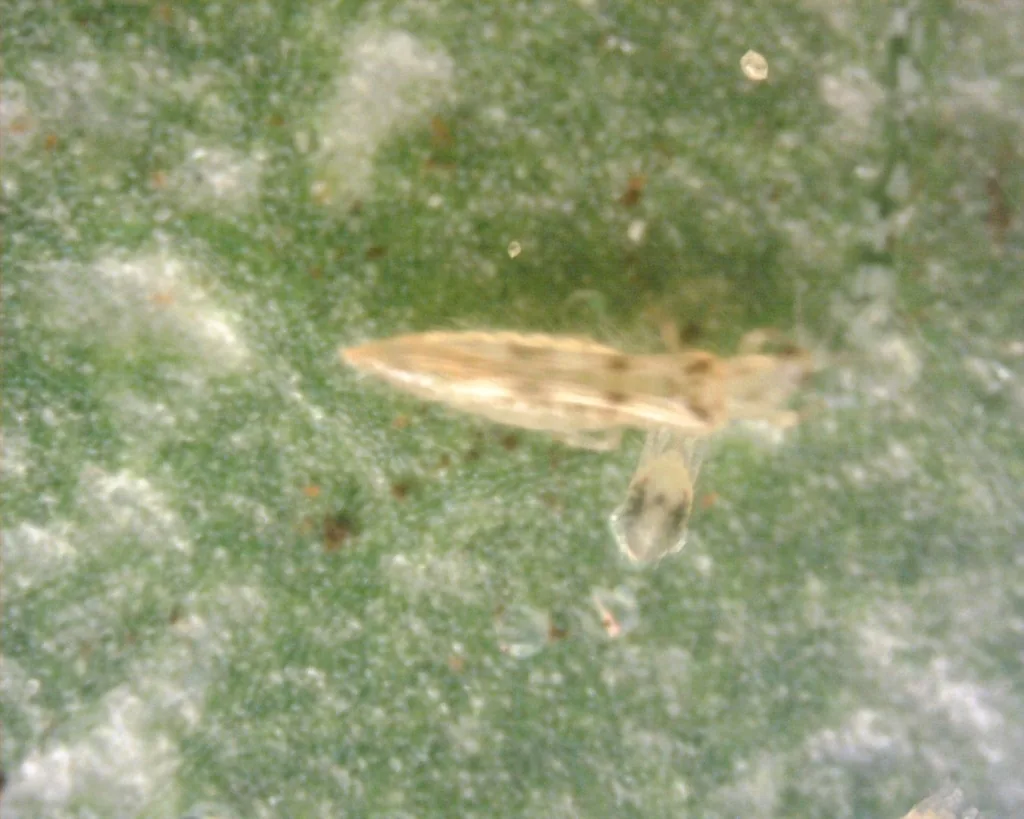
How to identify it
Look-alikes
| Look-alike | How to tell them apart |
|---|---|
| Pest thrips | Six dark wing spots on a pale thrips separate this species from common pest thrips, and it's usually found among mites, often feeding on them.[1] |
Where it lives
It occurs on most plants infested with spider mites. At least three Scolothrips species live in California, and two can be told apart only by an expert.[1]
Biology and life cycle
Eggs are laid inside plant tissue; the thrips passes through two larval stages, a prepupa and a pupa.[1]
Egg to adult takes about 10 days in the growing season, with many generations where it's warm and mites are plentiful.[1]
Damage and signs
Health risk
UC IPM describes it only as a mite predator and gives no sign of any concern for people.[1]
Control
Prevention
Before treating thrips, check what they're doing: pale thrips with spotted wings feeding among spider mites are allies.[1]
Biological control
It finds prey well even when mites are scarce and needs relatively few to survive.[1]
Common questions
Sources
- University of California Statewide IPM Program, “Sixspotted Thrips (Natural Enemies Gallery).” ipm.ucanr.edu/natural-enemies/sixspotted-thrips/ (accessed 2026-10-06)
- iNaturalist, “Scolothrips sexmaculatus taxon page (order and family).” www.inaturalist.org/taxa/308423 (accessed 2026-10-06)