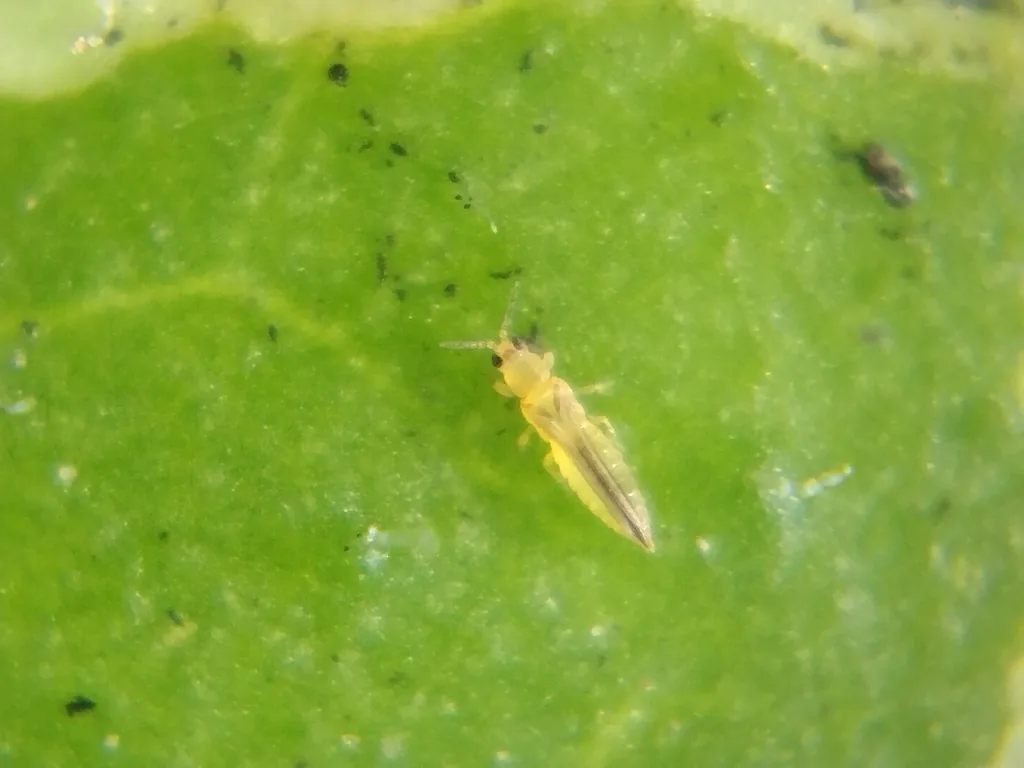
How to identify it
Look-alikes
| Look-alike | How to tell them apart |
|---|---|
| Other thrips | Chilli thrips are small and fast, making them hard to spot without magnification.[1] |
Where it lives
Probably from Southeast Asia or India, it's now widely distributed and has spread into the Western Hemisphere.[1]
Biology and life cycle
Females insert microscopic eggs into plant tissue; stages include two larval instars, prepupa and pupa.[1]
Damage and signs
- It causes feeding scars, leaf distortion and discolored buds, flowers and young fruit on more than 100 plant groups.[1]
Health risk
It feeds on plants; UF/IFAS mentions no risk to people.[1]
Control
Sanitation
Remove weeds that can host it, and rotate crops.[1]
Biological control
Support natural enemies, a basic practice recommended for this pest.[1]
Common questions
Sources
- University of Florida IFAS Extension (Featured Creatures), “Chilli Thrips, Scirtothrips dorsalis (EENY-463).” edis.ifas.ufl.edu/publication/IN833 (accessed 2026-10-06)
- iNaturalist, “Scirtothrips dorsalis taxon page (order and family).” www.inaturalist.org/taxa/688846 (accessed 2026-10-06)