The short answer
- Clusters of small soft insects on new shoots and buds, often with sticky honeydew: aphids, the most common insect pests on roses. Stippled, bleached leaves with tiny specks underneath and sometimes fine webbing: spider mites.[1][2]
- Leaves with see-through windowpane patches or large chewed holes and green, slug-like larvae: roseslugs, which are sawfly larvae. Blooms and leaves chewed by metallic green and copper beetles: Japanese beetles.[3][1][2]
- Petals streaked brown or distorted, or buds that won't open: thrips. Buds with drilled holes or ragged holes through the petals: rose curculio. Bud and shoot tips that turn black and wither: rose midge.[1][2][9][8]
- Many roses grow well with little or no insecticide. University of California advice is to choose less susceptible varieties, keep up good cultural care, check plants regularly and use handpicking or water sprays, because natural enemies often bring aphids, mites and other pests down quickly.[1]
Rose pest profiles
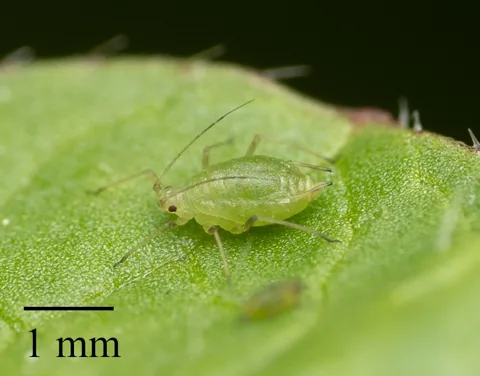 Aphids
Myzus persicae
Aphids are small, soft-bodied insects that pierce tender stems and leaves and suck out plant sap. Almost every plant hosts at least one aphid species, but established plants usually tolerate them, treating aphids for the plant's health is usually unnecessary, and natural enemies often bring numbers down.
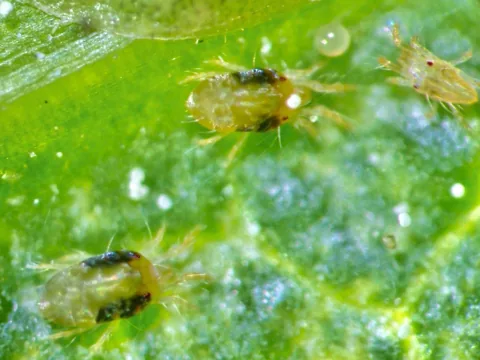 Spider Mites
Tetranychus urticae
Spider mites are tiny arachnids, relatives of spiders and ticks, that live in colonies on leaf undersides and suck out plant cells. The twospotted spider mite is the most important species in yards and gardens and on house plants, and Minnesota says it can infest over 200 species of plants.
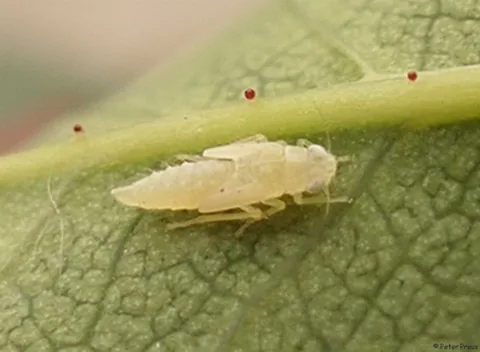 Rose Leafhopper
Edwardsiana rosae
The rose leafhopper is a small, pale, whitish-green leafhopper from Europe. It lays its overwintering eggs in rose and bramble canes, breeds on roses in spring and spends the summer on apple, dogwood, oak, maple and other trees, where its feeding leaves pale stippling on the leaves.
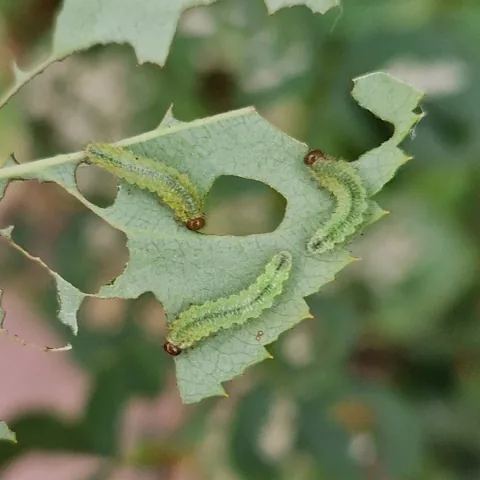 Rose Slugs (Rose Sawflies)
Cladius difformis (bristly roseslug; listed by iNaturalist as Cladius pectinicornis), Endelomyia aethiops and Allantus cinctus
Rose slugs, or roseslugs, are the larvae of sawflies, wasp relatives that feed on rose leaves. The bristly roseslug causes the most trouble because it keeps producing new generations all season, while other rose sawflies feed mainly early on.
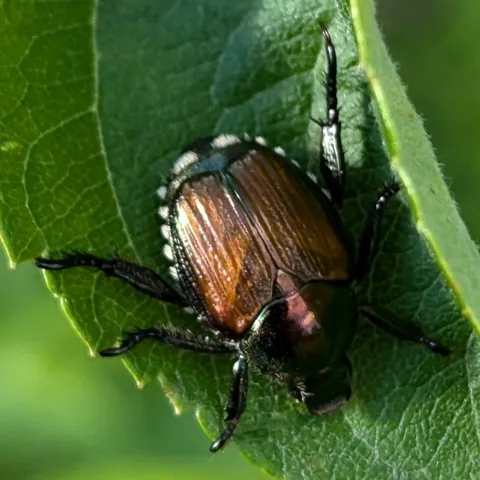 Japanese Beetle
Popillia japonica
The Japanese beetle damages landscapes twice: metallic green adults chew the leaves, flowers and fruit of hundreds of plants in early summer, and their white grubs feed on grass roots underground. A review of its biology calls it the most widespread and destructive insect pest of turf, landscapes and nursery crops in the eastern United States.
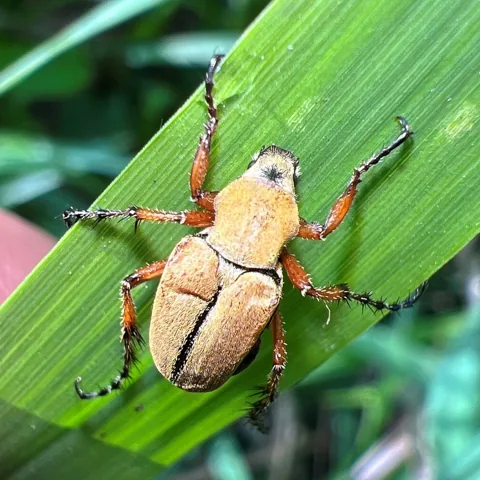 Rose Chafer
Macrodactylus subspinosus
The rose chafer is a native scarab beetle that feeds on flowers, fruits and leaves for a few weeks in late spring and early summer. It is worst on sandy soils, where its grubs develop, and the adults contain a toxin that can kill chickens and other birds.
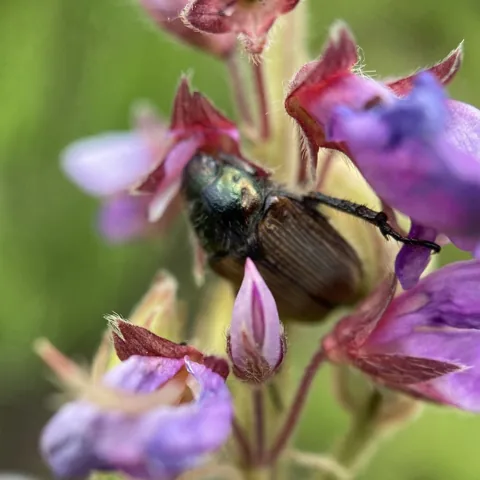 Spring Rose Beetle
Strigoderma arbicola (often written arboricola)
The spring rose beetle (false Japanese beetle) is a scarab about half an inch long that chews the flowers of roses, especially pale and white ones, and of iris, peony and lilies. Its grubs live in the soil and often attack crops grown in sandy soil, which is why it is also called the sand chafer.
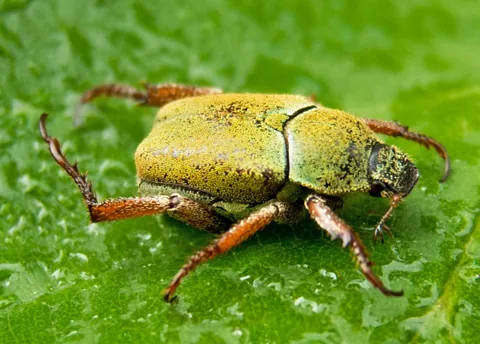 Hoplia Beetle
Hoplia callipyge (shown: a Hoplia species)
Hoplia beetles chew holes in light-colored rose blossoms for a few spring weeks; handpicking is the main remedy, since sprays rarely reach them.
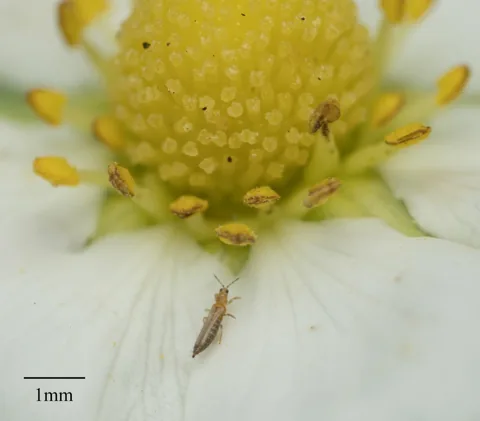 Western Flower Thrips
Frankliniella occidentalis
Western flower thrips are slender yellow to dark brown insects, about 1/16 inch long or smaller, that feed in flowers and buds and on fruit and leaves. Their feeding leaves silvery or pale scars and distorted growth, and they spread tospoviruses such as tomato spotted wilt and impatiens necrotic spot.
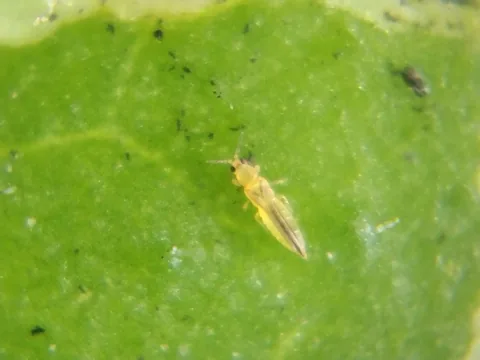 Chilli Thrips
Scirtothrips dorsalis
Chilli thrips are pale thrips under 2 mm long whose feeding curls, bronzes and scars the young leaves, buds and fruit of roses, peppers and many ornamentals. Damage is usually noticed before the insects are.
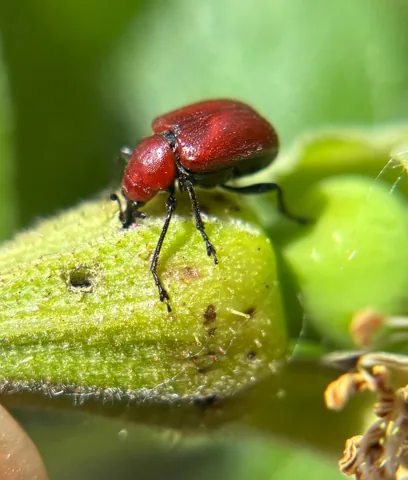 Rose Curculio
Merhynchites bicolor
Rose curculio adults drill holes in rose buds, which can kill the bud or leave ragged holes in the open flower.
No photo yet
Rose Midge
Dasineura rhodophaga (iNaturalist genus: Dasineura)
The rose midge is a tiny fly whose maggots feed in new rose buds and shoot tips, deforming and killing them; damaged tissue turns brown, then black.
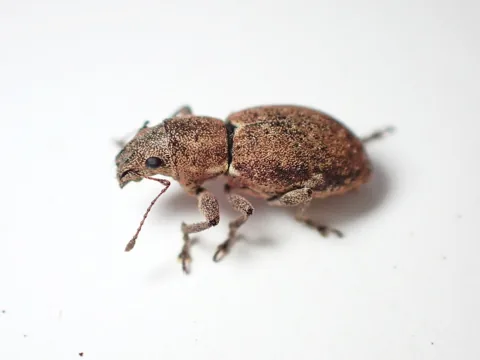 Fuller Rose Beetle
Pantomorus cervinus (also listed as Naupactus cervinus)
Ragged notches along the edges of rose, citrus or photinia leaves, with no insect in sight by day, are often the work of the night-feeding Fuller rose beetle.
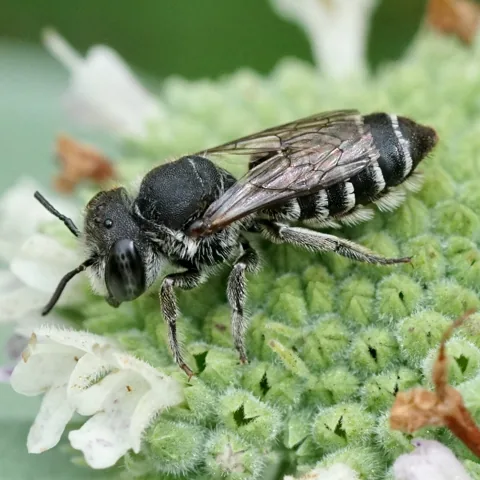 Leafcutter Bees
Megachile species
Neat semicircles cut from the edges of rose leaves are the work of leafcutter bees. These solitary pollinators carry the pieces off to line their nest cells and don't eat the leaves.
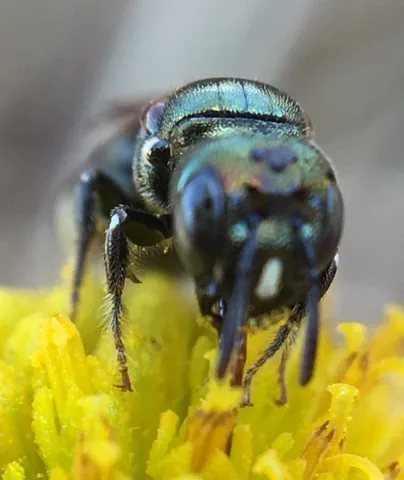 Small Carpenter Bees
Ceratina species
Small carpenter bees are tiny, shiny black bees with blue or green highlights that hollow out nests in the pith of broken weed stems, dead canes and freshly cut rose stems. They are gentle pollinators, though nesting in a fresh rose cut can make the cane die back.
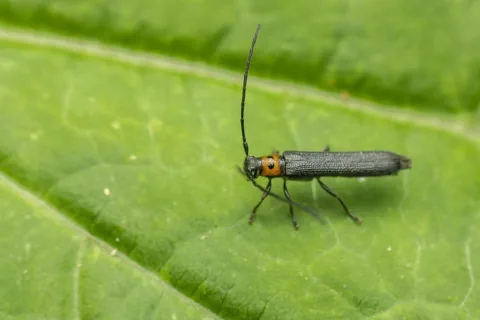 Raspberry Cane Borer
Oberea perspicillata
Raspberry cane borer attacks blackberry, raspberry and rose, causing tip dieback and cane death.
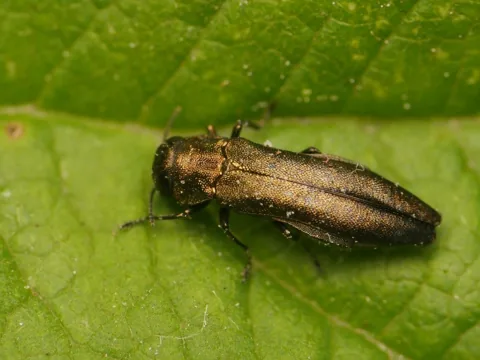 Rose Stem Girdler
Agrilus cuprescens
The rose stem girdler is a small copper-green metallic beetle whose larvae tunnel inside raspberry, blackberry and rose canes, girdling them and cutting berry yields.
No photo yet
Raspberry Horntail
Hartigia cressoni (iNaturalist genus: Phylloecus)
Raspberry horntail larvae feed inside rose stems, making cane tips wilt and die in spring and reducing second-cycle blooms.
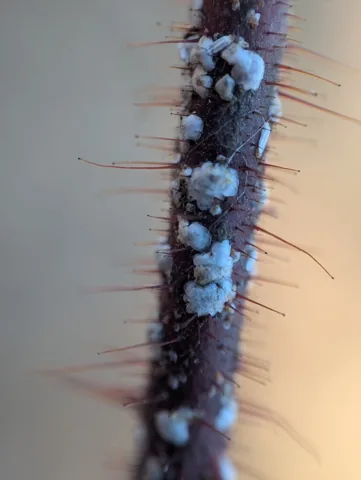 Rose scale
Aulacaspis rosae
The rose scale is an armored scale of roses and their relatives. Its flat, white, nearly circular covers coat the canes of roses, raspberries, blackberries and currants, and a heavy infestation can cause rose canes to decline and die back or kill the plant. Mississippi State calls it one of the more common armored scales on roses. Crawlers spread it along the plant and on the wind; settled scales and eggs travel on infested plants. On roses, winter pruning of the worst canes plus an oil spray usually gives sufficient control, and parasitic wasps attack it.
No photo yet
Rose Rosette Mite
Phyllocoptes fructiphilus
The rose rosette mite is a microscopic eriophyid mite that feeds on roses and carries rose rosette virus from plant to plant. The disease it spreads has no cure.
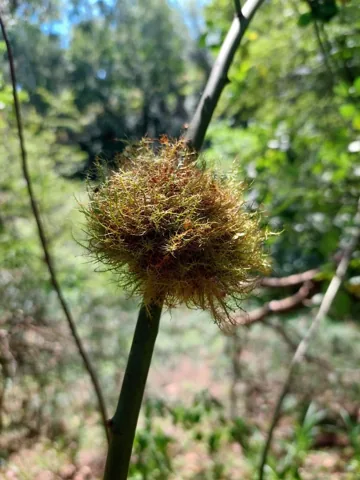 Rose gall wasps
Diplolepis (e.g., Diplolepis rosae, mossy rose gall wasp, and Diplolepis bicolor, spiny rose gall wasp)
Rose gall wasps are tiny wasps, about an eighth to a quarter of an inch long, that are almost never seen; what gardeners notice are the galls their larvae cause roses to grow. The mossy rose gall is a cluster of hard, kernel-like cells on a stem or leaf covered in moss-like filaments, sometimes bigger than a golf ball, and it occurs on cultivated roses. The spiny rose gall is a hard sphere bristling with sharp spines, usually on the leaves of wild roses. Both are harmless to healthy plants. The wasp spends the year inside the gall and emerges in spring, so pruning galls out in late summer or winter, before the exit holes appear, is the only practical control; no spray removes a gall once it has formed.
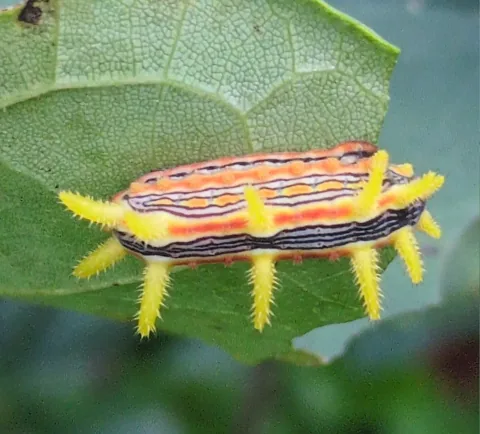 Stinging Rose Caterpillar
Parasa indetermina
The stinging rose caterpillar's bright stripes and spiny horns are warning colors: the spines sting. It is a slug caterpillar of eastern forests, widespread but not particularly common.
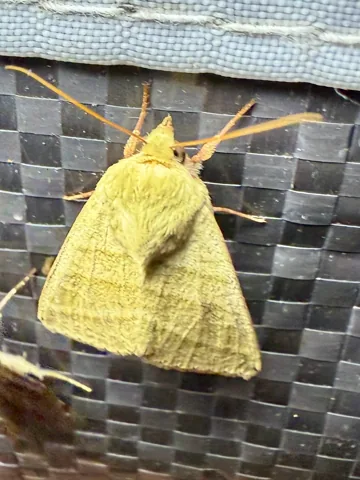 Tobacco Budworm
Chloridea virescens
Tobacco budworm caterpillars, also called geranium budworms, feed on the buds and petals of geranium, petunia, nicotiana and other garden flowers.
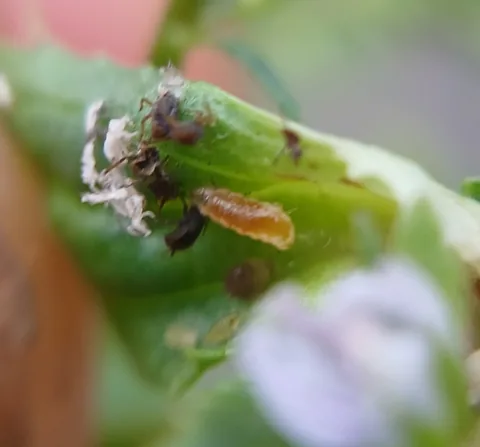 Aphid Midge
Aphidoletes aphidimyza
The aphid midge is a tiny fly whose orange larvae paralyze aphids and suck them dry. It attacks over 60 aphid species and is widely used for aphid control in greenhouses.
Start with the damage
Use the symptom to narrow the list, then look for the insect before you decide anything. Several of these pests leave damage that looks alike, and some insects on roses are harmless or helpful.[1][2]
- New shoots and buds curled, distorted or stunted, sticky leaves or black sooty mold: aphids. Look for the clusters on buds and tender tips.[1][2]
- Fine light-colored stippling that merges into a bleached or bronzed look, specks on the leaf undersides and webbing in heavy infestations: spider mites.[2][1]
- Stippling with larger spots that are more widely spaced than mite damage, white cast skins and no webbing on the undersides: rose leafhopper.[1][2]
- Windowpane-like patches where the leaf surface is scraped away, or larger holes chewed through leaves, with green slug-like larvae: roseslugs (sawfly larvae).[3][1][2]
- Blooms disfigured and leaves eaten, with shiny metallic green and copper beetles on the plant in summer: Japanese beetles.[2][1]
- Large irregular holes in blossoms and leaves skeletonized between the veins, with slender tan beetles on long reddish spiny legs in late spring and early summer: rose chafers.[4][6]
- Petals streaked with brown, silvery or bleached patches, crinkled or distorted blooms, or buds that fail to open: thrips. White and light-colored roses show it most.[1][2]
- Holes drilled in flower buds, buds that die before opening, or ragged holes through the petals when the flower opens: rose curculio.[1][9]
- Bud and shoot tips that turn brown or black, wither and die, or shoots that never form a flower bud: rose midge.[7][8][2]
- Wilted or dying cane tips, a hole in the cut end of a cane, or swellings and spiral grooves on canes: cane borers or cane-nesting wasps and bees.[12][13][16][15]
- Neat semicircular pieces cut out of leaf edges: leafcutting bees. They are pollinators, so leave them alone.[1][2]
- Leaf edges notched or ragged, with no insect in sight during the day: Fuller rose beetle, a flightless weevil that feeds at night.[1]
- Small grayish, round to oval crusts on the canes: armored scales such as rose scale.[1][2]
- Dense clusters of new stems at cane tips (a witches' broom), usually dark red, with small leaves and extra thorns: rose rosette, a virus disease carried by an eriophyid mite. Spraying won't cure a plant that already has it.[2]
Aphids
Aphids are the most common insect pests on roses. UC IPM names the rose aphid, potato aphid and cotton aphid among the species. They favor buds and fast-growing shoots, and heavy numbers can distort or kill buds and shrink flowers.[1]
Low to moderate numbers do little harm. Lady beetles, parasitic wasps, syrphid fly larvae, soldier beetles and lacewings feed on them, and a forceful spray of water early in the day is often all that's needed on top of that.[1][2]
Mississippi State adds that too much nitrogen fertilizer encourages aphids and that some rose varieties are more susceptible than others.[2]
Spider mites
Spider mites are tiny (UC IPM compares them to the period at the end of a sentence) and easiest to see with a hand lens. Mississippi State says one common species, the twospotted spider mite, has a dark spot on each side of its body.[1][2]
Mites start on the undersides of leaves. Mississippi State says they can complete a generation in as little as 7 days, and heavy feeding leaves foliage bleached or bronzed, then curled and dropping. Hot, dry and dusty conditions favor outbreaks.[2][1]
- Washing the leaves with water, keeping plants watered and cutting down dust all help. Spray the undersides of the leaves.[1][2]
- Outbreaks often follow insecticide sprays aimed at other pests. Both UC IPM and Mississippi State name carbaryl and pyrethroids, and Mississippi State adds acephate and imidacloprid.[1][2]
- Western flower thrips and sixspotted thrips both feed on spider mites, and predatory mites often keep them at tolerable levels.[1]
- The spider mite guide covers soaps, oils and when to treat.[1][2]
Roseslugs (sawfly larvae)
Roseslugs aren't slugs or caterpillars. They are the larvae of several species of sawflies, a group of wasps. UC IPM lists the bristly roseslug as the most common in California, with the curled rose sawfly and the roseslug (also called the American, European or common roseslug) as occasional pests.[3][1][2]
- Bristly roseslug: pale green larvae with a brown head and many tiny bristles, about 3/4 inch long when grown. Young larvae scrape the leaf underside, older ones chew holes.[3]
- Curled rose sawfly: green larvae up to 3/4 inch long that often coil while feeding. They chew through leaves from the edges and can cut half-moon shapes that look like leafcutting bee damage.[3]
- Roseslug: green on top and yellowish on the sides, up to 1/2 inch long. Larvae of all ages scrape the upper leaf surface into windowpanes and don't chew holes.[3]
- Handpicking or a strong stream of water removes them. Bt products don't work, because sawfly larvae are not caterpillars.[3][1][2]
- The sawfly guide covers soaps, oils and spinosad and when they make sense.[3][1]
Japanese beetles
Where Japanese beetles are established, Mississippi State calls them one of the most important insect pests of roses. The adults fly in from lawns, where the grubs develop, and feed mostly on blooms, favoring light-colored ones, though they eat leaves too.[2]
Adults are shiny metallic green with copper wing covers. Mississippi State points to the row of white hair tufts along each side of the abdomen to tell them from other metallic beetles. UC IPM notes they are not established in California and that hoplia beetles there are about half their length.[2][1]
- Handpicking works on small plantings with light infestations, and some gardeners cover prized buds and blooms with mesh.[2]
- Mississippi State warns that pheromone traps may attract more beetles than they catch, and that any traps should go well away from the roses.[2]
- Soil-applied systemic insecticides won't stop adult beetles from damaging blooms. The Japanese beetle guide covers adults and grubs.[2]
Thrips
Thrips are tiny, slender insects no more than 1/16 inch long that feed inside flowers and buds. Western flower thrips are among the most common on roses. Damage is worst when buds are attacked early, and heavy infestations can keep buds from opening.[2][1]
Fragrant, white and light-colored roses are attacked most, and dark blooms less. Mississippi State says thrips are carried on the wind, and large numbers migrate from maturing weeds in late spring and early summer.[1][2]
Chilli thrips, found on roses in southern California in 2015, feed on leaves as well as flowers and can do more serious damage than other thrips.[1]
Rose chafer
The rose chafer is a slender, pale green to tan beetle with reddish-brown or orange spiny legs, 5/16 to almost 1/2 inch long (Minnesota). Adults chew large irregular holes in blossoms, especially roses and peonies, and skeletonize leaves between the veins.[4][6]
Adults come out of the ground in late May and early June and feed for three or four weeks. Wisconsin says damage occurs in June. There is one generation a year, and the grubs feed on roots of grasses and weeds. UMass notes adults are active earlier in the season than Japanese beetles.[4][5][6]
Damage is worst on light, sandy soil, which the larvae need. Wisconsin says heavy or clay soils hamper their development.[5][4][6]
- Handpick into soapy water, and check often because new beetles keep flying in.[4][6]
- Cover plants with cheesecloth or floating row cover while the beetles are active and take it off after they finish feeding.[4][6]
- Rose chafers contain a toxin. Birds and small animals can die from eating them, and they are toxic to chickens, so don't let poultry feed on them.[4][5][6]
- Minnesota says a garden insecticide may be needed when large numbers are present, possibly more than once.[4]
Rose cane borers
"Rose cane borer" covers several unrelated insects that tunnel in canes. Colorado State says the most common tunnelers in rose canes are small hunting wasps that nest in the pith, feed their young on aphids and are mostly beneficial.[16]
- Small carpenter bees: black bees with blue or green highlights, no more than 3/8 inch long, that bore into freshly cut rose stems. NC State says this is fairly rare, but the stem dies back to the depth of the nest, which can be 1¼ to 12 inches deep.[15]
- Raspberry cane borer: two rings of punctures about 1/2 inch apart, 4 to 6 inches below the growing tip, make the tip wilt. Kentucky lists rose as a host along with blackberry and raspberry.[12]
- Rose stem girdler: a small metallic flatheaded beetle whose larvae carve spiral grooves and gall-like swellings under the bark. Utah State says wild and shrub-like roses are especially attractive hosts.[13][14]
- Flatheaded borers (Chrysobothris) can kill canes or whole plants. UC IPM says they lay eggs mostly on stressed plants, especially at sunburned or diseased bark.[1]
- Raspberry horntail larvae tunnel inside rose canes and make the tips wilt and die in spring. UC IPM says to check canes from mid-April to mid-June for egg-laying cuts or swellings.[1]
- For all of these: cut the cane below the damage, down to healthy tissue, and destroy it. Insecticides can't reach larvae inside canes.[1][13][14][16]
- To keep wasps and bees from nesting in fresh cuts, Colorado State suggests sealing pruning cuts with water-insoluble glue or nail polish, and NC State suggests tree paint on freshly cut rose stems.[16][15]
Rose midge
Rose midges are tiny flies, about 0.05 inch long (PNW handbook) or 1/20 inch (Mississippi State). Females lay eggs under the sepals of flower buds or in shoot tips, and the maggots feed there, leaving tips and buds blackened, deformed and dead. NC State says shoots may end up "blind", with no flower buds.[7][2][8][1]
The mature maggot is about 0.0625 inch long by the PNW handbook, 1/16 to 3/32 inch by NC State and about one-twelfth of an inch by Mississippi State. It drops to the soil to pupate. UC IPM gives 2 to 4 generations a year, and NC State says one cycle takes 12 to 16 days, so damage builds through summer.[7][8][2][1]
Mississippi State calls it a serious pest across the northern part of the country. UC IPM says it is established in Oregon and Washington but hasn't been reported in California since 1996.[2][1]
- Cut out and destroy infested tips as soon as you see them. NC State suggests checking every few days.[7][8][2]
- Don't confuse it with the aphid midge, a beneficial fly. Its larvae feed in plain view inside aphid colonies, while rose midge larvae hide at the base of developing buds.[1]
- Sources that discuss insecticides aim them at the soil under the plant, where maggots drop to pupate. Mississippi State warns that repeated pyrethroid sprays and soil-applied imidacloprid can both trigger spider mite outbreaks.[2][8]
Rose leafhopper
Leafhoppers are small, wedge-shaped insects that run, hop or fly when disturbed. They leave white or yellow stippling that is larger and more widely spaced than spider mite damage, plus cast skins on the leaf undersides.[1][2]
Females lay eggs in rose and bramble canes in fall, and the eggs hatch in spring. Penn State gives three generations a year, and UMass says several are possible, with at least three.[10][11]
UC IPM and Mississippi State both call leafhoppers minor pests in most gardens, and UC IPM says plants tolerate moderate stippling. UMass notes that heavy feeding can let canker fungi into canes and occasionally kill roses.[1][2][10]
Rose curculio
The rose curculio is a red and black snout weevil about 1/4 inch long. The PNW handbook says one form is entirely black. UC IPM says it prefers yellow and white roses.[1][9]
Adults drill into flower buds, which may die or open with ragged holes through the petals, and can kill shoot tips when flowers are scarce. Larvae feed inside the buds, drop to the soil and spend the winter there, and adults emerge in spring. There is one generation a year.[1][9]
Other insects you may find on roses
- Leafcutting bees cut semicircular holes in leaf edges to line their nests. Damage is usually minor, they are pollinators, and there is no effective control.[1][2]
- Fuller rose beetle: a flightless pale brown weevil about 3/8 inch long that feeds at night and notches leaf edges. Handpick, band stems with sticky material and trim branches that touch walls or other plants.[1]
- Caterpillars, such as tobacco budworm, leafrollers and loopers, can chew leaves or bore into buds. Handpick them or prune out infested buds. Bt and spinosad work best on small caterpillars feeding on leaves and are unlikely to reach those inside buds.[1][2]
- Armored scales such as rose scale form small crusts on canes. Prune out heavily infested canes, and horticultural oil in winter works where coverage is thorough.[1][2]
- Mossy rose gall wasps make round, spiny, moss-like galls on twigs. UC IPM says galls are generally not damaging and pruning them out is enough.[1]
- Rose rosette is spread by a wingless eriophyid mite. Mississippi State says controlling the mite won't help a plant that already shows symptoms: remove the whole plant, bag it, and clear nearby multiflora rose.[2]
Keep sprays from making things worse
Broad-spectrum sprays kill the predators that keep mites and aphids down. UC IPM says broadly toxic insecticides aren't warranted in most gardens, and Mississippi State advises avoiding unnecessary insecticide treatments.[1][2]
- UC IPM says spraying carbaryl or pyrethroids for insect pests is often followed by a spider mite increase, and that soil-applied systemic insecticides such as imidacloprid are usually unnecessary for aphids and may harm pollinators and natural enemies.[1]
- Mississippi State says frequent spraying for Japanese beetles raises the risk of mite outbreaks and that mite outbreaks are more likely on plants treated with imidacloprid.[2]
- UC IPM says insecticidal soaps and horticultural oils suppress aphids with only moderate impact on natural enemies, and it lists soap and oil for spider mites and roseslugs as well.[1][3]
Where to go next
Once you know which pest you have, go to its guide for control details. Those pages carry the treatment plans, so they aren't repeated here.[1]
- Aphids on buds and shoots: the aphid guide.[1][2]
- Stippled, bronzed or webbed leaves: the spider mite guide.[1][2]
- Windowpaned or skeletonized leaves with green larvae: the sawfly guide.[3]
- Metallic beetles on blooms: the Japanese beetle guide, which also covers the grubs in your lawn.[2]
- Streaked or deformed blooms: the thrips guide.[1][2]
- Crusty bumps on canes: the scale insect guide.[1][2]
Common questions
- What is eating holes in my rose leaves?
- Windowpane patches or holes with small green larvae point to roseslugs. Neat semicircles cut from the edges are leafcutting bees, notched edges with nothing visible by day suggest Fuller rose beetle, and leaves skeletonized between the veins with beetles present mean Japanese beetles or rose chafers.[3][1][2][4]
- Why are my rose buds turning black and not opening?
- Blackened, withered bud and shoot tips are the classic sign of rose midge. Buds with drilled holes point to rose curculio, and buds that open streaked or distorted, or not at all, often have thrips inside.[7][8][9][1][2]
- Are roseslugs caterpillars?
- No. They are sawfly larvae, which is why Bt products, made for caterpillars, don't kill them.[3][2]
- Is it spider mites or leafhoppers?
- Both stipple the leaves. Leafhopper spots are larger and more widely spaced, and you'll find white cast skins and no webbing underneath. Spider mites leave fine stippling, tiny specks on the undersides and webbing when numbers are high.[1][2]
- What is boring into my rose canes?
- Often small wasps or small carpenter bees nesting in the pith of cut canes. Wilting tips with rings of punctures point to raspberry cane borer, and spiral grooves or swellings to rose stem girdler. Cut below the damage to healthy tissue.[16][15][12][13]
Photo credits
- Aphids: Jesse Rorabaugh, public domain (CC0), via iNaturalist
- Spider Mites: (c) Mike Bowie, some rights reserved (CC BY) — via iNaturalist, CC BY 4.0
- Rose Leafhopper: (c) Peter Preus, some rights reserved (CC BY) — via iNaturalist, CC BY 4.0
- Rose Slugs (Rose Sawflies): (c) Gabriele Pradelli, some rights reserved (CC BY) — via iNaturalist, CC BY 4.0
- Japanese Beetle: (c) Emmett Collins-Sussman, some rights reserved (CC BY) — via iNaturalist, CC BY 4.0
- Rose Chafer: (c) Andy Jordan, some rights reserved (CC BY) — via iNaturalist, CC BY 4.0
- Spring Rose Beetle: (c) Michelle Orcutt, some rights reserved (CC BY) — via iNaturalist, CC BY 4.0
- Hoplia Beetle: (c) katunchik, some rights reserved (CC BY) — via iNaturalist, CC BY 4.0
- Western Flower Thrips: Jesse Rorabaugh, public domain (CC0), via iNaturalist
- Chilli Thrips: 余世文, public domain (CC0), via iNaturalist
- Rose Curculio: (c) Alex Day, some rights reserved (CC BY) — via iNaturalist, CC BY 4.0
- Fuller Rose Beetle: (c) Saryu Mae 前 朝琉, some rights reserved (CC BY) — via iNaturalist, CC BY 4.0
- Leafcutter Bees: (c) Amy Schnebelin, some rights reserved (CC BY) — via iNaturalist, CC BY 4.0
- Small Carpenter Bees: (c) James Kindt, some rights reserved (CC BY) — via iNaturalist, CC BY 4.0
- Raspberry Cane Borer: (c) Zachary Dankowicz, some rights reserved (CC BY) — via iNaturalist, CC BY 4.0
- Rose Stem Girdler: (c) Alexis Tinker-Tsavalas, some rights reserved (CC BY) — via iNaturalist, CC BY 4.0
- Rose scale: (c) Zihao Wang, some rights reserved (CC BY) — via iNaturalist, CC BY 4.0
- Rose gall wasps: (c) E. Borchert, some rights reserved (CC BY) — via iNaturalist, CC BY 4.0
- Stinging Rose Caterpillar: Jess Miller-Camp, public domain (CC0), via iNaturalist
- Tobacco Budworm: (c) Jane Weeden, some rights reserved (CC BY) — via iNaturalist, CC BY 4.0
- Aphid Midge: (c) Martin Scheuch, some rights reserved (CC BY) — via iNaturalist, CC BY 4.0
Sources
- University of California Statewide IPM Program, “Pest Notes: Roses: Insects and Mites.” ipm.ucanr.edu/home-and-landscape/roses-insects-and-mites/ (accessed 2026-11-10)
- Mississippi State University Extension Service, “Insect Pests of Roses, Publication 2472.” extension.msstate.edu/sites/default/files/P2472_web.pdf (accessed 2026-11-10)
- University of California Statewide IPM Program, “Pest Notes: Rose Sawflies (Roseslugs).” ipm.ucanr.edu/home-and-landscape/rose-sawflies-roseslugs/ (accessed 2026-11-10)
- University of Minnesota Extension, “Rose chafers.” extension.umn.edu/garden-and-home/yard-and-garden/yard-and-garden-insects/rose-chafers (accessed 2026-11-10)
- University of Wisconsin-Madison Extension, Wisconsin Horticulture, “Deciduous Tree and Shrub Disorder: Skeletonizing by Rose Chafer, A3122 (R. C. Williamson, C. F. Koval).” hort.extension.wisc.edu/articles/deciduous-tree-and-shrub-disorder-skeletonizing-by-rose-chafer (accessed 2026-11-10)
- UMass Amherst Center for Agriculture, Food, and the Environment, “Macrodactylus subspinosus (rose chafer), Landscape Insect & Mite Guide.” www.umass.edu/agriculture-food-environment/landscape/publications-resources/insect-mite-guide/macrodactylus-subspinosus (accessed 2026-11-10)
- Pacific Northwest Pest Management Handbooks (Oregon State, Washington State and University of Idaho Extension), “Rose (Rosa)-Rose midge, Pacific Northwest Insect Management Handbook.” pnwhandbooks.org/insect/hort/landscape/hosts-pests-landscape-plants/rose-rosa-rose-midge (accessed 2026-11-10)
- NC State Extension, “Rose Midge.” content.ces.ncsu.edu/rose-midge (accessed 2026-11-10)
- Pacific Northwest Pest Management Handbooks (Oregon State, Washington State and University of Idaho Extension), “Rose (Rosa)-Rose curculio, Pacific Northwest Insect Management Handbook.” pnwhandbooks.org/insect/hort/landscape/hosts-pests-landscape-plants/rose-rosa-rose-curculio (accessed 2026-11-10)
- UMass Amherst Center for Agriculture, Food, and the Environment, “Edwardsiana rosae (rose leafhopper), Landscape Insect & Mite Guide.” www.umass.edu/agriculture-food-environment/landscape/publications-resources/insect-mite-guide/edwardsiana-rosae-l (accessed 2026-11-10)
- Penn State Extension, “Tree Fruit Insect Pest - Rose Leafhopper.” extension.psu.edu/tree-fruit-insect-pest-rose-leafhopper (accessed 2026-11-10)
- University of Kentucky Entomology, “Rednecked and Raspberry Cane Borers, ENTFACT-209.” entomology.mgcafe.uky.edu/ef209 (accessed 2026-11-10)
- Utah State University Extension and Utah Plant Pest Diagnostic Laboratory, “Rose Stem Girdler, ENT-178-15 (D. Alston, October 2015).” extension.usu.edu/pests/uppdl/files/factsheet/ENT-178-15.pdf (accessed 2026-11-10)
- Washington State University Extension, “Raspberry: Rose stem girdler (Hortsense).” hortsense.cahnrs.wsu.edu/?p=4231 (accessed 2026-11-10)
- NC State Extension, “Small Carpenter Bees.” content.ces.ncsu.edu/small-carpenter-bees (accessed 2026-11-10)
- Colorado State University Extension, “1463 - Rose Cane Borer (PlantTalk Colorado).” planttalk.colostate.edu/?p=1657 (accessed 2026-11-10)