HomePest LibrarySpider Mites
Garden Pest — Thrives in Heat & Dust
🕷

Spider Mites

Tetranychus urticae — Two-Spotted Spider Mite

Spider mites are barely visible to the naked eye — 0.5mm — but their damage is unmistakable: stippled yellow or bronze leaves with fine webbing on undersides. They thrive in hot, dry, dusty conditions and reproduce explosively. A strong water spray disrupts colonies; neem oil and miticides provide control.

Size0.5mm — barely visible without magnification
SignStippled yellow leaves + fine webbing undersides
Thrives inHot, dry, dusty conditions
Natural enemiesPredatory mites — avoid broad-spectrum pesticides
Best first stepStrong water spray to undersides of leaves
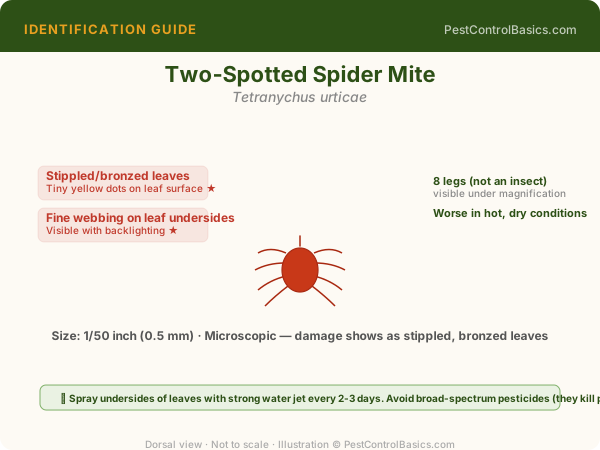
📐 FIELD GUIDE ILLUSTRATION
Spider Mite (Tetranychidae) identification illustration with labeled anatomical features — PestControlBasics.com

Original illustration by PestControlBasics.com. Use anatomical labels above to confirm your identification.

Identification

Webbing + stippling is the diagnostic combination

Spider mites damage plants in a specific, recognizable pattern. Individual feeding punctures remove chlorophyll from leaf cells, creating tiny yellow or white dots (stippling) on the upper leaf surface. As the infestation intensifies, leaves take on a bronzed, dusty, or gray-silver appearance before yellowing and dropping.

The webbing test: Fine, silk-like webbing on leaf undersides and between leaves confirms spider mites. Run your finger across the underside of a stippled leaf — if you feel silk strands or see tiny specks moving, you have spider mites.

The paper test: Hold a white piece of paper under a suspected leaf and tap it sharply. Tiny specks that fall and begin moving on the white paper are spider mites.

Conditions that favor outbreaks: Spider mites thrive in hot (above 85°F), dry, dusty conditions. Drought stress on plants creates conditions ideal for rapid mite population growth. Dusty leaves (from road dust or soil splash) interfere with natural predator activity. Overuse of broad-spectrum pesticides eliminates predatory mites that naturally keep spider mite populations in check.

Control

Water spray first, then escalate if needed

Strong water spray: First and most important step. A forceful spray to leaf undersides physically removes mites, disrupts webbing, and raises humidity (which spider mites hate). Do this every 2–3 days on all affected plants. Many infestations can be managed with water spray alone if started early.

Increase humidity: Spider mites thrive in dry conditions. Increasing ambient humidity around plants through regular misting, grouping plants together, or adding a pebble tray with water slows mite reproduction significantly.

Neem oil: 2 tablespoons neem oil + 1 tsp dish soap per gallon water. Apply to all leaf surfaces especially undersides. Disrupts mite development and has some ovicidal (egg-killing) activity. Repeat every 5–7 days.

Insecticidal soap: Kills mites on contact. Must coat the mites directly. No residual. Effective but requires thorough application and repeated treatment.

Predatory mites (Phytoseiidae): Commercially available Neoseiulus californicus or Phytoseiulus persimilis are natural predators of spider mites. Effective in greenhouse settings and in organic gardens. Purchase from biocontrol suppliers.

✕ Avoid Pyrethroid Sprays

Pyrethrin and pyrethroid insecticides kill predatory mites much more effectively than they kill spider mites — using them actually worsens spider mite infestations by removing the natural biological control. If you must use an insecticide, use products specifically labeled as miticides (bifenazate, abamectin).

DG
Derek Giordano
Certified Pest Control Operator · Former Business Owner
Derek ran his own pest control company in Florida for several years, servicing thousands of regular customers. All content is based on hands-on field experience and current EPA & university extension guidelines.

Related Resources

📚 Full Pest Library🧪 DIY vs. Pro Quiz💰 Cost Guide🌿 IPM Guide🔍 Find a Pro
🔗 Related Pests
Velvet Mite Rat Mite Grain Mite Varroa Mite
Compare similar pests to confirm your identification. → Use our ID Flowchart
🔮
Reviewed by Derek GiordanoContent on PestControlBasics.com is developed with input from certified pest management professionals and cross-referenced against EPA, CDC, and university extension guidance. Last reviewed: April 2026.
📚 Sources: CDC Venomous Spiders · EPA Safe Pest Control
Published: Jan 1, 2025 · Updated: Apr 7, 2026

Identifying medically significant spiders

Black widows (in their range) are identifiable by a shiny black body with a distinctive red hourglass on the underside of the abdomen — only adult females are medically significant. They build messy, irregular webs in undisturbed locations: woodpiles, sheds, basement corners, under outdoor furniture, in garage clutter. Brown recluse spiders (in their range, mostly south-central U.S.) have a violin-shaped marking on the back of the cephalothorax and only six eyes (most spiders have eight). They hide in undisturbed indoor areas — stored boxes, shoes left in closets, behind picture frames. Both species are non-aggressive and bite only when pressed against skin (rolled in clothing, pressed when reaching into stored items). The vast majority of suspected bites of either species are misidentifications — wound culture and physician evaluation is usually the right step rather than self-diagnosis.

How professional pest control programs differ from one-off treatments

A single treatment — DIY or professional — addresses what's visible today, but most pest pressure is cyclical. Professional pest control programs that work long-term are structured around inspection, monitoring, treatment, and follow-up as a recurring cycle rather than discrete events. The inspection phase identifies conducive conditions (moisture, harborage, food access, exclusion gaps) that one-time treatments don't address. The monitoring phase uses sticky traps, bait stations, or visual sweeps to catch population rebounds early, before they become visible infestations again. The treatment phase targets the specific life stages active during that visit — different than blanket spraying everything. The follow-up phase verifies treatment efficacy and adjusts. Homeowners can replicate this structure on a quarterly or seasonal schedule without buying expensive equipment, and the underlying logic — track, treat targeted, verify — produces consistently better results than reactive treatment after problems become obvious.

Exclusion and habitat reduction for spiders

Spiders enter homes seeking either food (other insects) or shelter. Reducing both reduces spider populations more durably than recurring spray. Sealing entry points — window screens in good repair, weatherstripping at door bottoms, caulking gaps in exterior walls — keeps the broader spider population outside. Indoor habitat reduction: eliminate cluttered storage areas where spiders can build undisturbed webs, vacuum corners and ceiling junctions regularly, and reduce ambient insect populations (since spiders follow their prey). Outdoor habitat that supports spider populations near the structure — stacked firewood against the house, dense ivy or shrubs on exterior walls, accumulated yard debris — can be moved or cleared. These changes are durable and reduce the need for spider-specific treatment to occasional cleanup.

Treatment options for spider hotspots

Where spider populations are concentrated in specific areas and need active reduction, residual pyrethroids (bifenthrin, lambda-cyhalothrin, deltamethrin) applied to harborage areas — corners, eaves, behind shutters, in garage perimeters — provide several weeks of residual. Spider control sprays at retail often use the same actives at similar rates. For garage and shed environments where black widows are a concern, a residual treatment applied at the start of warm season and refreshed mid-season meaningfully reduces population through fall. Direct contact treatment of webs and visible spiders works but doesn't address the broader population. Knockdown aerosols are appropriate for individual spider removal but don't provide ongoing protection.

Common DIY mistakes that defeat otherwise correct treatments

Most DIY pest control failures aren't product failures — they're application failures. The recurring patterns we see across reader emails and field experience: treating only where pests are visible rather than where they live (the active surface is rarely the harborage), spraying repellents over residual products and breaking the residual film, applying baits in already-treated areas (the residual kills foragers before they return with bait), overdiluting product because 'less chemical is safer' (it's not — it accelerates resistance), expecting overnight results when the kill curve is two to four weeks for most products, and stopping treatment at the first sign of improvement rather than completing the protocol. Each of these failure modes is independently preventable with attention to the product label and the pest's biology, and avoiding them improves outcomes more than upgrading to a more expensive product.

Spider control without insecticide: physical exclusion that works

Spider populations in homes respond strongly to non-chemical interventions, and many homeowners find that targeted physical exclusion produces better results than chemical treatment. The high-yield interventions: vacuum existing webs and visible spiders weekly during peak season (typically late summer to fall, when spiders are most visible), which both removes individuals and disrupts the conditions that support web maintenance; reduce exterior lighting or convert to yellow 'bug light' bulbs (which attract fewer insects, reducing the food supply that draws spiders); seal gaps around windows, doors, and utility penetrations with appropriate weatherstripping and caulk; trim vegetation away from the structure to eliminate access bridges; declutter basements, garages, and storage areas to reduce harborage. These interventions address the underlying drivers of spider populations — insect prey availability and harborage availability — rather than just killing individuals, producing more durable reduction. Chemical treatment of spiders is generally less effective than against most insects because spiders walk on relatively few surfaces (mostly the points where they anchor webs) and don't pick up residue from broad-coverage applications.

Building a pest control file: documentation that compounds over years

Most homeowners treat pest issues episodically and lose information between events. Building a simple ongoing pest file — even a single document in a notes app or folder of photos — produces compounding benefits across years of property ownership. The contents that matter: date and location of every notable sighting, identification (with photos where possible), treatment applied and product names used, professional service records and warranty terms, structural sealing work performed and where, drainage and moisture correction work performed, and observations across seasons. Over two or three years, patterns emerge that aren't visible in single incidents: which months reliably bring ant activity, which exterior corner gets wasps every spring, which entry points keep failing, which products actually worked versus which were tried and abandoned. This file becomes useful at property sale (documenting professional treatment and remediation), at insurance claim time (documenting pre-existing conditions or treatment history), and at any future pest problem (where past records narrow the diagnostic space immediately). The effort to maintain is minimal — a few minutes per incident — and the cumulative information value substantial.

Identifying dangerous spiders: brown recluse and black widow specifics

The two North American spider species with medically significant venom are black widow (Latrodectus species, multiple regional varieties) and brown recluse (Loxosceles reclusa, with related species in the southern U.S.). Both are commonly misidentified, leading to unnecessary alarm about harmless species and missed identification of actual specimens. Black widows are identifiable by the distinctive red hourglass on the underside of a glossy black abdomen in adult females; the body is roughly the size of a US dime including legs, and the spider is typically found in undisturbed locations like garages, sheds, basement corners, and outdoor stone walls. Brown recluse spiders have a violin-shaped dark marking on the cephalothorax, six eyes arranged in three pairs (most spiders have eight), uniform light brown coloration without complex patterns, and are found in undisturbed indoor areas particularly in the south-central states; many spider species are mistakenly identified as brown recluse. Photograph any candidate specimen before destroying it; local extension offices and online identification forums can confirm or deny identity quickly, which matters because medical management of confirmed bites differs from the wait-and-see approach appropriate for most spider bites.

Webbing identification: reading what spider activity looks like

Spider webbing varies by species in ways that are diagnostically useful when inspecting a property. Funnel weavers produce dense, sheet-like webs in corners and against walls, with a tunnel retreat at one end where the spider waits. Cellar spiders produce loose, irregular webs in protected corners of basements, garages, and ceilings, and individuals often hang inverted from the web. Cobweb spiders, including black widows, produce tangled, irregular webs in concealed locations — wood piles, garden sheds, outdoor furniture undersides, basement corners — and the web structure is messy by design rather than from neglect. Orb weavers produce the familiar circular webs in vegetation and open spaces, typically outdoors. Reading the webbing in an inspection tells you which species are present without necessarily seeing the spiders themselves, which is useful both for risk assessment (only a few species are medically significant in residential settings) and for treatment planning (different species respond to different control approaches). The presence of abandoned webbing also indicates historical activity that may have shifted to a different microhabitat, which can direct subsequent inspection effort more productively than treating each visible web as a separate problem.

Coordinating pest control with renovation and construction work

Renovation work is one of the highest-value moments for pest intervention, and it's also one of the most consistently missed. When walls are open, when slabs are exposed, when crawlspaces are accessible, when sill plates are visible — these are the windows during which exclusion work, soil treatment, perimeter sealing, and harborage elimination can be done at a fraction of their normal cost and with dramatically better completeness. The same caulk-and-foam exclusion job that takes hours of awkward work after the fact can be done in minutes when the wall cavity is open. A pre-construction termite soil treatment is dramatically more effective than any post-construction equivalent, but it has to happen before the slab is poured. Even non-structural renovations like flooring replacement, kitchen rework, or basement finishing create windows during which the home's pest-relevant geometry can be improved. The cost of pulling in a pest professional during the renovation envelope, even just for an inspection and recommendations, is almost always recovered in reduced future treatment costs and avoided structural damage. The conversation to have with general contractors is whether they're willing to coordinate with a pest specialist during the open-wall phase, and most reputable contractors are, particularly on larger jobs where the small additional scheduling complexity is offset by the value-add for the homeowner.

Brown recluse harborage: the specific places to look

Brown recluse spiders inhabit a specific range of microhabitats that are worth knowing if you live in their native range — broadly, the central and southern United States. They prefer undisturbed, dry, dark locations: behind boxes in storage rooms, in stored clothing and linens, in shoes that haven't been worn, inside cardboard boxes in attics and basements, behind picture frames on infrequently-used walls, in seldom-opened cabinets, and inside infrequently-moved furniture. They actively avoid disturbed areas, which is why properties with regular human traffic in storage spaces have lower recluse populations than properties where storage areas are left undisturbed for months at a time. The practical implications for management are specific: rotating storage so nothing sits untouched for long periods, sealing stored clothing in plastic bins rather than cardboard boxes, shaking out shoes that have been stored, and using glue boards in known harborage locations to monitor population levels. Sprays are largely ineffective for recluse populations because the spiders don't traverse open treated surfaces; they're effective only when applied directly to harborage. Most successful recluse management programs are exclusion and inspection programs with insecticide as a minor component, not the other way around.

🗺️ US Distribution — Spider Mites

image/svg+xml
Common Occasional Not Present
States Present
49
Occasional
2
Primary Region
Continental US
📊 Source: University extension services, USDA, CDC vector data, and published entomological surveys.