On this page
How to identify it
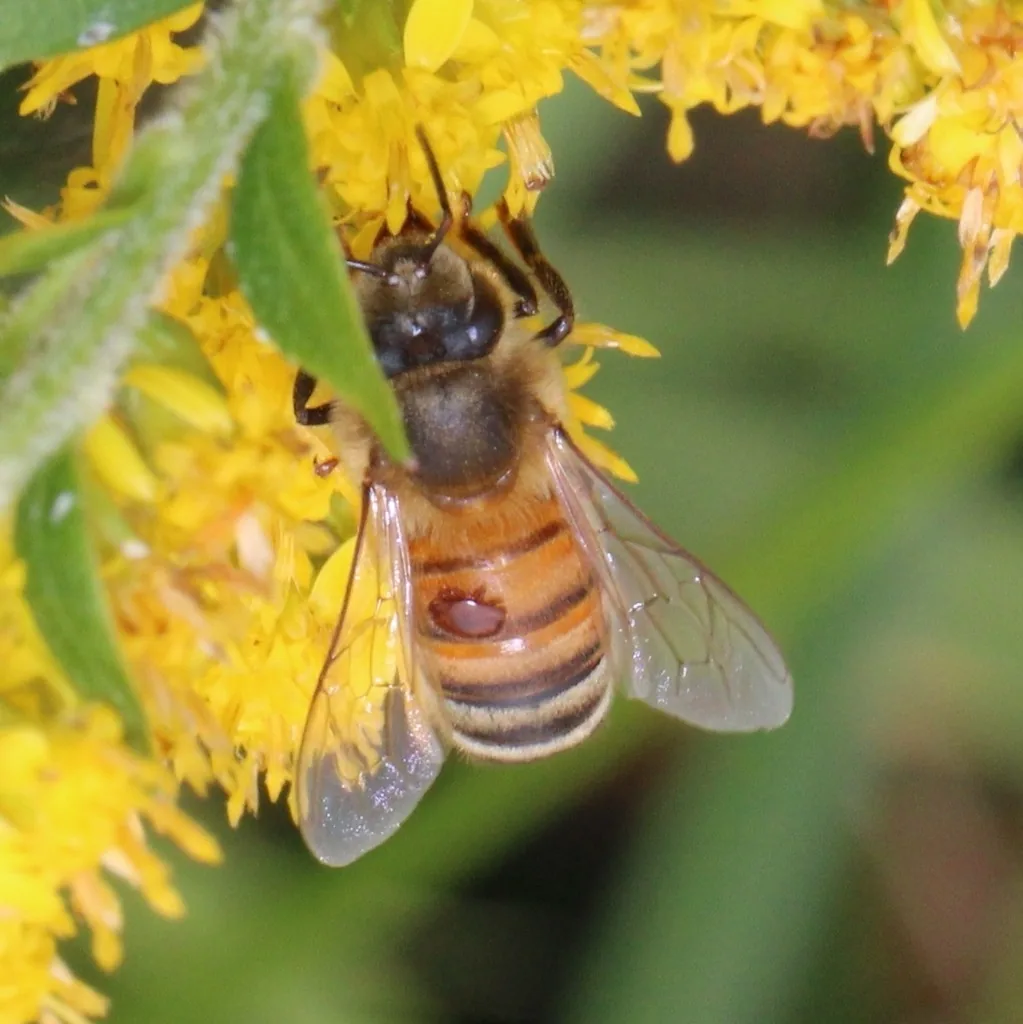
- In heavily infested hives the mites can be seen clinging to the bodies of adult bees.[1]
- Bees with crumpled, deformed wings are a warning sign, because the mites spread deformed wing virus.[1]
- By the time mites are easy to see, numbers are often already high, so beekeepers count them with a sampling method such as an alcohol wash or powdered sugar shake rather than waiting for symptoms.[3][1][4]
Where it lives
Originally from Southeast Asia and now established in the United States, where state agriculture departments and Extension services from Maine to Mississippi treat it as the most serious threat to honey bees.[3][2][1]
Biology and life cycle
A female mite reproduces inside a capped brood cell; her first egg becomes a male and later eggs become females, which develop alongside the growing bee.[3]
Mites feed on both adult bees and developing brood, and their numbers can grow quickly through the season.[1][3]
Damage and signs
- Feeding weakens the bees and spreads viruses, especially deformed wing virus; heavily infested colonies decline and can die.[1]
Health risk
It parasitizes honey bees only; none of the sources reports any risk to people or pets.[1][3]
Control
Prevention
Check mite levels regularly, monthly through the season according to Delaware and at least twice a year according to Mississippi State, with an alcohol wash: shake a sample of adult bees in 70 percent rubbing alcohol or soapy water and count the mites that fall out.[1][2]
Mississippi State recommends treating when counts exceed 1 mite per 100 bees in February or 3 mites per 100 bees from May through October, which leaves time to protect the bees that will overwinter.[2]
Biological control
Non-chemical tools include brood interruption and mite-resistant bee stocks such as Varroa Sensitive Hygienic, Russian and Minnesota Hygienic bees.[3]
Pesticides
Miticides labeled for honey bee colonies, such as formic acid strips and other 'soft' treatments that act for 3 to 10 days, are used when counts pass the threshold; rotate products to slow resistance and follow the label.[3][2]
Common questions
- How do I check my hive for Varroa mites?
- Use an alcohol wash: shake a sample of adult bees from a brood frame in 70 percent alcohol or soapy water, count the mites and compare the count with a treatment threshold.[2][1]
- When should I treat for Varroa mites?
- Mississippi State uses thresholds of 1 mite per 100 bees in late winter and 3 per 100 from May through October; treating in time protects the winter bees.[2]
Sources
- Delaware Department of Agriculture, “Varroa Mites (June 2023).” agriculture.delaware.gov/wp-content/uploads/sites/108/2023/06/Varroa-Mites_Final_6.12.23.pdf (accessed 2026-10-17)
- Mississippi State University Extension, “Sampling for Varroa Mites Using an Alcohol Wash (P4049, J. Harris).” web.archive.org/web/20241031082520/http://extension.msstate.edu/node/61293 (accessed 2026-10-17). Archived copy (Internet Archive, captured 2024-10-31); the original page https://extension.msstate.edu/node/61293 returns 404 (page removed or moved).
- Maine Department of Agriculture, Conservation and Forestry, “Honey bee pests: Varroa mite (State Apiarist fact sheet).” www.maine.gov/dacf/php/apiary/documents/factsheets/pests.pdf (accessed 2026-10-17)
- Virginia Cooperative Extension, “Varroa Mite Sampling Methods (ENTO-332, 2025).” aaec.vt.edu/content/dam/pubs_ext_vt_edu/ENTO/ento-332/ENTO-332.pdf (accessed 2026-10-17)
- iNaturalist, “Varroa destructor taxon page (order and family).” www.inaturalist.org/taxa/194693 (accessed 2026-10-06)