On this page
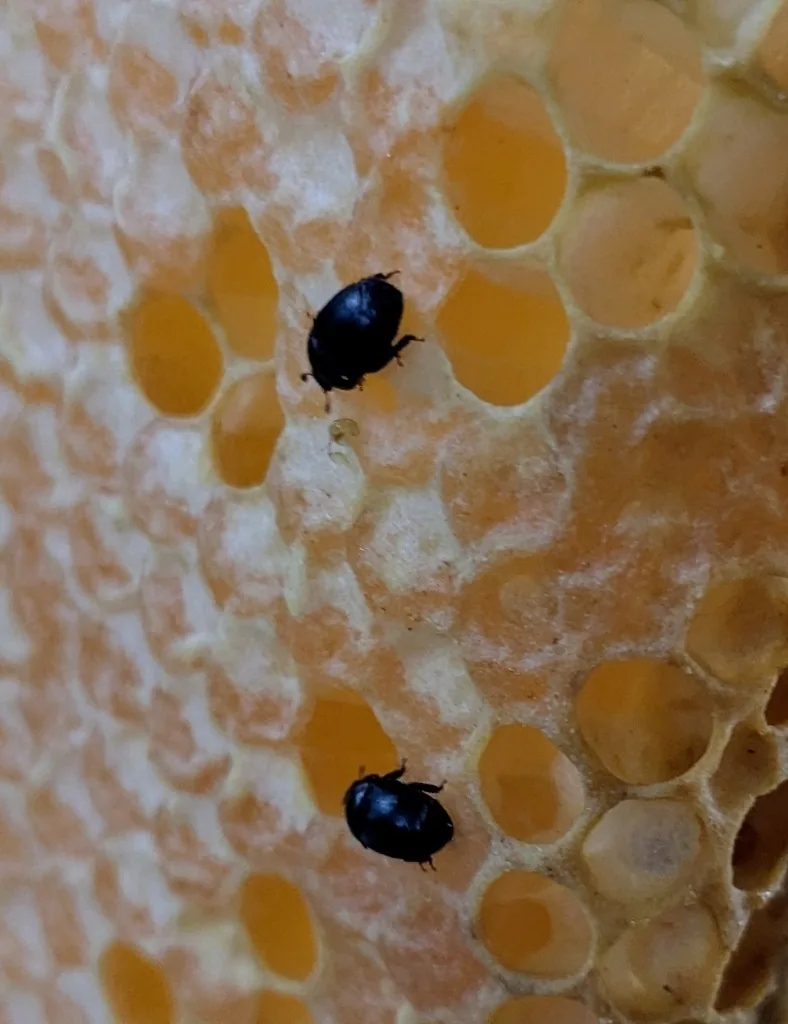
How to identify it
Look-alikes
| Look-alike | How to tell them apart |
|---|---|
| Sap beetles | Related sap beetles in the same family can be mistaken for small hive beetles.[2] |
Where it lives
Confirmed in Florida in 1998 and now reported in 35 states, Canada, Australia and Mexico; it favors hot, humid climates.[1][2]
Biology and life cycle
Females lay eggs in cracks in the hive or in cells with brood or bee bread; eggs hatch in two to four days.[1][2]
Grown larvae leave the hive and pupate about 4 inches deep in soil for three to six weeks; adults then fly to new colonies.[1][2]
Damage and signs
Health risk
No risk to people; it is a pest of honey bee colonies.[1][2]
Control
Prevention
Keep colonies strong and the apiary clean of abandoned combs and dead-out equipment.[2]
Keep them out
Placing hives on rocky or clay ground or on platforms keeps larvae from reaching soil to pupate.[2]
Sanitation
Freeze frames with beetle eggs or larvae for at least 48 hours, and keep honey houses clean.[2]
Common questions
- Why is the honey in my hive slimy?
- Small hive beetle larvae feeding in combs cause slimy, fermenting honey.[2]
Sources
- University of Florida IFAS Extension (EDIS, Featured Creatures), “Small Hive Beetle, Aethina tumida (EENY-474).” ask.ifas.ufl.edu/publication/IN854 (accessed 2026-10-16)
- Oregon State University Extension, “The Small Hive Beetle: A Potential Pest in Honey Bee Colonies in Oregon (EM 9143).” extension.oregonstate.edu/catalog/em-9143-small-hive-beetle-potential-pest-honey-bee-colonies-oregon (accessed 2026-10-16)
- iNaturalist, “Aethina tumida taxon page (order and family).” www.inaturalist.org/taxa/457066 (accessed 2026-10-06)