On this page
How to identify it
- Larvae tunnel through the comb, preferring old brood comb rich in pollen and bee bread, and leave silk webbing, trails and droppings; young larvae often escape a beekeeper's notice.[1][3]
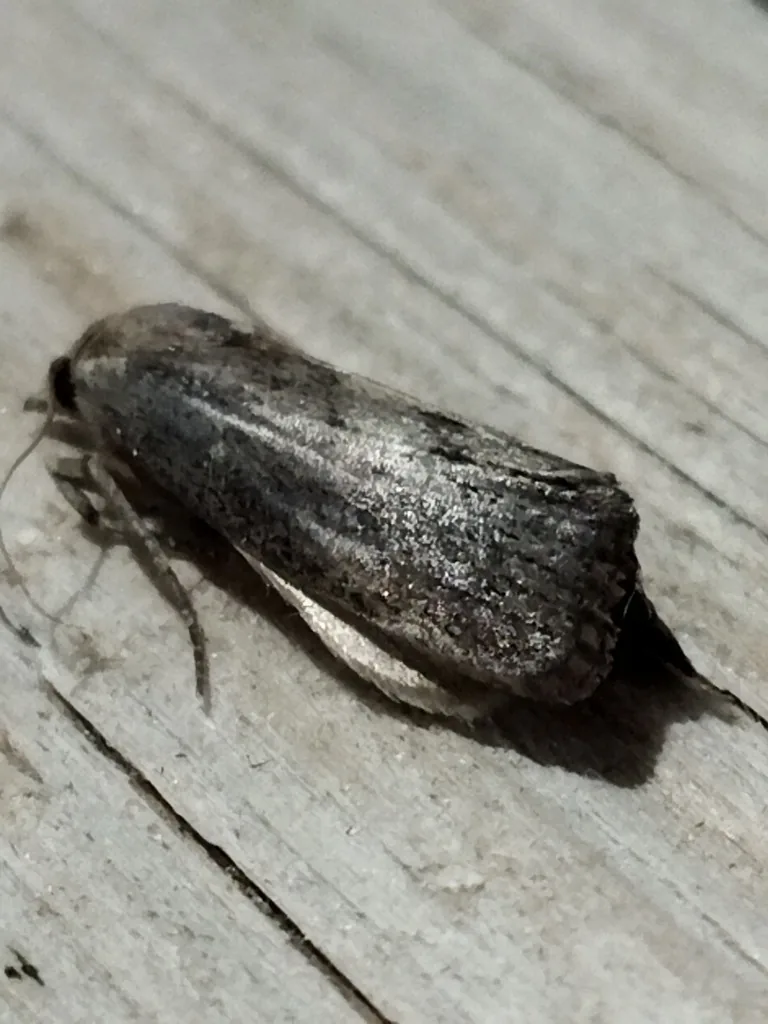
- Lesser wax moth adults are about 1/2 inch long, and their larvae are smaller than those of the greater wax moth.[4][1]
- Young wax moth larvae are often confused with small hive beetle larvae.[1]
Look-alikes
| Look-alike | How to tell them apart |
|---|---|
| Small hive beetle | Its larvae can look like young wax moth larvae in the comb; Mississippi State compares the two side by side.[1] |
Where it lives
Major pests of honey bee colonies in Florida and Mississippi and covered by Utah's agriculture department; the lesser wax moth does best in warmer tropical and subtropical climates.[2][1][3][4]
Biology and life cycle
The greater wax moth does most of the damage to stored combs and woodenware.[1]
Weak, diseased or queenless colonies and combs in storage are the most vulnerable; strong colonies keep the moths in check.[2][3]
Damage and signs
Health risk
They feed on beeswax and comb only; none of the sources reports any risk to people or pets.[1][2]
Control
Prevention
The best defense in living colonies is keeping them strong, free of other diseases and pests, and queenright.[2]
Traps and physical control
Freeze stored combs to kill all stages, then keep them in sealed, moth-proof storage so they aren't reinfested.[1][4][2]
Pesticides
For stored comb, the fumigant paradichlorobenzene (sold as Para-Moth) is registered for stored comb only, not comb honey, and a Bacillus thuringiensis product that targets moth larvae can be applied to comb; never use naphthalene mothballs.[3][1]
Common questions
Sources
- Mississippi State University Extension, “Wax Moths, Greater and Lesser (Publication 3195).” extension.msstate.edu/sites/default/files/publications/P3195_web.pdf (accessed 2026-10-17)
- UF/IFAS Extension (EDIS), “Wax Moth Control (AA141, C. J. Jack and J. D. Ellis, 2018).” edis.ifas.ufl.edu/publication/AA141 (accessed 2026-10-17)
- Utah Department of Agriculture and Food, “Wax Moth (Fact Sheet V1.0, March 2023).” web.archive.org/web/20250615070508/ag.utah.gov/wp-content/uploads/2023/03/UDAF-Wax-Moth-Fact-Sheet-V1.0.pdf (accessed 2026-10-17). Archived copy (Internet Archive, captured 2025-06-15); the original page https://ag.utah.gov/wp-content/uploads/2023/03/UDAF-Wax-Moth-Fact-Sheet-V1.0.pdf returns 404 (file removed).
- UF/IFAS Extension (EDIS), “Lesser Wax Moth, Achroia grisella (Featured Creatures, IN1108).” edis.ifas.ufl.edu/publication/IN1108 (accessed 2026-10-17)
- iNaturalist, “Galleria mellonella taxon page (order and family).” www.inaturalist.org/taxa/122940 (accessed 2026-10-06)