On this page
How to identify it
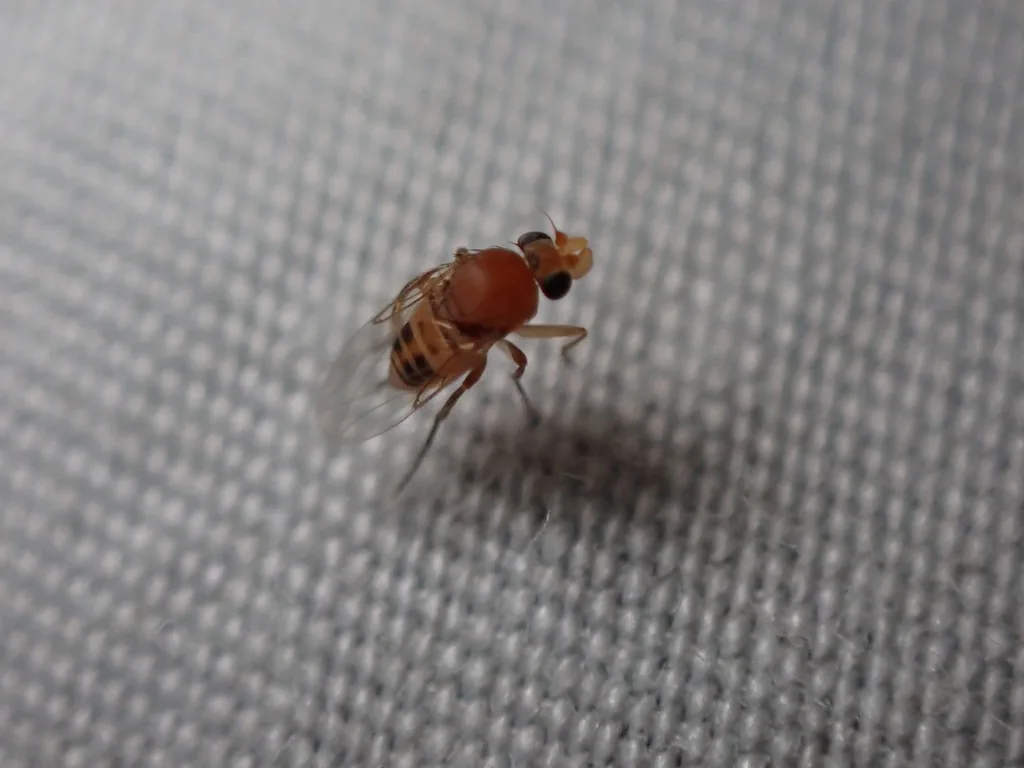
- Adults are only 2.0 to 2.9 mm long (about 1/10 inch) and can look like small fruit flies. The body is pale yellow with an orange patch in the middle of the abdomen; the abdominal segments carry brown patches that get larger toward the rear, and the fifth segment is all brown.[1]
- The wings are clear and narrow with few veins, and the upper edge has a fine fringe of long hairs out to about the middle. The female's egg-laying tube is brownish black with a pale tip.[1]
- Full-grown maggots are smooth, pale yellow and about 3.5 mm long. They crawl out of a dead bee at the joint between the head and thorax, and form small brown to amber pupae under 2 mm long.[1]
- Signs at a hive: honey bees leaving the hive at night, gathering at nearby lights, moving in a disoriented way and dying within hours.[1][2]
Look-alikes
| Look-alike | How to tell them apart |
|---|---|
| Phorid flies (scuttle flies) | Most phorids that people notice are scavengers that breed in decaying matter. The zombie fly belongs to a group that parasitizes insects other than ants, and it is found developing inside bees and wasps.[1] |
| Fire ant decapitating flies | Related phorid flies that parasitize fire ants rather than bees.[1] |
| Small fruit flies | To an untrained eye, adult zombie flies may look like small fruit flies.[1] |
Where it lives
A North American species. It has been collected from host insects in the western and eastern United States and Canada. In honey bees it has been confirmed along the West Coast and in South Dakota and Vermont; one South American record may be an error.[1]
Biology and life cycle
Its usual hosts are bumble bees and wasps, including paper wasps and yellowjackets; in California the bumble bees Bombus vosnesenskii and B. melanopygus are commonly attacked. It can also parasitize many other arthropods.[1][3]
A female lands on a host and pushes her egg-laying tube into its abdomen for 2 to 4 seconds. The maggots feed inside the bee.[1]
About seven days after the eggs are laid, 1 to 13 mature maggots emerge from each dead host and pupate away from it. Adults emerge after a pupal stage of about 28 days.[1][2]
In California urban gardens, bumble bees were parasitized more often than honey bees and produced nearly twice as many fly pupae per bee. Parasitism of both rose where honey bees were more abundant and where trees and shrubs were more plentiful.[3]
In San Francisco, honey bee parasitism rose and fell through the year, with peaks in mid-September, February, late March and early May; in early May more than half of the bees sampled were parasitized.[4]
Damage and signs
- Each parasitized bee dies. In the San Francisco Bay Area, the fly was found at 77% of the honey bee sites sampled, and it was detected in commercial hives in South Dakota and California's Central Valley.[2][1]
- Fly maggots and adults tested positive for deformed wing virus and Nosema ceranae, so the fly may carry or harbor these honey bee pathogens. How much it affects whole colonies, and native pollinators, is still not known.[2][1]
Health risk
It is a parasite of bees and wasps; the sources do not describe it bothering people.[1][2]
Control
Prevention
Beekeepers can check for infection by placing a light trap near a hive to collect bees that leave at night, then holding them to see whether fly maggots emerge.[1][4]
No proven control exists yet. Research continues, and the fly's spread, host interactions and susceptibility to insecticides are still unknown.[1]
Common questions
- Why are my honey bees flying to the porch light at night and dying?
- Bees infected by the zombie fly leave the hive at night, are drawn to lights, act disoriented and die within a few hours. Maggots usually come out of a dead infected bee about a week after it was parasitized, from the joint between the head and thorax, so holding some of the dead bees for a while can confirm it.[1][2][4]
- Is the zombie fly new?
- No. It was already known as a parasite of bumble bees and wasps in North America. What was new in 2012 was the discovery that it also attacks honey bees.[1][2]
Sources
- University of Florida/IFAS Extension (Featured Creatures), “Zombie Fly (suggested common name) Apocephalus borealis Brues, EENY605 (N. A. Casuso, A. N. Mortensen and J. D. Ellis; October 2014).” journals.flvc.org/edis/article/view/129015 (accessed 2026-11-09)
- PLoS ONE (via NCBI PubMed), “A new threat to honey bees, the parasitic phorid fly Apocephalus borealis (A. Core et al.; PLoS ONE 7(1): e29639, 2012; abstract).” pubmed.ncbi.nlm.nih.gov/22235317/ (accessed 2026-11-09)
- Environmental Entomology (via NCBI PubMed), “Vegetation Management and Host Density Influence Bee-Parasite Interactions in Urban Gardens (Environmental Entomology, 2017; abstract).” pubmed.ncbi.nlm.nih.gov/29069309/ (accessed 2026-11-09)
- Insects (via NCBI PubMed), “A Note on the Honey Bee Parasitic Phorid Fly (Apocephalus borealis Brues) in an Urban Ecosystem (Insects, 2025; abstract).” pubmed.ncbi.nlm.nih.gov/40870566/ (accessed 2026-11-09)
- iNaturalist, “Apocephalus borealis taxon page (order and family).” www.inaturalist.org/taxa/417247 (accessed 2026-11-09)