HomePest LibraryAphids
Garden Pest — Beneficial Insects Help
🪲

Aphids

Aphididae — Multiple species

Soft-bodied, pear-shaped, and devastatingly effective at reproducing. A single aphid can give birth to 80 live offspring per week without mating. They suck phloem sap, causing curled leaves and stunted growth, then excrete honeydew that grows black sooty mold. Ladybugs and parasitic wasps are your best allies.

ReproductionSingle aphid: 80 live young/week — no mating needed
DamageSap feeding → curled leaves + sooty mold
Natural enemiesLadybugs: 5,000 aphids/lifetime
Best controlWater spray, neem oil, encourage beneficials
ColorsGreen, black, gray, pink, white — varies by species
📐 FIELD GUIDE ILLUSTRATION
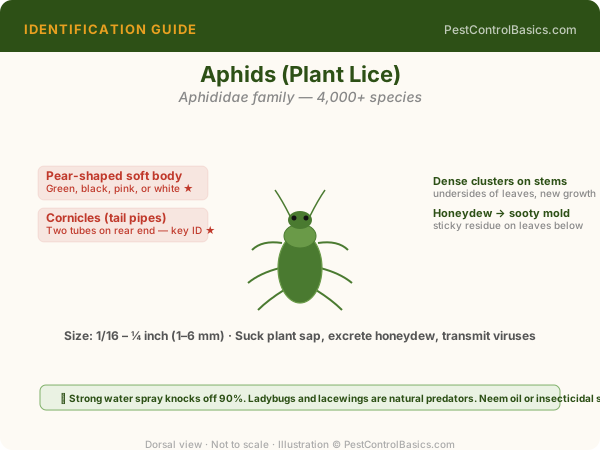
Aphids identification illustration with labeled anatomical features — PestControlBasics.com

Original illustration by PestControlBasics.com. Use anatomical labels above to confirm your identification. For photo references, see the identification section below.

Biology

The explosive reproduction problem

Aphids have one of the most remarkable reproductive strategies in the insect world. In spring and summer, females reproduce by parthenogenesis — giving birth to live female offspring without mating. These offspring are born already pregnant. A single aphid in optimal conditions can produce a colony of thousands within weeks.

Identification by plant location: Aphids cluster on the underside of leaves and on new growth — the youngest, most tender plant tissue with the most accessible phloem. Curling or puckering of new leaf growth, often with a sticky residue on leaves below, is the first visible sign.

Sooty mold: The honeydew aphids excrete as a byproduct of sap feeding falls on lower leaves and surfaces below the infestation, where a black fungus (sooty mold) grows on it. The mold itself doesn't damage plants but blocks sunlight and indicates a significant aphid population above.

Ant farming: Many ant species actively protect aphid colonies from predators in exchange for honeydew — this is why ants are often found on aphid-infested plants. Controlling ants near garden plants (sticky bands around trunks) improves natural predator access to aphids.

Control

Encouraging predators vs. direct treatment

Strong water spray: The simplest and most immediate treatment. A strong stream of water from a garden hose dislodges aphids from stems and leaves. Aphids that fall cannot climb back to the plant. Effective for small to moderate infestations when done every 2–3 days.

Neem oil spray: Mix 1–2 tablespoons neem oil + 1 teaspoon dish soap per gallon of water. Apply to all plant surfaces including undersides of leaves. Neem disrupts aphid development and reproduction. Most effective on nymphs; repeat every 5–7 days.

Insecticidal soap: Directly kills aphids on contact by disrupting their cell membranes. Must contact the pest directly — no residual. Apply in early morning or evening to avoid leaf burn.

Encouraging natural enemies: Plant flowers that attract beneficial insects near the garden — dill, fennel, yarrow, sweet alyssum. Avoid broad-spectrum insecticides that kill ladybugs, lacewings, and parasitic wasps. A single ladybug eats 50–60 aphids per day and 5,000+ in its lifetime. Lacewing larvae are similarly voracious.

💡 Never Use Systemic Insecticides on Flowering Plants

Imidacloprid and other systemic insecticides applied as soil drenches are taken up into all plant tissues including pollen and nectar. On flowering plants, this kills pollinators. Use only contact sprays (neem, soap) on flowering plants, and only when bees are not actively foraging.

DG
Derek Giordano
Certified Pest Control Operator · Former Business Owner
Derek ran his own pest control company in Florida for several years, servicing thousands of regular customers. All content is based on hands-on field experience and current EPA & university extension guidelines.

Related Resources

📚 Full Pest Library🧪 DIY vs. Pro Quiz💰 Cost Guide🌿 IPM Guide🔍 Find a Pro
🔮
Reviewed by Derek GiordanoContent on PestControlBasics.com is developed with input from certified pest management professionals and cross-referenced against EPA, CDC, and university extension guidance. Last reviewed: April 2026.
📚 Sources: UC IPM Aphids · EPA Safe Pest Control
Published: Jan 1, 2025 · Updated: Apr 7, 2026

Sources used across this site

Editorial sources used consistently across this site: the EPA pesticide registration database for current product use directions and active ingredient information; CDC for public health context on pest-borne disease; the National Pesticide Information Center (NPIC) for homeowner pesticide questions; university Cooperative Extension publications (UC IPM, NC State Extension, Penn State Extension, University of Florida IFAS, and others) for region-specific identification and treatment guidance; the National Pest Management Association (NPMA) for industry context; and peer-reviewed entomological literature for biology, resistance management, and emerging issues. Product reviews reflect editorial testing and aggregated user-reported outcomes rather than manufacturer-supplied claims. Where regional information matters, we link to state and local extension publications rather than generalizing across regions.

Reading pesticide labels: what most homeowners miss

The pesticide label is the most important document in any pest control decision, and it's the document most people skim. Under FIFRA (the federal law that governs pesticide registration), the label is legally binding — using a product inconsistent with its label is a violation, regardless of intent. The label has several sections that homeowners should read fully before purchase, not after: the use sites (where it can legally be applied), the target pests (some products legal indoors are not for the specific pest), the mixing rate (overdosing wastes product without improving efficacy and increases drift risk; underdosing accelerates resistance), the PPE requirements (some require respirators, not just gloves), and the re-entry interval (how long until the treated area is safe for people and pets). The signal word — Caution, Warning, Danger — indicates acute toxicity but not chronic risk; that's elsewhere on the label. Reading labels well prevents nearly every common DIY misapplication.

How content is reviewed and updated

Content on this site is reviewed by Derek Giordano, a former pest control company owner and previously licensed Pest Control Operator in Florida with several years of field experience servicing thousands of regular customers. Reviews check treatment recommendations against current EPA-registered products and label use directions, cross-reference major treatment claims against university extension publications and CDC public health guidance, and verify that any product mentions reflect current registration status and reasonable consumer availability. Pages get updated as treatment recommendations evolve — pesticide products are deregistered, resistance patterns shift, regional pest distributions change. The 'Updated' date at the bottom of each page reflects the most recent review pass on that specific page; the site-wide approach to E-E-A-T (experience, expertise, authoritativeness, trustworthiness) follows Google's published guidance on health and safety topics.

How to use this guide effectively

This guide is one entry point in a connected library. Each pest profile, treatment guide, and tool on this site links to related references that go deeper than any single page can. Working through a pest problem effectively usually means starting with identification (so you know what you're treating), reading the species-specific treatment guide, checking the product or tool references for specific selection guidance, and confirming approach with the FAQ and troubleshooting sections. Bookmarking a few core references — the species profile, the relevant treatment guide, and one tool that supports the decision-making (product selector, cost estimator, treatment schedule) — gives you a workflow you can return to as the situation evolves. The structure is intentional: surface-level summary first, then increasing depth, with the deepest detail in the dedicated tool and reference pages.

How resistance develops and how to slow it down

Pesticide resistance is now common enough across major pest categories — cockroaches, bedbugs, mosquitoes, certain ant species, some flies — that treatment recommendations have shifted to account for it. Resistance develops through repeated exposure to a single active ingredient class; the surviving population reproduces, and over generations the population shifts toward resistance. Slowing resistance development requires rotating active ingredient classes (not just brands), using full label rates rather than reduced rates, and avoiding routine prophylactic spraying when it isn't needed. The EPA mode-of-action (MoA) classification on product labels helps with rotation: alternating between products in different MoA classes is more effective than alternating brand names within the same class. For homeowners, the practical translation is: don't use the same product month after month; if you're spraying regularly, rotate among at least two unrelated chemistries; and don't spray when monitoring suggests no active population.

Integrated pest management for households: the practical hierarchy

Integrated pest management (IPM) is a structured approach to pest control developed for agricultural and commercial settings that translates well to residential use. The hierarchy: prevention first (sanitation, exclusion, habitat modification to make conditions unfavorable for pests), monitoring second (sticky monitors, visual inspection, identifying pests at low population before infestation establishes), targeted intervention third (using the least disruptive effective method against an identified pest in an identified location), and broad chemical treatment last (when targeted approaches have failed or aren't feasible). The hierarchy matters because higher-level interventions are durable and address root causes, while lower-level chemical interventions address symptoms and require repeat application. Most residential pest control reverses this hierarchy — chemical treatment first, sometimes prevention later — and produces the predictable consequence of recurring problems. Households that adopt the IPM hierarchy (often without using the term) generally describe spending less time and money on pest issues over years even though specific incidents might take more thought to address than spray-and-forget approaches.

The cost of doing nothing: implicit pest tolerance and its hidden expenses

Pest control discussions usually frame the costs of treatment without quantifying the costs of non-treatment, but the latter are often larger and almost always less visible. Cockroach allergens add measurable healthcare costs in homes with asthma. Rodent activity in attics damages insulation (reducing R-value and adding seasonal heating and cooling costs) and creates fire risk through wire chewing that doesn't show up until something fails. Termite damage in unmonitored properties produces structural repair bills in the five-figure range, often discovered during unrelated renovation. Stored-product pests destroy food inventory at rates that aren't tracked because items are discarded individually rather than tallied. The cumulative cost of doing nothing isn't a single line item but a sum of small chronic losses across years. The framing that helps: pest control isn't a luxury expense layered onto a working baseline; it's a maintenance expense that competes with the slow accumulating cost of allowing a problem to continue. Households running the comparison honestly almost always find that modest preventive spending is the cheaper path.

Choosing a pest control company: questions worth asking

Pest control companies vary substantially in approach, training, and pricing, and the questions to ask before signing a contract often aren't the obvious ones. Worth asking: what's the technician's training and certification (state pest control certification is the floor; advanced training in IPM, structural inspection, or specific pest specialties is meaningful additional credentialing); what does the service include beyond visiting and spraying (inspection, monitoring, exclusion recommendations, follow-up scheduling); what guarantees apply if pests return between visits; what's the protocol for hard-to-resolve issues (some companies escalate to senior technicians or supervisors; others repeat the same approach); what active ingredients are used and whether the company will use specific products on request (homeowners with chemical sensitivities, pollinator gardens, or other concerns may want specific products); and what's the contract structure (per-visit, annual, multi-year). Worth less than expected: brand recognition and advertising spend (large national chains and small local operators both produce excellent and mediocre service); 'green' or 'organic' labels (which mean different things to different companies and often don't correspond to specific product or practice differences); price alone (typical pricing variance is modest, and the floor of cheap options often includes poor service).

Pest control and HOA dynamics: where they overlap

Homeowners' associations vary widely in how they engage with pest control, and the variations create practical issues that affect individual treatment decisions. Some HOAs maintain common-area pest treatment programs that handle perimeter spraying, mosquito treatment, or rodent monitoring on shared property; others leave all pest control to individual homeowners. Some have rules about treatment products or notification requirements; others don't. Some include treatment in the HOA fee structure; others bill separately. For homeowners in HOA communities dealing with persistent pest pressure, understanding what the HOA does and doesn't do is the first step in figuring out what additional individual action is needed. For HOAs without coordinated programs in areas with significant pressure, organizing a neighborhood-level treatment plan often produces dramatically better results than individual treatment efforts that don't coordinate timing or coverage. The conversations are sometimes politically awkward in HOA contexts, but the underlying problem — that some pests are neighborhood-scale and unit-level treatment can't address them — is structural rather than personal. Bringing the issue to an HOA meeting with concrete proposals tends to produce more constructive responses than complaint-style framing.

Annual pest control budgets: planning versus reactive spending

Most households treat pest control as an emergency expense rather than a line item, and the resulting spend is almost always higher than what a planned program would have cost. A property that allocates a modest annual budget toward inspections, preventive perimeter work, and one or two scheduled treatments at high-pressure times of year typically spends a fraction of what a comparable property spends on crisis response to a single major infestation. The math is straightforward: a moderate cockroach, rodent, or bed bug job typically costs more than a year of preventive service, and the labor and disruption costs to the household are not trivial either. Building a budget also forces the kind of structured thinking that catches problems early — when a homeowner has already decided to allocate funds, they're more willing to call for an inspection at the first ambiguous sign, rather than waiting until the situation is unambiguous and more expensive. The shift from reactive to planned spending is one of the highest-leverage changes a household can make in this category.

Understanding pest forecast reports and what they signal

Pest forecast reports — issued by some state agricultural agencies, cooperative extension services, and commercial pest control companies — are an underutilized resource for homeowners who want to anticipate rather than react to seasonal pest activity. These reports typically combine historical pest data, current weather conditions, and growing degree day calculations to predict when specific pests will emerge or peak in specific regions. A tick forecast for an upcoming spring season, a mosquito pressure forecast after a wet winter, a termite swarm prediction for a specific week in the Southeast — these aren't speculation but reasonably calibrated predictions based on biological timing. For homeowners, the value is in scheduling preventive treatment and personal protection to match the predicted high-pressure windows rather than reacting after problems have established. Subscribing to a regional pest newsletter from a cooperative extension service or state agriculture department is free or low cost and produces these forecasts during relevant seasons. The information is dramatically more actionable than generic pest control content because it's calibrated to your specific region and current conditions.

🗺️ US Distribution — Aphids

image/svg+xml
Common Occasional Not Present
States Present
49
Occasional
2
Primary Region
All agricultural regions
📊 Source: University extension services, USDA, CDC vector data, and published entomological surveys.