On this page
How to identify it
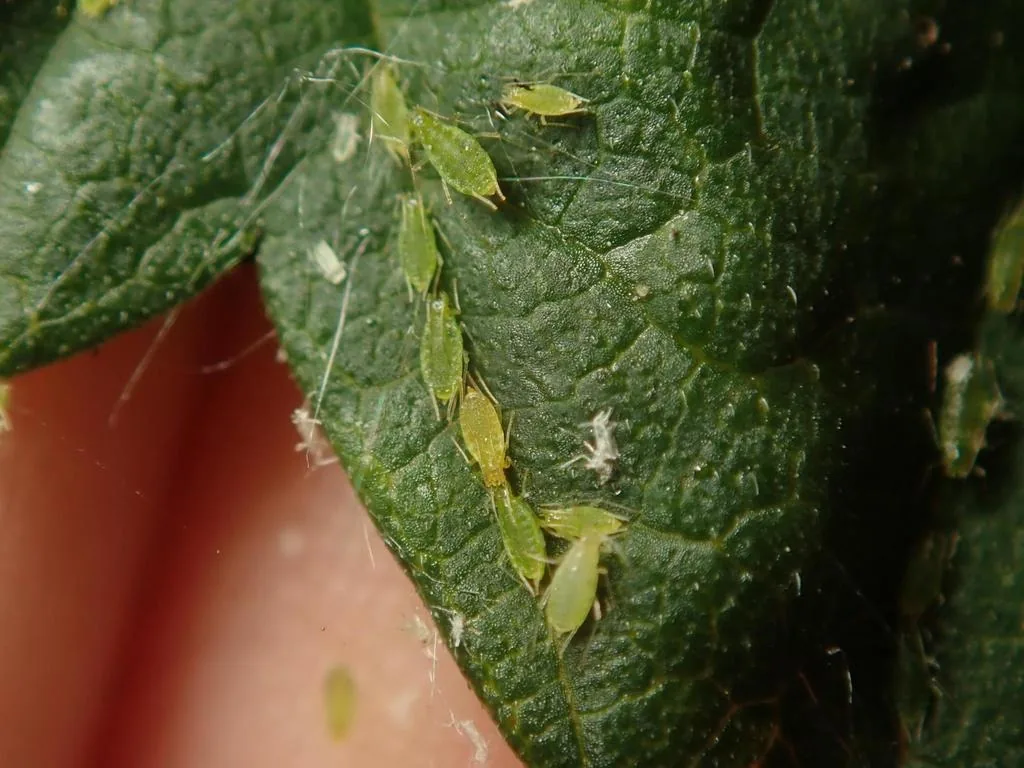
- Wingless hop aphids, the form that builds colonies on hops and on plum trees in spring, are pale yellowish green.[1][2]
- Winged forms are much darker: greenish to dark green or nearly black.[1][2]
- It is nearly identical to the cannabis aphid of hemp; the two can be told apart only by examining the front of the head under a microscope.[3]
Look-alikes
| Look-alike | How to tell them apart |
|---|---|
| Cannabis aphid | Looks almost the same as the hop aphid and is separated only by microscopic features of the head, such as horn-like projections at the antennal bases.[3] |
| Leafcurl plum aphid | Also infests plum and prune, but varies from shiny green to brownish green or brownish yellow, and its summer hosts are mostly plants in the aster family.[2] |
| Thistle aphid | Another plum and prune aphid; relatively large (about 0.1 inch) and shiny green with dark patches on its back.[2] |
Where it lives
In the United States it is a pest of hop yards in the Pacific Northwest, including Oregon, and it is one of the three major arthropod pests of hop production in the Northeast, where it has been studied in Vermont.[1][4][5]
Biology and life cycle
Eggs spend the winter in crevices and on twigs of Prunus trees. Plum and prune are the preferred winter hosts, though peaches and cherries are also used.[2]
The eggs hatch in late March, and several generations of wingless females feed and reproduce on the plum or prune trees before winged females migrate to hops in May.[2]
Several generations of wingless females live on hops, as late as August and September. Winged adults then fly back to Prunus trees, mate, and lay the overwintering eggs around buds, bud scales and cracks in the bark of twigs and shoots.[2]
The species has three winged migratory forms: spring migrants that fly to hops, and in the fall winged females that produce the egg-laying sexual females, and males, which respond most strongly to the species' sex pheromone components.[6]
In a nine-year study of a new Oregon hop planting, lady beetles were the predatory insects most closely tied to hop aphid numbers, and minute pirate bugs were present every year.[4]
Damage and signs
- On hops, the aphids suck plant juices and excrete honeydew that can contaminate the cones, especially when sooty mold colonizes the honeydew.[1]
- On plum and prune, aphid feeding on the shoot tips can stunt and deform the tips of young trees, heavy populations on older trees can reduce fruit set in later years, and honeydew promotes sooty mold on the fruit.[2]
Health risk
The sources describe it only as a plant pest; none mentions any risk to people or pets.[1][2]
Control
Prevention
On plum and prune, start checking shoots before budbreak. Control works best early in the season, while numbers are low and before emerging leaves curl around the colonies.[2]
Avoid over-fertilizing with nitrogen and over-watering fruit trees, which produce flushes of succulent growth that aphids favor.[2]
Traps and physical control
Home orchardists can wash aphids off with a strong stream of water or wipe them off by hand.[2]
Biological control
Lady beetles, syrphid fly larvae, minute pirate bugs, bigeyed bugs, damsel bugs, lacewing larvae and parasitic wasps attack aphids; avoid broad-spectrum insecticides that disrupt them.[2][4]
Natural enemies alone are often not enough in commercial hops: in the Oregon study, stable biological control of hop aphid was not reached in most years and aphicides were needed in 5 of 9 years.[4]
Pesticides
For commercial hops, the PNW handbook lists options that include the insect-killing fungus Beauveria bassiana, insecticidal soap (potassium salts of fatty acids), flonicamid, pymetrozine, spirotetramat, imidacloprid and several pyrethroids. Follow the label.[1]
Common questions
- Why do the aphids on my plum tree disappear in summer?
- Hop aphids spend spring on plum and prune trees, then winged females migrate to hops in May. They return to Prunus trees in the fall to lay the eggs that overwinter.[2]
- Is the hop aphid the same as the cannabis aphid?
- No. They are separate species that look almost the same; telling them apart takes a microscope look at the front of the head.[3]
- Can predators control hop aphids?
- They help, but a nine-year Oregon study found that natural enemies alone rarely gave stable control in hop yards, and aphicides were still needed in most years.[4]
Sources
- Pacific Northwest Pest Management Handbooks (Oregon State University, Washington State University and University of Idaho Extension), “Hop-Hop aphid, Pacific Northwest Insect Management Handbook.” pnwhandbooks.org/insect/agronomic/hop/hop-hop-aphid (accessed 2026-11-09)
- Pacific Northwest Pest Management Handbooks (Oregon State University, Washington State University and University of Idaho Extension), “Plum and prune-Aphid, Pacific Northwest Insect Management Handbook.” pnwhandbooks.org/insect/tree-fruit/plum-prune/plum-prune-aphid (accessed 2026-11-09)
- NC State Extension, “Cannabis Aphid in Industrial Hemp (M. Pulkoski).” content.ces.ncsu.edu/cannabis-aphid-in-industrial-hemp (accessed 2026-11-09)
- Entomological Society of America (Journal of Economic Entomology), “Woods JL, James DG, Lee JC, Walsh DB, Gent DH. Development of biological control of Tetranychus urticae (Acari: Tetranychidae) and Phorodon humuli (Hemiptera: Aphididae) in Oregon hop yards. Journal of Economic Entomology 107(2):570-581 (2014) (abstract).” doi.org/10.1603/ec13488 (accessed 2026-11-09)
- Entomological Society of America (Environmental Entomology), “Calderwood L, Cubins J, Vesty D, Darby H. Effect of drive row ground covers on hop (Rosales: Cannabaceae) yard arthropod pests in Vermont, USA. Environmental Entomology 46(2):183-190 (2017) (abstract).” doi.org/10.1093/ee/nvw069 (accessed 2026-11-09)
- Elsevier (Journal of Insect Physiology), “Pope TW, Campbell CA, Hardie J, Wadhams LJ. Electroantennogram responses of the three migratory forms of the damson-hop aphid, Phorodon humuli, to aphid pheromones and plant volatiles. Journal of Insect Physiology 50(11):1083-1092 (2004) (abstract).” doi.org/10.1016/j.jinsphys.2004.09.010 (accessed 2026-11-09)
- iNaturalist, “Phorodon humuli taxon page (order and family).” www.inaturalist.org/taxa/454594 (accessed 2026-11-09)