On this page
How to identify it
Look-alikes
| Look-alike | How to tell them apart |
|---|---|
| Hop aphid | Also overwinters on plum and prune, but wingless hop aphids are pale yellowish green and the winged forms dark green to nearly black; it spends summer on hops.[1] |
| Thistle aphid | Another plum and prune aphid; relatively large (about 0.1 inch) and shiny green with dark patches on its back.[1] |
Where it lives
Found worldwide in all but the coldest land habitats. In the United States it is one of the aphids the PNW handbook lists on Pacific Northwest plums and prunes.[2][1]
Biology and life cycle
Like the hop aphid, it spends the winter as eggs on its Prunus host trees, builds up through several spring generations there, then flies to summer hosts and returns in the fall to mate and lay eggs.[1]
Many of its summer hosts are in the aster family, including chrysanthemum, mayweed and groundsel.[1]
Its host range is broad, covering plants in nearly 65 families. It is particularly important on apple, plum, cherry, peach and almond and on sunflower and chrysanthemum, and it also attacks beans, alfalfa, parsley, celery and many ornamentals.[2]
It has been implicated in spreading nearly 10 plant viruses.[2]
Damage and signs
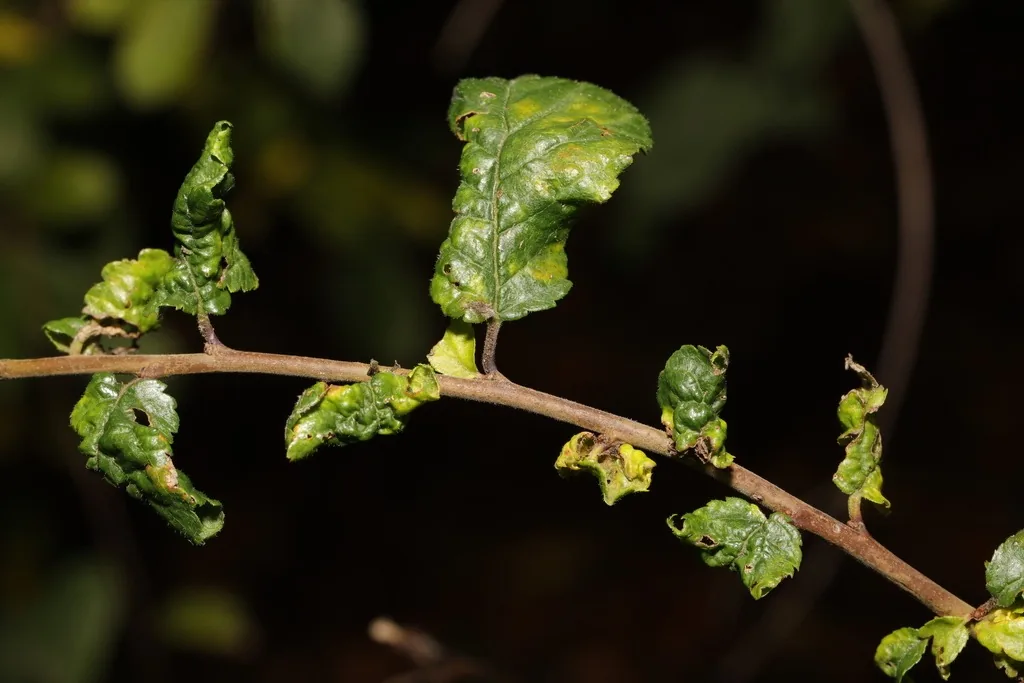
- Feeding on shoot tips stunts and deforms the new growth on young trees, and heavy populations on older trees can reduce fruit set in later years.[1]
- Honeydew from the colonies promotes black sooty mold on the fruit.[1]
- In Himalayan plum orchards in India it is considered a destructive pest, with numbers peaking in March and falling off by May.[3]
Health risk
The sources describe it only as a plant pest; none mentions any risk to people or pets.[1][2]
Control
Prevention
Start checking shoots before budbreak. Control is most effective early, while aphid numbers are low and before the emerging leaves curl around and protect the colonies.[1]
Plum cultivars differ in how well the aphid does on them: in laboratory life-table studies in India it reproduced less on 'Fortune' and 'Angeleno' than on 'Red Beaut'.[3]
Traps and physical control
In home orchards, wash aphids off with a strong stream of water or wipe them off by hand, and avoid heavy nitrogen and over-watering, which produce the succulent growth aphids favor.[1]
Biological control
Lady beetles, syrphid fly larvae, minute pirate bugs, bigeyed bugs, damsel bugs, lacewing larvae and parasitic wasps all attack plum aphids; avoid broad-spectrum insecticides that kill them.[1]
Pesticides
For home orchards, the PNW handbook lists a dormant or delayed-dormant horticultural oil spray, and growing-season options such as insecticidal soap, neem extract (azadirachtin) and kaolin, applied when the overwintering eggs hatch around prebloom or petal fall and before leaves curl. Several listed insecticides are highly toxic to bees.[1]
Common questions
- Why are the new leaves on my plum tree curled up?
- Leafcurl plum aphids feed on shoot tips in spring and the leaves curl around their colonies. Uncurl a leaf and look for small green to brownish aphids.[1]
- When is the best time to treat plum aphids?
- Early: around egg hatch at prebloom or petal fall, and before the leaves curl, since curled leaves protect the colonies.[1]
- Does the leafcurl plum aphid only feed on plums?
- No. It has a broad host range, recorded on plants in nearly 65 families, from stone fruits and almonds to sunflowers, chrysanthemums and vegetables.[2]
Sources
- Pacific Northwest Pest Management Handbooks (Oregon State University, Washington State University and University of Idaho Extension), “Plum and prune-Aphid, Pacific Northwest Insect Management Handbook.” pnwhandbooks.org/insect/tree-fruit/plum-prune/plum-prune-aphid (accessed 2026-11-09)
- USDA APHIS PPQ Identification Technology Program (idtools.org), “Brachycaudus helichrysi fact sheet, AphID: Identification guide for cosmopolitan and polyphagous aphid species (C. Favret and G. Miller).” www.aphid.aphidnet.org/Brachycaudus_helichrysi.php (accessed 2026-11-09)
- Cambridge University Press (Bulletin of Entomological Research), “Shandil D, Bhat A, Thakur R, Sharma S, Kumar D. Age-stage, two-sex life table and seasonal dynamics of Brachycaudus helichrysi on Prunus domestica: implications for pest management in Himalayan plum orchards. Bulletin of Entomological Research (2026, online ahead of print) (abstract).” doi.org/10.1017/S0007485326101151 (accessed 2026-11-09)
- iNaturalist, “Brachycaudus helichrysi taxon page (order and family).” www.inaturalist.org/taxa/381024 (accessed 2026-11-09)