On this page
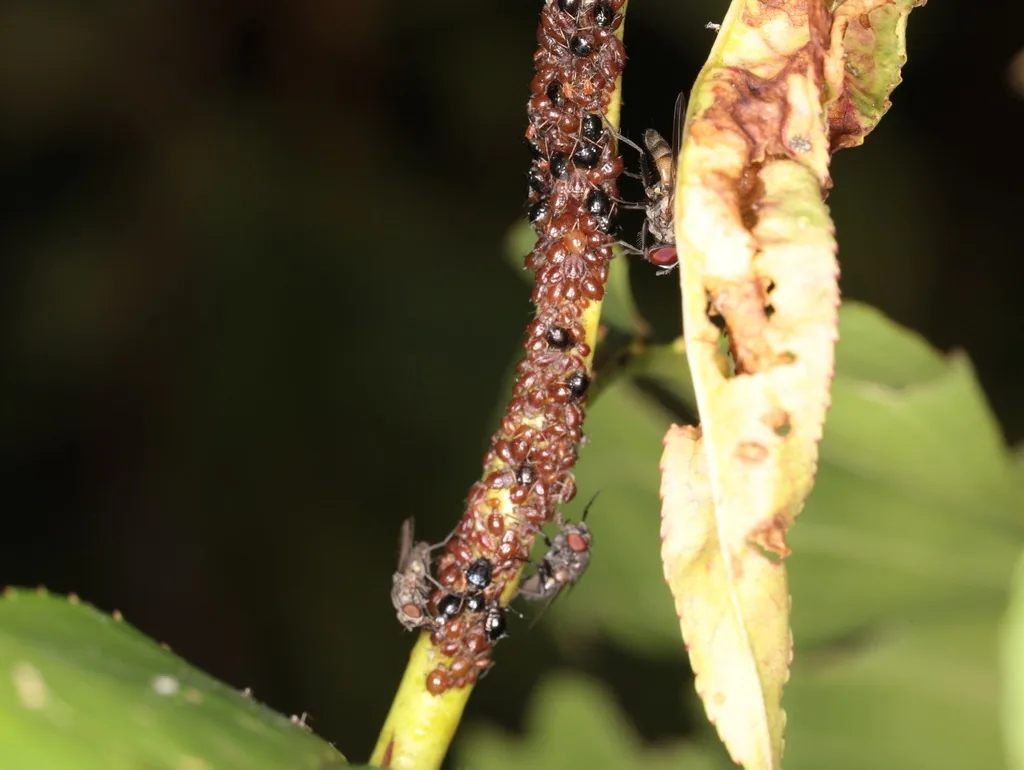
How to identify it
Look-alikes
| Look-alike | How to tell them apart |
|---|---|
| Green peach aphid | Adults are yellowish green, pear-shaped and about 0.05 inch long, and on peach they overwinter as eggs in bark crevices and twigs rather than on the roots.[4] |
Where it lives
UC IPM says it is prevalent in California's San Joaquin Valley. It has also been studied as a pest of young peach trees in New Jersey and in tests with Pennsylvania isolates of plum pox virus.[1][2][3]
Biology and life cycle
Wingless forms spend the winter on the roots of nectarine and closely related trees. In early spring some move from the roots to new growth and start colonies on the young leaves.[1]
Several generations of females follow. In early summer winged adults are produced and fly to other trees, and by midsummer the wingless forms have gone back to the roots to feed and overwinter.[1]
Ants tend the aphids while they are on the roots.[1]
Damage and signs
- Feeding causes leaf curling, yellowing and early leaf drop, and the curling shows first at the shoot tips.[1]
- When aphids are abundant, their honeydew can lead to black sooty mold on leaves and fruit.[1]
- Young trees can be killed: in greenhouse studies about half of the untreated young peach trees died from black peach aphid infestations.[2]
- It is one of four aphid species that consistently transmitted plum pox virus in Pennsylvania tests; after probing on infected seedlings it passed the virus to 32% of healthy peach seedlings.[3]
Health risk
The sources describe it only as a fruit-tree pest; none mentions any risk to people or pets.[1][2]
Control
Prevention
In spring, when growth begins, look for colonies at the shoot tips while monitoring for other pests. If this aphid caused problems in the past, take control measures in spring.[1]
Biological control
UC IPM says this aphid is not particularly damaging in nectarine orchards and populations may be managed by predators; the multicolored Asian lady beetle is a common predator.[1]
Pesticides
UC IPM lists imidacloprid as a foliar spray, applied after pollination is complete and bees are no longer in the orchard. In a New Jersey field study, dipping young peach tree roots in imidacloprid before planting, or drenching after planting, eliminated infestations and kept aphids off the roots for at least a year.[1][2]
Common questions
- Why do the black aphids on my peach tree disappear in summer?
- By midsummer the wingless forms move down to the roots, where they feed and spend the winter, while winged adults fly off to other trees in early summer.[1]
- Can black peach aphids kill a tree?
- Young trees are at risk: in greenhouse studies about half of the untreated young peach trees died from infestations. UC IPM's nectarine guidelines call it not particularly damaging.[2][1]
- Do black peach aphids spread plum pox?
- Yes. In Pennsylvania tests it was one of four aphid species that consistently transmitted plum pox virus to peach seedlings.[3]
Sources
- University of California Statewide IPM Program, “Black Peach Aphid, UC IPM Pest Management Guidelines: Nectarine.” ipm.ucanr.edu/agriculture/nectarine/black-peach-aphid/ (accessed 2026-11-09)
- Entomological Society of America (Journal of Economic Entomology), “Managing Brachycaudus persicae (Homoptera: Aphididae) during peach orchard establishment (Shearer and Frecon 2002).” doi.org/10.1603/0022-0493-95.2.368 (accessed 2026-11-09)
- American Phytopathological Society (Phytopathology), “Plum pox in North America: identification of aphid vectors and a potential role for fruit in virus spread (Gildow et al. 2004).” doi.org/10.1094/PHYTO.2004.94.8.868 (accessed 2026-11-09)
- Pacific Northwest Pest Management Handbooks (Oregon State University, Washington State University and University of Idaho Extension), “Peach and nectarine-Aphid, Pacific Northwest Insect Management Handbook.” pnwhandbooks.org/insect/tree-fruit/peach-nectarine/peach-nectarine-aphid (accessed 2026-11-09)
- iNaturalist, “Brachycaudus persicae taxon page (order and family).” www.inaturalist.org/taxa/386782 (accessed 2026-11-09)