On this page
How to identify it
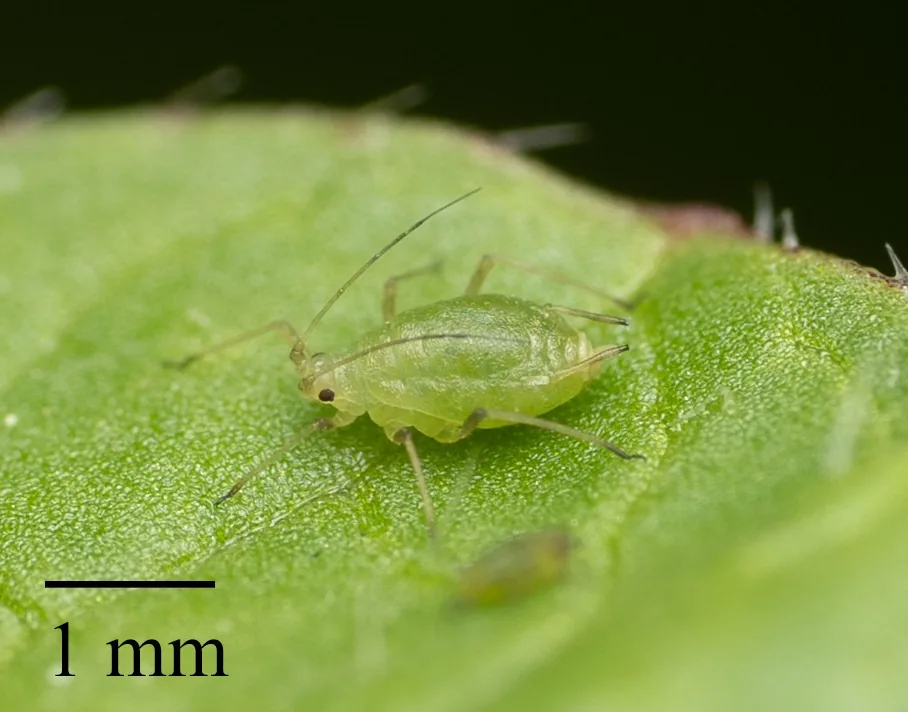
- Wingless adults are about 1/16 inch (1.7 to 2.0 mm) long, yellowish or greenish, often with three darker green stripes down the back.[1][2]
- Winged adults have a black head and thorax and a yellowish-green abdomen with a large dark patch.[1]
- Its cornicles (tailpipes) are moderately long and slightly swollen.[1]
Look-alikes
| Look-alike | How to tell them apart |
|---|---|
| Other aphids | Many aphids look alike; keys and close inspection separate green peach aphid from other vegetable aphids.[1] |
| Melon aphid | Another common garden aphid that also transmits viruses.[1] |
Where it lives
Found worldwide, including all of North America, in fields and greenhouses.[1][2]
Biology and life cycle
Where winters are cold it overwinters as eggs or wingless females under peach buds and on other Prunus; in spring stem mothers produce live young, and winged forms then move to summer hosts.[1][2]
A generation can take only 10 to 12 days, with more than 20 generations a year in mild climates; each wingless female can produce 30 to 80 young.[1]
In fall, winged aphids return to Prunus to lay eggs.[1]
Damage and signs
Health risk
Control
Prevention
Avoid unnecessary broad-spectrum insecticides, which kill natural enemies and can trigger aphid outbreaks; treat spotty early infestations promptly.[1][2]
Sanitation
Control broadleaf weeds, which can harbor aphids and the viruses they carry.[1]
Biological control
Lady beetles, flower flies, lacewings, parasitic wasps and fungi attack it, often crashing populations.[1]
Pesticides
Contact sprays struggle to reach aphids under leaves, especially in cool weather; on peach and nectarine, Penn State suggests treating at one colony per nectarine tree or five per peach tree.[1][2]
Common questions
Sources
- University of Florida IFAS Extension (EDIS, Featured Creatures), “Green Peach Aphid, Myzus persicae (Sulzer) (EENY-222).” ask.ifas.ufl.edu/publication/IN379 (accessed 2026-10-16)
- Penn State Extension, “Tree Fruit Insect Pest - Green Peach Aphid.” extension.psu.edu/tree-fruit-insect-pest-green-peach-aphid/ (accessed 2026-10-16)
- iNaturalist, “Myzus persicae taxon page (order and family).” www.inaturalist.org/taxa/243745 (accessed 2026-10-06)