On this page
How to identify it
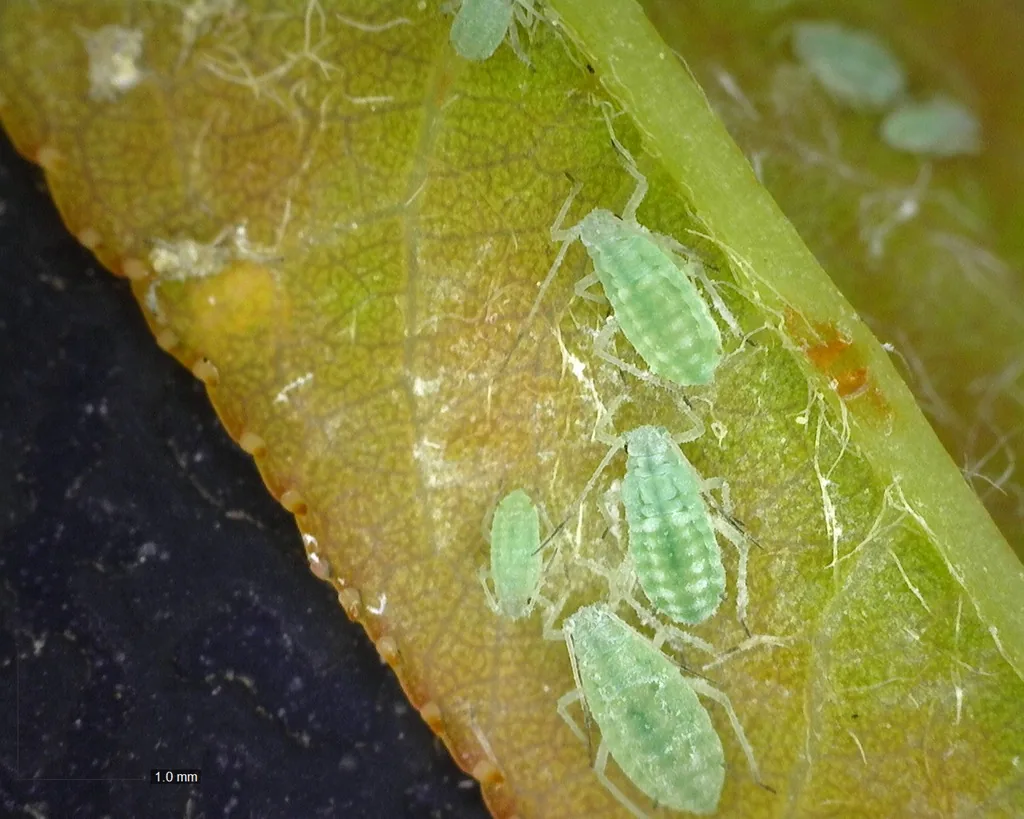
- Wingless adults are pale green or whitish green with three dark green stripes running down the back, and the body is covered with white mealy wax.[1][2]
- The winged form has a dark thorax and crosswise bands on the abdomen.[1]
- Colonies sit on the undersides of leaves and are often found inside leaves that are only slightly curled.[1][2]
- On peaches and nectarines in the Pacific Northwest, adults are described as pale bluish green to light purple with a white, powdery coating.[3]
Look-alikes
| Look-alike | How to tell them apart |
|---|---|
| Leaf curl plum aphid | Also attacks plum and prune and curls the leaves, but it spends summer on plants in the aster family rather than on cattails and reeds.[6] |
| Green peach aphid | Adults are yellowish green and pear shaped, about 0.05 inch long. It is the more serious aphid on nectarines.[3] |
| Other Hyalopterus aphids | In Turkey, Hyalopterus aphids on almond and on apricot and peach are recognized as separate species from the plum species, and DNA and body measurements suggest host plant use drives the split.[5] |
Where it lives
It is a pest of plum and prune orchards in California and is listed among the aphids on peaches and nectarines in the Pacific Northwest. In summer it lives on reed grass, cattails and common reed (Phragmites).[1][3][4]
Biology and life cycle
Eggs spend the winter near the bases of buds and hatch during early bloom, and the young develop into wingless adults.[1]
There are 3 to 13 generations a year. Winged adults appear in June and July and fly to reed grass or cattails for the summer.[1][2]
Only the offspring of winged aphids that fly back to the trees in fall (October on prunes) lay overwintering eggs. Wingless aphids that stay on vigorous tree growth through summer cannot lay them.[1]
On its summer host, common reed (Phragmites), the aphid sweeps wax around itself with its hind legs. The waxed leaf surface sheds water and holds air bubbles, and in tests waxing aphids survived 48 hours underwater about twice as often as aphids without wax.[4]
Damage and signs
- Feeding on leaf undersides in spring leaves the foliage slightly curled and stunted.[1][2]
- Large numbers reduce tree vigor, slow growth and lower the sugar content of the fruit, and honeydew dripping onto fruit can make it crack.[1][2]
- On peaches and nectarines, aphid feeding on shoot tips can stunt and deform the tips of young trees, and honeydew can lead to sooty mold on fruit.[3]
Health risk
The sources treat it only as a fruit tree pest; none mentions bites or any risk to people or pets.[1][3]
Control
Prevention
Aphid numbers tend to be higher on trees fertilized heavily with nitrogen. Avoid that and excessive watering, which together produce flushes of succulent growth.[3]
Sanitation
In prune orchards, a postharvest zinc sulfate foliar spray hastens leaf fall, and getting the leaves off the tree disrupts the aphid's life cycle.[1]
Traps and physical control
Home orchardists can wash aphids off with a strong stream of water or wipe them off by hand.[3]
Biological control
Lady beetles, green and brown lacewings, syrphid flies and soldier beetles feed on mealy plum aphid, and an introduced parasitic wasp, Aphidius transcaspicus, now parasitizes it substantially. Curled leaves will not uncurl, and fruit size may still suffer, even after natural enemies knock the aphids back.[1]
Pesticides
UC lists the best time to treat as late October through the delayed-dormant period. Oil sprays are not recommended while leaves are still on after mid-October, because they harm parasites and do not work well on the aphid then. Two oil sprays at bloom, when parasites are inactive, can control the aphid very effectively.[1]
For organic orchards UC lists biological control plus narrow-range oil, neem oil, or neem oil with insecticidal soap.[1]
Common questions
- Why do my plum leaves have white, powdery aphids underneath?
- Pale green aphids with three dark stripes and a coating of white mealy wax on the undersides of plum or prune leaves are mealy plum aphids.[1][2]
- Where do the aphids go in summer?
- Winged adults leave the trees in June and July for reed grass and cattails, and their offspring return to the trees in fall to lay eggs.[1][2]
- Will the leaves uncurl after the aphids are gone?
- No. Curled leaves will not uncurl after the aphids are suppressed, and fruit size may still be reduced.[1]
Sources
- University of California Statewide IPM Program, “Mealy Plum Aphid (Prune Pest Management Guidelines).” ipm.ucanr.edu/agriculture/prune/mealy-plum-aphid/ (accessed 2026-11-09)
- University of California Statewide IPM Program, “Mealy Plum Aphid (Plum Pest Management Guidelines).” ipm.ucanr.edu/agriculture/plum/mealy-plum-aphid/ (accessed 2026-11-09)
- Pacific Northwest Pest Management Handbooks (Oregon State University, Washington State University and University of Idaho Extension), “Peach and nectarine-Aphid, Pacific Northwest Insect Management Handbook.” pnwhandbooks.org/insect/tree-fruit/peach-nectarine/peach-nectarine-aphid (accessed 2026-11-09)
- Oxford University Press (Journal of Evolutionary Biology), “Aphids increase their rate of survival on emergent aquatic plants through niche construction (Kodera et al. 2024, Journal of Evolutionary Biology 37:283-289).” doi.org/10.1093/jeb/voae011 (accessed 2026-11-09)
- Magnolia Press (Zootaxa), “Incorporation of Turkish Hyalopterus spp. into recent species reassessment based on their molecular and morphometric features (Senol and Goz 2022, Zootaxa 5183:254-272).” doi.org/10.11646/zootaxa.5183.1.20 (accessed 2026-11-09)
- University of California Statewide IPM Program, “Pest Notes: Aphids.” ipm.ucanr.edu/home-and-landscape/aphids/ (accessed 2026-11-09)
- iNaturalist, “Hyalopterus pruni taxon page (order and family).” www.inaturalist.org/taxa/143343 (accessed 2026-11-09)