On this page
How to identify it
Where it lives
NC State lists eastern white, loblolly, pitch, red, Scots, shortleaf, slash and Virginia pines as hosts, and the Pacific Northwest handbook lists it as a pest of pines there too.[1][2]
Biology and life cycle
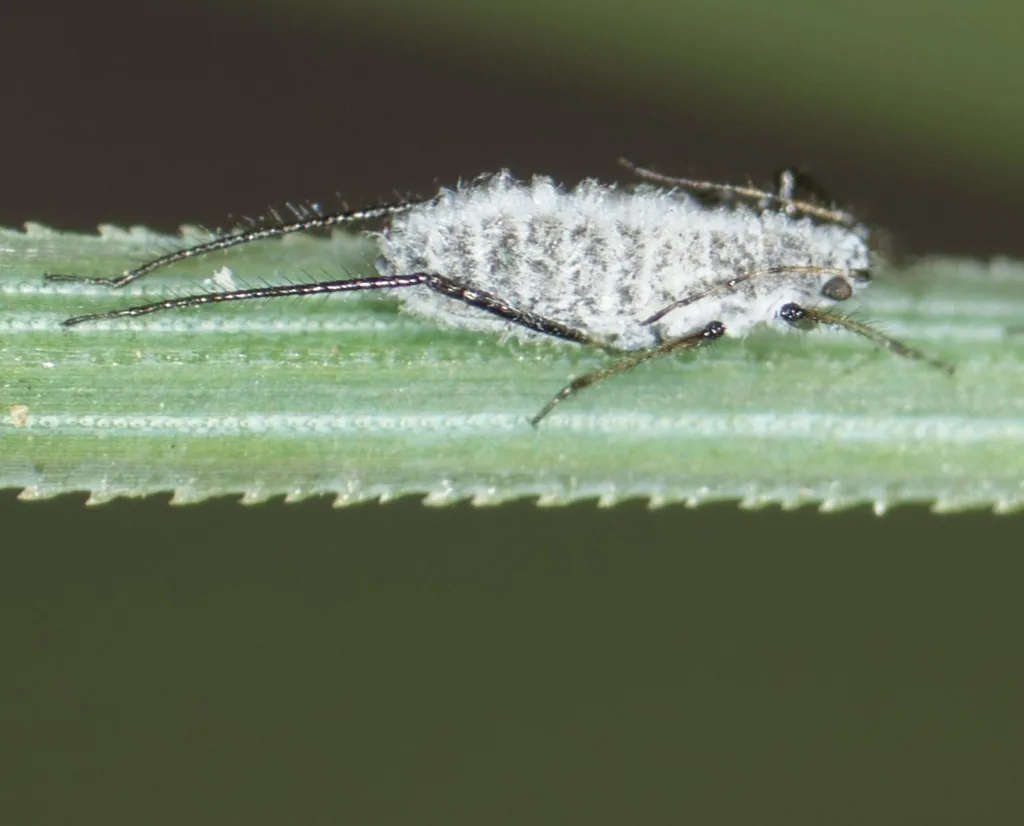
Some wingless females lay eggs that overwinter on pine, but other stages also survive mild winters, and populations often peak in winter when lady beetles and syrphid fly larvae are less active.[1]
Females can reproduce without mating; in a study in Zimbabwe each adult produced three to five young a day, 15 to 35 in all.[1][3]
Winged adults fly to other pines, and in warm weather parasitic wasps, lady beetles, syrphid fly larvae and lacewings usually bring numbers down quickly.[1]
Damage and signs
Health risk
It feeds only on pine sap; NC State and the PNW Handbook mention no risk to people.[1][2]
Control
Biological control
Natural enemies usually control it once the weather warms, so give them a chance first.[1]
Pesticides
If they don't, horticultural oil works and helps loosen sooty mold, but it can strip the bluish wax bloom from white and Scots pines and leave them looking yellow; other insecticides labeled for aphids on home ornamentals also work.[1]
Common questions
- Why are aphids so bad on my pine in winter?
- Powdery pine needle aphids keep reproducing in mild winter weather while the lady beetles and fly larvae that eat them are mostly inactive.[1]
- What is the black coating on my pine and the grass under it?
- Probably sooty mold growing on honeydew from aphids such as the powdery pine needle aphid.[1]
Sources
- NC State Extension, “Powdery Pine Needle Aphid (PDIC Factsheet).” content.ces.ncsu.edu/powdery-pine-needle-aphid (accessed 2026-10-19)
- Oregon State University, Washington State University and University of Idaho Extension, “Pine (Pinus): Powdery pine needle aphid (Pacific Northwest Insect Management Handbook).” pnwhandbooks.org/node/7009 (accessed 2026-10-19)
- South African Forestry Journal (NISC abstract), “Biology and Population Dynamics of the Pine Needle Aphid, Eulachnus rileyi (Williams) in Zimbabwe (Y. Katerere, South African Forestry Journal 129, 1984).” www.nisc.co.za/products/abstracts/13798/biology-and-population-dynamics-of-the-pine-needle-aphid-eulachnus-rileyi-williams-in-zimbabwe (accessed 2026-10-19)
- iNaturalist, “Eulachnus rileyi taxon page (order and family).” www.inaturalist.org/taxa/532779 (accessed 2026-10-06)