On this page
How to identify it
Look-alikes
Where it lives
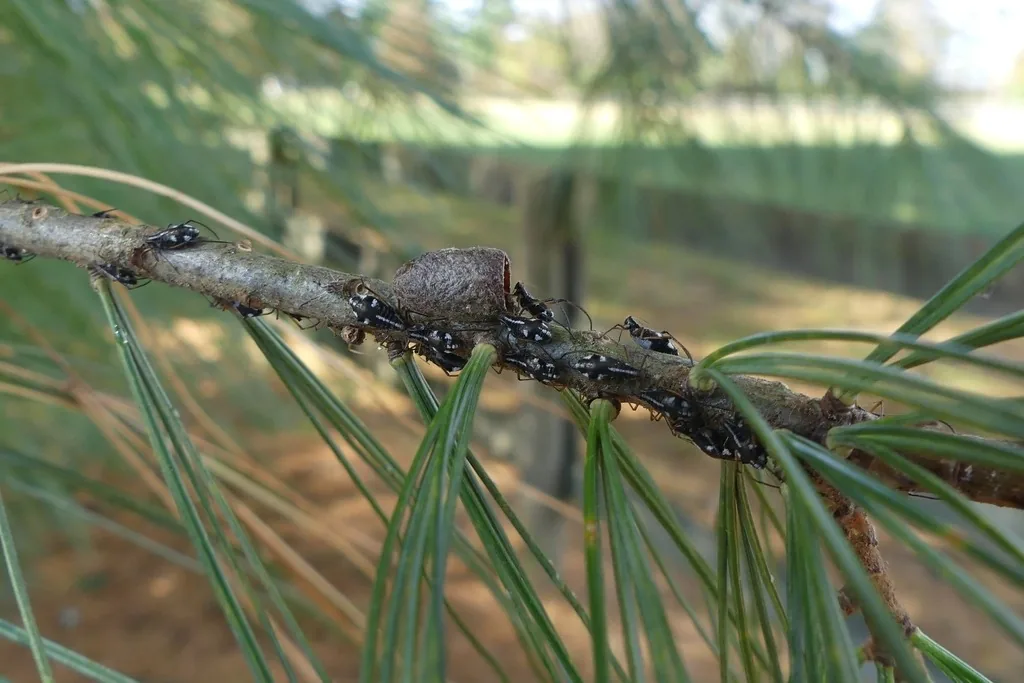
Found on eastern white pine in New England and North Carolina.[1][2]
Biology and life cycle
Populations are often large in fall and through mild late winters and springs; at higher elevations they overwinter as eggs that hatch very early in spring.[2]
UMass suggests looking for aphids in May and June.[1]
Damage and signs
Health risk
None to people or pets; aphids on indoor Christmas trees are a nuisance only.[2]
Control
Traps and physical control
Spray aphids off with a strong jet of water, or remove overwintering eggs before they hatch.[1]
Biological control
Lady beetles, lacewings, hover flies, predatory midges and parasitic wasps usually bring populations down.[1][2]
Pesticides
If natural enemies fail, insecticidal soaps and oils are labeled for aphids.[2]
Common questions
- What are the black bugs crawling off my Christmas tree?
- Often white pine aphids leaving a drying white pine.[2]
Sources
- UMass Extension Landscape, Nursery and Urban Forestry Program (Landscape Insect & Mite Guide), “Cinara strobi (White Pine Aphid).” www.umass.edu/agriculture-food-environment/landscape/publications-resources/insect-mite-guide/cinara-strobi (accessed 2026-10-16)
- NC State Extension, “White Pine Aphid (PDIC Factsheet).” content.ces.ncsu.edu/white-pine-aphid (accessed 2026-10-16)
- iNaturalist, “Cinara strobi taxon page (order and family).” www.inaturalist.org/taxa/366315 (accessed 2026-10-06)