On this page
How to identify it
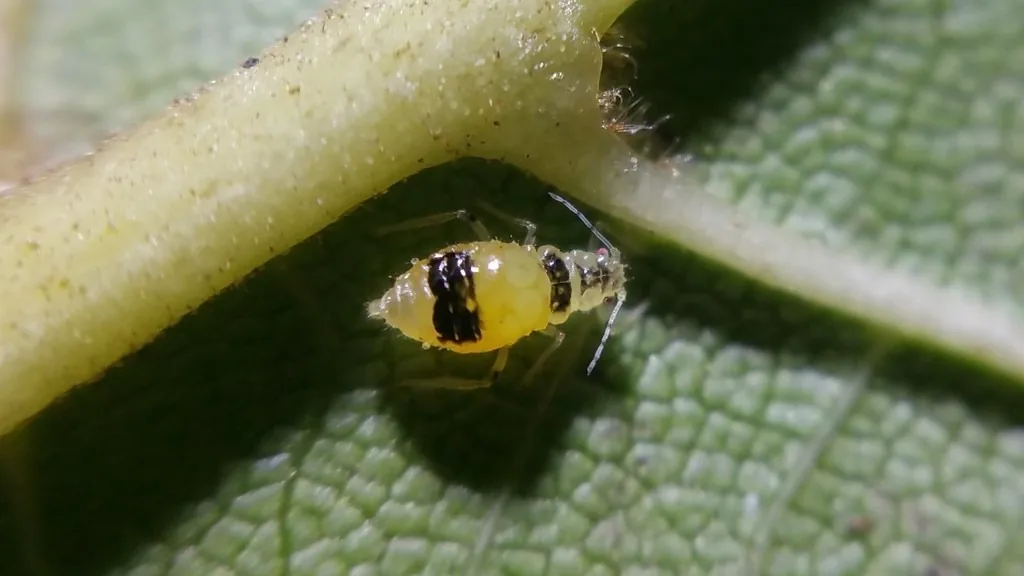
- Walnut aphids are pale yellow and much smaller than the other common walnut aphid, the dusky-veined aphid.[2][1]
- They are found scattered on the lower surface of the leaflets rather than lined up along the midvein.[1][2]
- Nymphs lack the dark banded spots on the back that mark dusky-veined aphid nymphs, or show them only faintly.[1]
- A white form of the walnut aphid has been found in California's Sacramento Valley; it builds up later in the season than the usual yellow form.[1]
- Parasitized aphids turn tan and become 'mummies', some with a small exit hole where the adult wasp chewed its way out.[1]
Look-alikes
Where it lives
It is a pest of walnut orchards in California and the Pacific Northwest, where both UC IPM and the PNW handbook give management advice for it.[1][2]
Biology and life cycle
Eggs spend the winter on twigs and hatch as the leaf buds of early cultivars begin to open.[1]
Through spring and summer, females reproduce without mating and give birth to live nymphs. There are many generations a year, depending on temperature.[1]
In the fall, wingless females mate with smaller, winged males and lay the overwintering eggs.[1]
The parasitic wasp Trioxys pallidus, introduced in the 1980s, lays its eggs inside the aphids, and the wasp larva eats the aphid from the inside. It has greatly reduced walnut aphid problems.[2][1]
Lady beetles, bigeyed bugs, plant bugs in the genus Deraeocoris, syrphid fly larvae and green lacewings also eat walnut aphids, though where Trioxys is active aphid numbers stay too low for predators to build up.[2][1]
Damage and signs
- Feeding can reduce tree vigor, nut size, yield and quality. Aphids are most damaging in spring and early summer, while nuts are growing rapidly.[1][2]
- High numbers can make leaves drop, exposing nuts to sunburn that darkens or shrivels the kernels.[1][2]
- Honeydew from the aphids grows black sooty mold on the husks, and on some varieties the honeydew itself is toxic to the husk and turns it black.[1][2]
- UC IPM reports that more than 15 walnut aphids per leaflet early in the season reduce yield and quality and increase nuts with perforated shells. Some late cultivars, such as Franquette, tolerate heavy numbers.[1]
Health risk
The sources describe it only as a walnut pest; neither mentions any risk to people or pets.[1][2]
Control
Prevention
Start watching shoots before budbreak, while aphids are few. From May on, UC IPM suggests checking the undersides of 5 subterminal leaflets on each of 10 trees and looking for aphid mummies, which show the wasp is present.[2][1]
Avoid liberal nitrogen fertilizer and, in home orchards, excessive watering, which together produce flushes of succulent growth that favor aphids. Home orchardists should also control ants, which tend aphids for honeydew and protect them from predators.[2]
Biological control
Protect Trioxys pallidus. Outbreaks of walnut aphid tend to follow broad-spectrum insecticides applied for other pests such as codling moth, and oil sprays during the growing season also harm the wasp.[1][2]
Pesticides
UC IPM suggests considering a treatment only if healthy (non-parasitized) walnut aphids average more than 15 per leaflet on early, heavy-bearing varieties. Oil sprays may suppress aphids but work better on the dusky-veined aphid and harm natural enemies.[1]
Common questions
- What are the tan, puffy aphids on my walnut leaves?
- They are aphid mummies: walnut aphids killed by the parasitic wasp Trioxys pallidus. A small hole in the mummy means the adult wasp has already emerged.[1]
- Do I need to spray walnut aphids?
- Usually not, because the introduced wasp keeps them low in most orchards. UC IPM suggests considering a treatment only above an average of 15 healthy aphids per leaflet on early, heavy-bearing varieties.[1]
- What is the other aphid on top of walnut leaves?
- That is probably the dusky-veined aphid, which feeds in rows along the midvein on the upper surface and blackens the midrib.[1][2]
Sources
- University of California Statewide IPM Program, “Aphids, UC IPM Pest Management Guidelines: Walnut.” ipm.ucanr.edu/agriculture/walnut/aphids/ (accessed 2026-11-09)
- Pacific Northwest Pest Management Handbooks (Oregon State University, Washington State University and University of Idaho Extension), “Walnut-Aphid, Pacific Northwest Insect Management Handbook.” pnwhandbooks.org/insect/nut/walnut/walnut-aphid (accessed 2026-11-09)
- iNaturalist, “Chromaphis juglandicola taxon page (order and family).” www.inaturalist.org/taxa/908108 (accessed 2026-11-09)