On this page
How to identify it
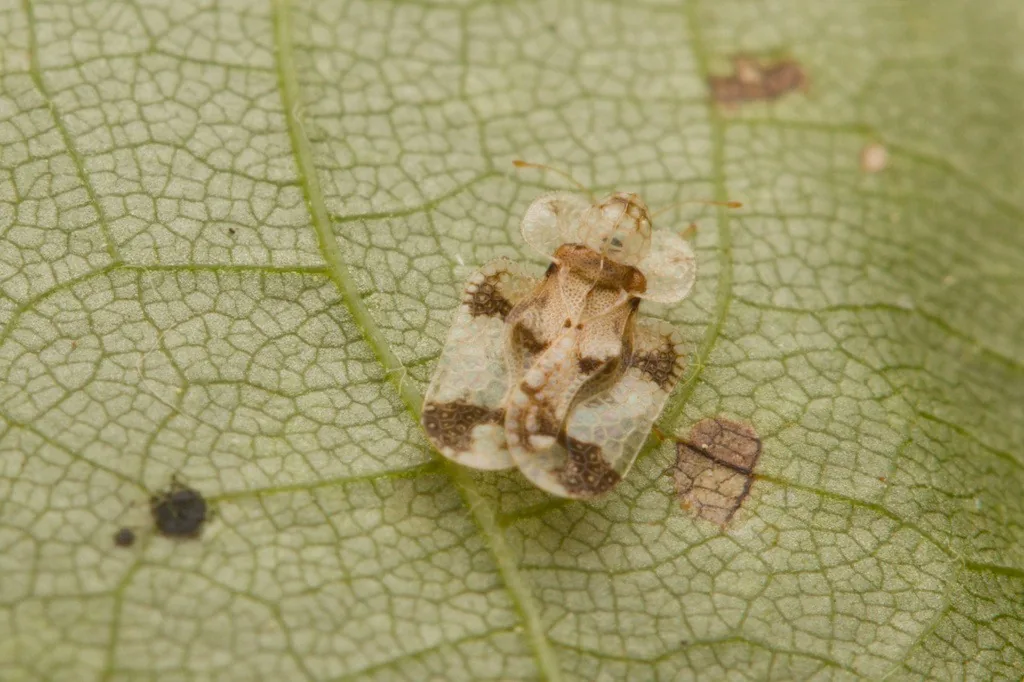
- Adults are small and flat, with broad, gauzy wing covers that hide the abdomen and a large hood that often hides the head. The whole surface is netted like lace.[2][3]
- Nymphs are black and often spiny.[2]
- Look on the leaf underside, where the bugs feed alongside their eggs, cast skins and dark excrement. In heavy infestations some move to the upper side of the leaflet.[2][1]
Look-alikes
| Look-alike | How to tell them apart |
|---|---|
| Hawthorn lace bug | A Corythucha relative found on hawthorn and pyracantha rather than walnut.[2] |
| Sycamore lace bug | Same genus and same kind of damage, but it prefers sycamore and only occasionally feeds on ash, hickory and mulberry.[2] |
Where it lives
Listed by the USDA Forest Service among the lace bugs of eastern forests, and studied on butternut in northeastern Massachusetts.[2][1]
Biology and life cycle
Hosts are black walnut, butternut and linden.[2]
Adults spend the winter in hiding and come out in early or mid-May, timed to the host's leaf-out. A paint-marked bug in the Massachusetts study survived the winter and was found again the next season.[1]
Two broods a year are usual in northeastern Massachusetts. The first matures by late June or early July and the second by mid-August or early September. In good years the bugs stay active into early October.[1]
Weather can cut the season short: in 1960 a storm followed by a light frost sent most of them into hibernation about a month early.[1]
Populations can differ a lot between trees. Of two butternuts only about 60 feet apart, one was heavily infested every year and the other carried few bugs.[1]
Damage and signs
Health risk
The sources describe only sap feeding on leaves and report no harm to people.[2][1]
Control
Prevention
Check leaf undersides early in the season if the tree had lace bugs before; Ohio State's general lace bug advice is to stop the first generation, because spotting already on the leaves will not go away.[3]
Traps and physical control
On small trees, a hard jet of water knocks young nymphs off the leaves, and many die before getting back.[3]
Biological control
Green lacewings, mites and assassin bugs attack lace bugs; soaps and water sprays spare them better than standard insecticides.[3]
Pesticides
Insecticidal soap or horticultural oil works only if it hits the bugs, so spray the leaf undersides. Not every lace bug or host plant is on every label, so check before using any product.[3]
Common questions
- What are the tiny lacy bugs under my walnut leaves?
- Most likely walnut lace bugs. They feed on the undersides of black walnut, butternut and linden leaves along with their black, spiny nymphs.[2]
- When are walnut lace bugs active?
- In Massachusetts, from early or mid-May into early October, with two broods a year.[1]
Sources
- Psyche (Cambridge Entomological Club), “Bailey (1964), Further Studies of the Bioecology of the New England Tingidae (Heteroptera), Part III: Seasonal population trends of the walnut lace bug, Psyche 71:65-72.” groups.csail.mit.edu/mac/projects/psyche/71/71-065.html (accessed 2026-11-10)
- USDA Forest Service, “Eastern Forest Insects, Miscellaneous Publication 1175 (W. L. Baker, 1972; scanned copy).” archive.org/details/easternforestins1175bake (accessed 2026-11-10)
- Ohio State University Extension, Ohioline, “HYG-2150: Lace Bugs (D. J. Shetlar, 2011).” ohioline.osu.edu/factsheet/HYG-2150-10 (accessed 2026-11-10)
- iNaturalist, “Corythucha juglandis taxon page (order and family).” www.inaturalist.org/taxa/325975 (accessed 2026-11-10)