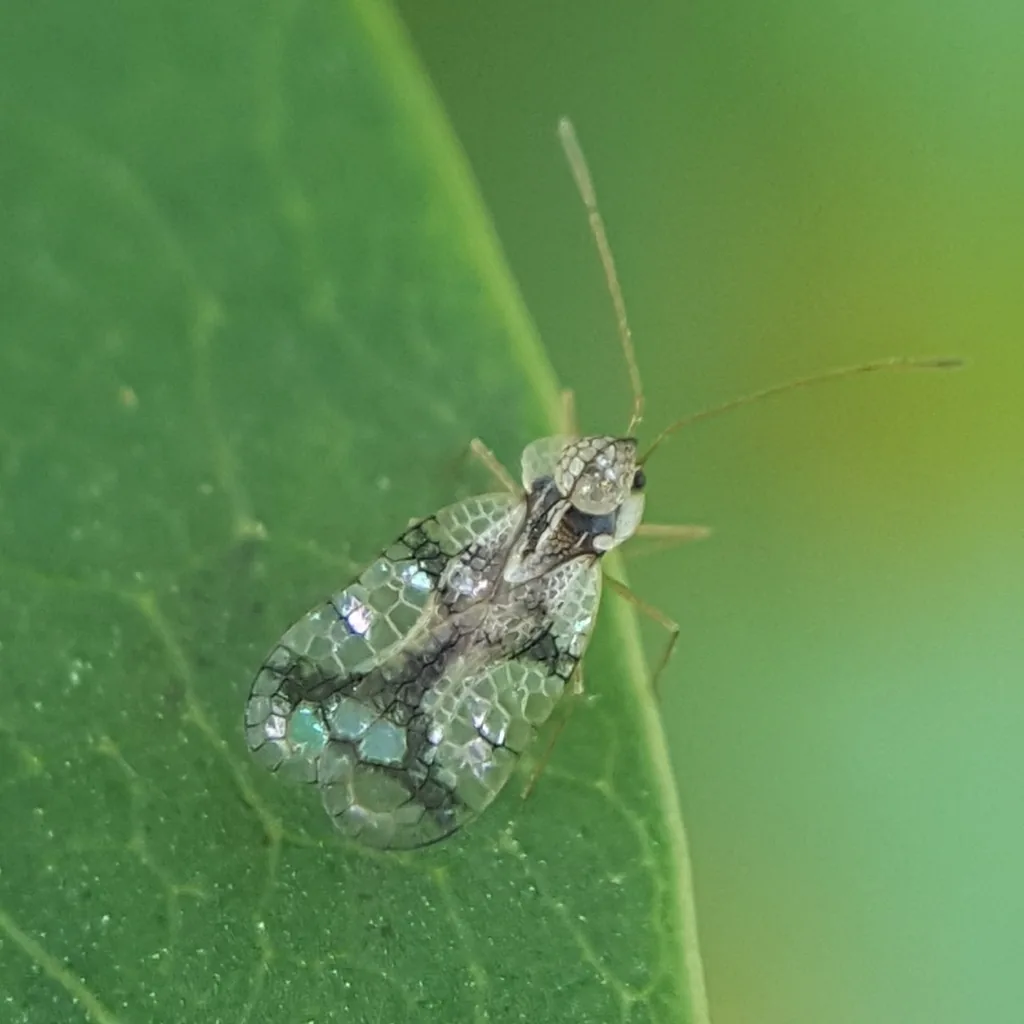
How to identify it
- Adults are about 1/8 inch long, with expanded, see-through wings and thorax made of many small cells that look like lace.[1][2]
- Nymphs are wingless, smaller, oval, usually dark and spiny.[1][2]
- Adults and nymphs feed together in groups on leaf undersides, along with black specks of excrement.[1][3]
- Each species feeds on one or a few related plants; this profile uses the azalea lace bug, the insect most often reported in landscapes in North Carolina.[1][2]
Look-alikes
| Look-alike | How to tell them apart |
|---|---|
| Spider mites | Mites also stipple leaves but leave no dark excrement specks, and they may leave fine webbing and cast skins.[1][2] |
| Thrips | Thrips injury looks similar but is finer than the coarser stippling lace bugs cause.[2] |
Where it lives
Lace bugs occur widely on landscape plants; the azalea lace bug attacks evergreen and deciduous azaleas and mountain laurel, and other species attack andromeda, rhododendron, sycamore, hawthorn and many shade trees.[2][3]
Biology and life cycle
Females insert eggs into leaf tissue, often along the midrib, and cover them with dark excrement that hardens into a varnish-like shield.[2][1]
Azalea lace bugs usually spend winter as eggs inside leaves; up to 90 eggs have been found in a single leaf.[2]
Nymphs are almost colorless at hatching, soon turn dark and spiny, and grow through several molts to adulthood.[2][1]
There are several generations a year, at least two for azalea lace bug in North Carolina, and the spring generations seem to do the most damage.[1][2]
Damage and signs
- Feeding empties leaf cells and leaves pale stippling that merges until leaves look bleached, yellow or bronzed.[2][3]
- Black, varnish-like specks of excrement foul leaf undersides and can drip onto pavement below.[1]
- Heavy infestations can cause early leaf drop and slower growth; severe cases can kill small shrubs.[1][3]
- Stressed broadleaved evergreens in full sun suffer the most damage.[3][1]
Health risk
Lace bugs feed only on plants; the harm is bleached, speckled foliage on trees and shrubs.[1][3]
Control
Prevention
Tolerate light damage, and grow plants suited to the site; azaleas in partial shade suffer less than those in hot, full sun.[1][3]
Inspect new growth weekly from late winter or early spring and act when nymphs become abundant, before damage spreads.[1][2]
Traps and physical control
On small shrubs, a forceful spray of water to the leaf undersides early in the season, repeated as needed, can suppress lace bugs.[1]
Biological control
Parasitic wasps, assassin bugs, lacewing larvae, lady beetles, jumping spiders, pirate bugs and predatory mites eat lace bugs; avoid persistent sprays that kill them.[1][2]
Pesticides
Insecticidal soap, horticultural oil, neem oil and pyrethrins control nymphs and adults if they thoroughly wet the leaf undersides, but they don't kill eggs, so repeat as needed.[1][2][3]
Systemic dinotefuran or imidacloprid applied to the soil can give season-long control; don't apply systemics during or just before bloom, to protect pollinators.[1][2]
UC IPM advises against long-lasting foliar sprays such as carbaryl, malathion and pyrethroids, which kill natural enemies and can trigger spider mite outbreaks.[1]
Damage doesn't go away
No treatment restores stippled leaves; the damage stays until it is pruned off or replaced by new growth, so the goal is protecting the next flush.[1]
Large trees don't need treatment for lace bugs, because the damage doesn't affect tree health.[3]
Common questions
- Why are my azalea leaves turning white and speckled?
- Check the leaf undersides: lacy-winged bugs, spiny dark nymphs and black specks of excrement mean azalea lace bugs.[2][1]
- Will lace bugs kill my shrubs?
- Rarely. The damage is mostly cosmetic, though very heavy infestations can cause leaf drop and occasionally kill small, stressed shrubs.[1][3]
Sources
- University of California Statewide IPM Program, “Lace Bugs (Pest Notes, Home and Landscape).” ipm.ucanr.edu/home-and-landscape/lace-bugs/ (accessed 2026-10-06)
- NC State Extension, “Azalea Lace Bug (reviewed/revised June 21, 2023).” content.ces.ncsu.edu/azalea-lace-bug (accessed 2026-10-06)
- University of Maryland Extension, “Lace Bugs on Trees and Shrubs (updated October 17, 2024).” extension.umd.edu/resource/lace-bugs-trees-and-shrubs (accessed 2026-10-06)
- iNaturalist, “Stephanitis pyrioides taxon page (order and family).” www.inaturalist.org/taxa/522538 (accessed 2026-10-06)