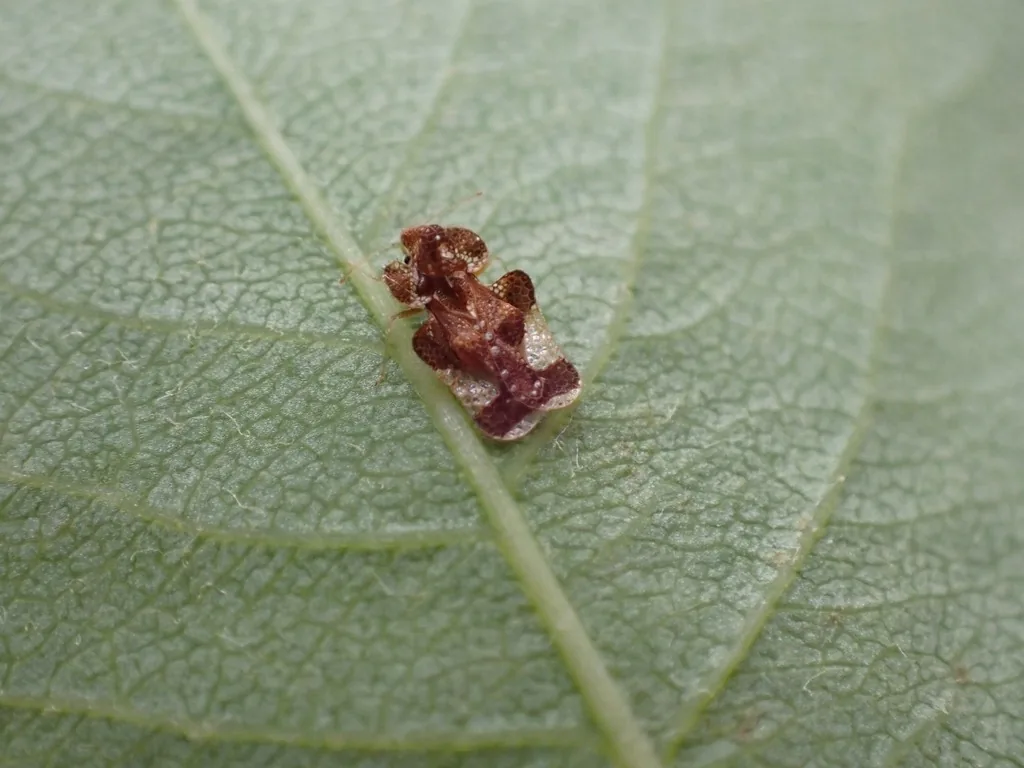
How to identify it
- Adults are about 1/8 inch long with lacy wings marked with large brown spots, or a double brown crossbar, and yellowish legs and antennae.[1][2]
- Nymphs are spiny and dirty to shiny brown, becoming oval and flat as they grow.[1][2]
- Eggs are fastened to the lower leaf surface, and females often cover them with a hard brown varnish.[1][2]
Look-alikes
| Look-alike | How to tell them apart |
|---|---|
| Spider mites | Mite damage is finer, and mites don't leave the noticeable dark specks of excrement that lace bugs leave on leaf undersides.[1] |
Where it lives
It occurs throughout much of the continental United States, southern Canada and northern Mexico.[2]
Biology and life cycle
Adults overwinter in fallen leaves or other protected spots near their hosts and lay eggs in small groups on leaf undersides in spring.[1][2]
Nymphs go through five stages; in New England the life cycle takes five to seven weeks, with one or more generations a year.[1][2]
Damage and signs
Health risk
Control
Sanitation
Adults overwinter in fallen leaves near their host plants.[1][2]
Pesticides
They are sluggish and not hard to control; NC State says most insecticides labeled for landscape use should work.[1]
Common questions
- Why are my pyracantha leaves pale and speckled?
- Hawthorn lace bugs feeding underneath leave pale spots above and dark specks below.[1][2]
- Is it lace bugs or spider mites?
- Lace bugs leave dark specks of excrement on the undersides; spider mites don't.[1]
- Where do hawthorn lace bugs spend the winter?
- As adults in fallen leaves near their host plants.[1][2]
Sources
- NC State Extension, “Hawthorn Lace Bug.” content.ces.ncsu.edu/hawthorn-lace-bug (accessed 2026-10-15)
- University of Florida IFAS Extension (Featured Creatures), “Hawthorn Lace Bug, Corythucha cydoniae (EENY-80).” ask.ifas.ufl.edu/publication/IN237 (accessed 2026-10-15)
- iNaturalist, “Corythucha cydoniae taxon page (order and family).” www.inaturalist.org/taxa/51151 (accessed 2026-10-06)