On this page
How to identify it
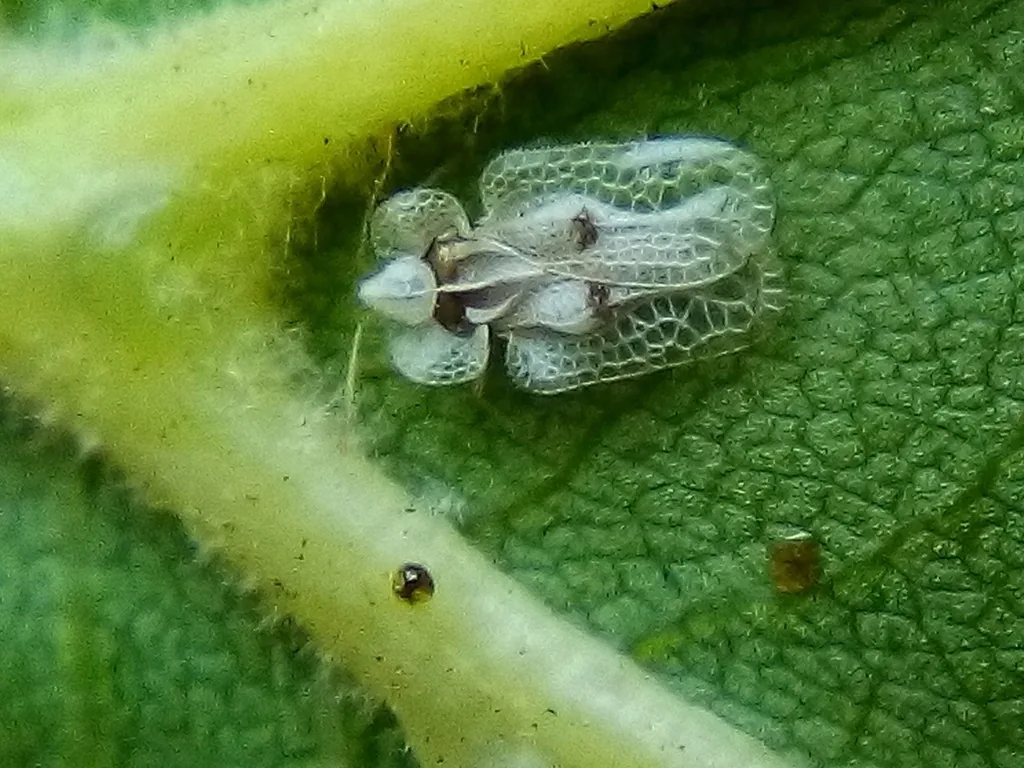
- Adults are about 1/8 inch long, milky white and nearly rectangular, with lacy, flattened wings and sides of the thorax and a dark spot on each wing.[1][2]
- Nymphs are smaller, black and spiny and feed in groups on the leaf underside.[2]
- Its host is a strong clue: it is the only lace bug listed on American sycamore.[1]
Look-alikes
| Look-alike | How to tell them apart |
|---|---|
| Florida oak lace bug and cotton lace bug | Look very similar; the sycamore lace bug is larger (3.2 to 3.7 mm) and milky white.[1] |
| Spider mites | Spider mites also stipple leaves but don't leave the black, varnish-like specks lace bugs leave under leaves.[2] |
Where it lives
Native to North America and found throughout the eastern United States and eastern Canada; it was carried to Europe in 1964.[1][3]
Biology and life cycle
Adults overwinter under loose sycamore bark or in nearby cracks and fly to the trees in spring to lay eggs along the veins under the leaves; one female can lay up to 350 eggs.[1][2]
Nymphs stay together until the fourth molt; a generation takes about six to eight weeks, with several generations a year in the South.[1][2]
Adults are strong fliers and can ride the wind for long distances.[2]
Damage and signs
- Feeding causes white stippling that progresses to yellow or bronzed leaves, early leaf drop and, in severe cases, late-summer defoliation.[1][2]
- Damage is worse in dry weather and in urban trees; several years of severe attack combined with other stresses can kill trees.[1][3]
- Occasional late-season defoliation of an otherwise healthy sycamore is mostly cosmetic.[1][2]
Health risk
None reported in the United States; in Europe, where sycamores shade cafes, the bugs are a nuisance and sometimes enter homes.[1]
Control
Prevention
Plant sycamores on suitable sites and avoid other stresses such as drought; this is the most important step.[3]
Most of the time treating sycamores is unnecessary; damaged leaves won't recover even if every bug is killed.[1][2]
Pesticides
Foliar sprays, trunk injections and soil treatments exist but are costly and often marginal on large trees because bugs re-invade from nearby trees.[1][2]
Common questions
- Why are my sycamore leaves turning white?
- Often sycamore lace bug feeding; check the leaf undersides for lacy bugs and black specks.[1][2]
- Will lace bugs kill my sycamore?
- Rarely; occasional late defoliation is mostly cosmetic, though years of severe attack plus other stress can kill trees.[1][2]
- Should I spray my sycamore?
- Usually not; treatment is costly and often ineffective on big trees.[1][2]
Sources
- University of Florida IFAS Extension (EDIS, Featured Creatures), “Sycamore Lace Bug, Corythucha ciliata (Say) (EENY-190).” ask.ifas.ufl.edu/publication/IN347 (accessed 2026-10-16)
- NC State Extension, “Sycamore Lace Bug (PDIC Factsheet, reviewed/revised Oct. 15, 2019).” content.ces.ncsu.edu/sycamore-lace-bug (accessed 2026-10-16)
- UMass Extension Landscape, Nursery and Urban Forestry Program (Landscape Insect & Mite Guide), “Corythucha ciliata, Sycamore Lace Bug (Landscape Insect & Mite Guide).” www.umass.edu/agriculture-food-environment/landscape/publications-resources/insect-mite-guide/corythucha-ciliata (accessed 2026-10-16)
- iNaturalist, “Corythucha ciliata taxon page (order and family).” www.inaturalist.org/taxa/333813 (accessed 2026-10-06)