The short answer
- Check whether you need to do anything. UC IPM says most larger plants tolerate light to moderate aphid numbers with little damage, University of Minnesota Extension says treating aphids for the health of plants is usually unnecessary, and Colorado State says most aphid species rarely injure plants.[1][4][7]
- Knock them off with a strong stream of water from a hose. Most dislodged aphids can't get back onto the plant, and the spray rinses off honeydew and sooty mold too.[1][4][7]
- Prune out curled leaves or shoots where aphids are packed in, since sprays and predators can't reach them there.[1]
- Look for natural enemies before spraying: lady beetles, lacewing larvae, syrphid fly larvae and the swollen tan or golden 'mummies' left by parasitic wasps. If you see mummies, UC IPM says the aphids will likely drop sharply within a week or two.[1][7][8]
- If ants are climbing a tree or shrub, stop them. Ants guard aphids from their enemies. A sticky band on a wrapped trunk or ant baits on the ground lets the predators back in.[1][2]
- Go easy on nitrogen fertilizer. High nitrogen favors aphid reproduction; use slow-release forms in small doses.[1]
- If you must spray, use insecticidal soap or a horticultural, neem or canola oil, cover the undersides of leaves, repeat as needed, and never spray drought-stressed plants or when it's over 90°F.[1][9]
- Avoid broad-spectrum sprays like malathion, permethrin or acephate, and keep systemic insecticides such as imidacloprid off plants before and during bloom. They kill the natural enemies that keep aphids down and can harm bees.[1][4][7]
Aphid profiles
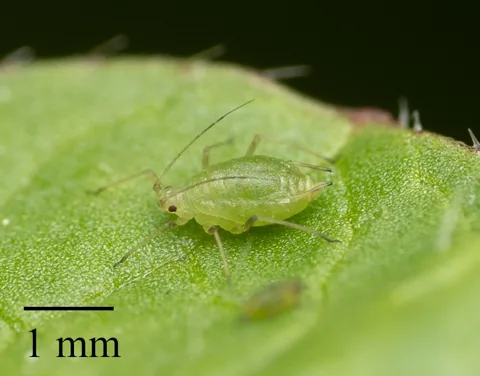 Aphids
Myzus persicae
Aphids are small, soft-bodied insects that pierce tender stems and leaves and suck out plant sap. Almost every plant hosts at least one aphid species, but established plants usually tolerate them, treating aphids for the plant's health is usually unnecessary, and natural enemies often bring numbers down.
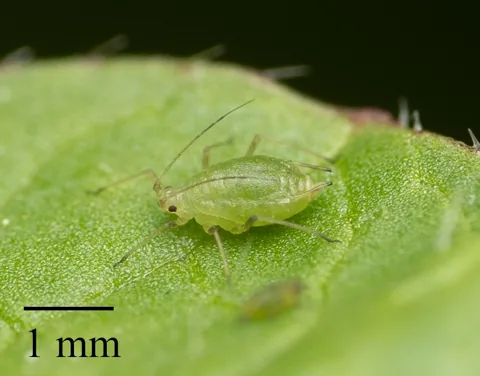 Green Peach Aphid
Myzus persicae
The green peach aphid is a small, pale green to yellowish aphid that overwinters on peach and other Prunus trees and spreads in summer to hundreds of vegetables, flowers and weeds. It carries many plant viruses and builds up so fast that it is a major greenhouse pest.
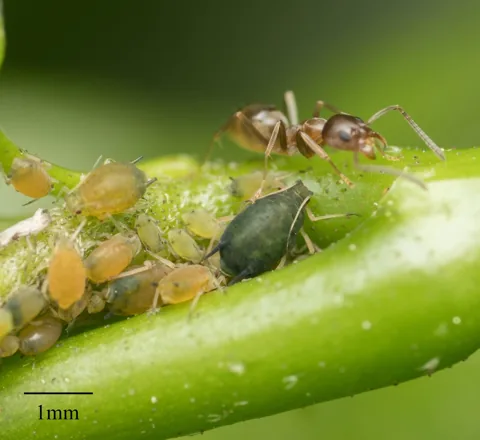 Melon aphid (cotton aphid)
Aphis gossypii
The melon aphid, also called the cotton aphid, is a small sap-feeding aphid with an unusually long host list. Large colonies distort leaves, coat plants and fruit with sticky honeydew and spread several plant viruses, and many populations resist common insecticides.
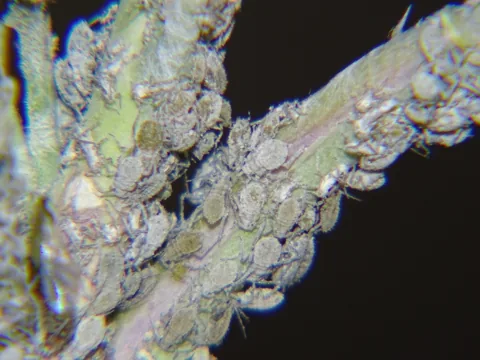 Cabbage Aphid
Brevicoryne brassicae
Dense, gray, powdery colonies on broccoli, cabbage, kale or Brussels sprouts are cabbage aphids. They feed only on the cabbage family and are worst on long-season fall crops, when cool weather lets populations explode.
 Oleander Aphid
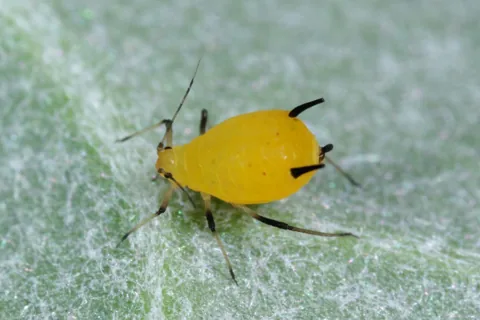
Aphis nerii
Bright yellow aphids crowding the new growth of milkweed, butterfly weed or oleander are oleander aphids, also called milkweed aphids. On milkweed grown for monarchs, skip insecticides and use simple hand methods instead.
 Woolly Apple Aphid
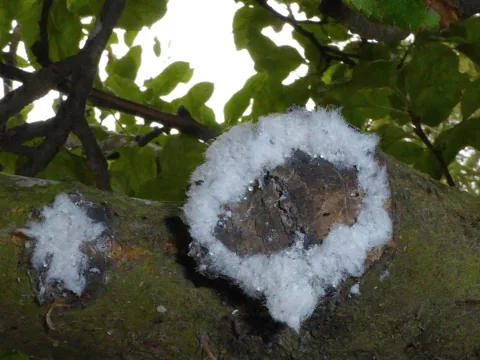
Eriosoma lanigerum
Fluffy white wax on apple bark and pruning wounds usually means woolly apple aphid; the real harm comes from galls they cause on roots.
How to tell it's aphids
Aphids are pear-shaped, soft-bodied insects with long legs and antennae. Color depends on the species and the plant: green, yellow, brown, red, black or gray. A few species are covered in white or gray wax that makes them look woolly. They usually feed in dense groups and, unlike leafhoppers and plant bugs, most don't scurry off when disturbed.[1][4][7][8]
- Size: 1/16 to 1/8 inch long (2 to 4 mm), per University of Minnesota Extension. Colorado State gives a slightly wider range, 1.5 to 5.0 mm, with the larger species living on stems and branches.[4][7]
- The tailpipes: most aphids have a pair of tube-like cornicles sticking backward from the rear of the body. UC IPM says cornicles set aphids apart from all other insects; UMN notes they're small and hard to see on some species.[1][4][7][8]
- Wings: adults are usually wingless, but winged forms appear when colonies get crowded, when the plant declines, and especially in spring and fall. Winged aphids are a little darker than wingless ones.[1][4][7]
- Cast skins: aphids shed their skins as they grow, and the white skins left on leaves or stuck in honeydew are often the first thing people notice.[4]
- Where to look: new, soft growth, unopened flower buds, the undersides of young leaves, stems, twigs, bark and even roots.[4][1]
- Woolly aphids: covered in white waxy strands that look like cotton. UMN says woolly aphid damage mostly affects how the plant looks, and the wax on the woolly alder aphid can be mistaken for a fungus. Colorado State adds that aphids which curl leaves, such as the leafcurl ash aphid, are wax-covered, as are most aphids that live on roots.[4][7]
Why aphid numbers explode
For most of the growing season, aphid colonies are all females that give birth to live young without mating. Young aphids molt about four times and there is no pupal stage. In warm weather many species go from newborn to reproducing adult in seven to eight days, and UC IPM says each adult can produce up to 80 offspring in about a week, often as many as 12 a day. UMN notes cabbage aphids can complete up to 15 generations in a season.[1][4]
Colorado State's figures are slower: a newborn aphid typically becomes full-grown in about 10 to 14 days, and adults usually produce three to five young a day over a life that may last about a month, though natural enemies usually cut it short. Either way, numbers can climb fast.[7]
When a colony gets crowded or the plant declines, winged aphids develop and leave for new plants. They're poor fliers but can ride the wind for miles. In many species, males appear in fall and females lay eggs that survive the winter on the plant, sometimes on a different host from the summer one.[4][1][7][8]
Some aphids switch plants with the seasons. Colorado State lists the green peach aphid wintering on peach, plum and apricot and spending summer on peppers, cabbage, potato and many other garden plants; the potato aphid winters on rose and moves to potatoes and tomatoes; and the rosy apple aphid winters on apple, pear and mountain-ash and moves to plantain. Eggs usually hatch in spring shortly after bud break.[7]
Damage, honeydew and sooty mold
Aphids feed with slender, needle-like mouthparts on plant sap. Often there are no visible symptoms. Heavy feeding turns leaves yellow, twists and curls them, and stunts or kills shoots. Some species inject a toxin that curls leaves, and a few cause galls.[4][1][7]
As they feed, aphids excrete a sticky, shiny, sugary liquid called honeydew. It coats leaves, bark and whatever sits under the plant, including cars and patio furniture. Honeydew draws ants, and yellowjackets especially in late summer and fall. A black sooty mold fungus often grows on it, leaving dark, fuzzy splotches on leaves and branches. Colorado State notes flies and bees also visit plants covered in honeydew.[4][1][7]
- Is honeydew harmful? UMN says honeydew generally does no harm to the plant, though it can stick leaves together, and the sooty mold that grows on it isn't harmful to trees either. You don't need to remove it from plants.[4]
- Washing it off plants: a strong water spray rinses off honeydew and sooty mold as it knocks off aphids. Clemson Extension says insecticidal soap also works as a leaf wash for honeydew and sooty mold.[4][1][9]
- Cars and outdoor surfaces: UMN says dish detergent or tar remover and a sponge will lift honeydew, but heavy-duty detergents and tar removers can damage paint and strip a car's clear coat. Test a small spot first.[4]
- Plant viruses: aphids spread viruses that mottle, yellow or curl leaves and stunt plants, including in squash, cucumber, pumpkin, melon, beans, potato, lettuce and beets. UC IPM says killing aphids rarely prevents this, because an aphid can transmit a virus in a few minutes, long before an insecticide kills it.[1][4][8]
When to leave aphids alone
Most larger plants tolerate light to moderate aphid numbers with little damage, and big populations often crash on their own once predators build up or hot weather arrives. UC IPM notes that some aphids can't take heat and are gone by midsummer, and that summer heat in California's Central Valley and deserts knocks down many species. On mature trees, aphids and their honeydew feed beneficial insects.[1]
- Usually tolerate: aphids on established trees and shrubs, a few colonies on sturdy garden plants, and woolly aphids on mature trees, which UMN says mainly affect appearance.[1][4][7]
- Worth acting on: seedlings and young transplants, which many vegetables are most vulnerable at, heavy colonies that are curling new growth, and honeydew that has become a real problem, such as dripping on cars parked under a tree.[1][4]
- Plants that commonly build up aphids: UC IPM lists flowering plums, roses, tulip trees, crape myrtles, apples and many vegetables.[1]
- Act early on leaf-curling species. Once leaves are curled, the aphids inside are sheltered from both sprays and natural enemies.[1]
Checking plants
Check plants at least twice a week while they're growing fast, so you can hose or prune before colonies spread. UC IPM says many aphids do the most damage in late spring when it's warm but not hot, about 65° to 80°F.[1]
- Look on the undersides of leaves, along the upwind edge of the garden, and near other plants of the same kind that already have aphids.[1]
- On trees, clip leaves from several parts of the canopy. Lots of ants climbing a trunk is a clue that aphids or other honeydew producers are higher up.[1]
- Count the helpers too: lady beetles, lacewings, syrphid fly larvae, parasitized mummies and disease-killed aphids. Plenty of these can mean the aphids are about to drop without any treatment.[1]
- Tell mummies from diseased aphids: parasitized aphids turn into crusty, bloated, tan to golden-brown mummies; a round hole shows where the adult wasp came out. Aphids killed by fungi turn reddish or brown, fuzzy and shriveled. Fungal disease can wipe out colonies in humid weather.[1]
- In vegetable gardens, infestations tend to be patchy. UW-Madison suggests looking for hot spots, checking plants in several areas, and repeating checks weekly.[8]
Let natural enemies do the work
Aphids have many predators and parasites, and they work best in yards that aren't sprayed with broad-spectrum insecticides such as organophosphates, carbamates and pyrethroids. Natural enemies usually don't show up in large numbers until aphids are plentiful, so there is a lag; UMN notes that because aphids multiply fast, predators need time to catch up.[1][4][8]
Timing matters. UW-Madison says aphids usually outpace their natural enemies in spring, when cool temperatures slow the predators down, and that natural controls work best in the warmer weather of summer and fall.[8]
- Parasitic wasps: tiny wasps lay eggs inside aphids, turning them into mummies. Their generations are short in warm weather, so mummies are a sign the colony will shrink substantially within a week or two. Colorado State describes the mummies as bloated, light brown or black, and stuck to the plant.[1][7]
- Lady beetles: both adults and larvae eat aphids, and Colorado State calls the larvae particularly voracious.[1][4][7]
- Lacewings: the larvae are the aphid hunters.[1][4][7]
- Syrphid (hover) fly larvae and soldier beetles also feed on aphids.[1][4][7][8]
- Help them stay: plant flowers that bloom at different times through the season for nectar and pollen, and avoid broad-spectrum sprays.[4][1][11]
- Buying lady beetles: UC IPM says purchased convergent lady beetles give at most temporary control, since most fly off within a few days, and that large numbers are needed. In UC research, one large, heavily infested rose bush took two releases a week apart of about 1,500 beetles each. Colorado State calls the record of released lady beetles in gardens typically poor: the beetles are highly dispersive, and field-collected ones usually aren't laying eggs when sold.[1][11]
- If you do release them: keep them refrigerated until release, let them go at dusk (daytime releases fly off at once), mist them and the plant with water, and set them at the base of infested plants or in low branch crotches.[1]
Water sprays, pruning and removing sources
A strong spray of water from a hose is the first thing to try on sturdy plants. Aphids are weak, and even a hard rain knocks them off; UMN notes you may see more aphids in seasons with lighter rain. Spray early in the day so leaves dry quickly in the sun and are less prone to fungal disease. You can also shake aphids off a plant. Colorado State adds that hosing can kill aphids outright and very few knocked to the ground find their way back.[1][4][7]
- Prune: where aphids are concentrated on a few curled leaves or new shoots, cut those parts off and dispose of them. In large trees, thinning the dense inner canopy where some aphids thrive makes it less suitable.[1]
- Weeds: sowthistle and mustards can carry large numbers of aphids that move to crop seedlings. Remove them near vegetable beds, though UC IPM notes infested weeds can also be an early source of natural enemies.[1][4]
- Transplants: check new plants for aphids and remove them before planting.[1]
- Perennials that die back in fall: on plants such as columbine, lupine and perennial asters, aphids lay eggs on the old leaves and stems in fall. Colorado State says removing the old top growth before new growth emerges in spring prevents the hatching aphids from reaching the plant. The trimmings can be composted, since hatchlings can only move inches before dying.[7]
Keep ants off trees and shrubs
Ants collect honeydew and in return protect aphids from lady beetles, parasitic wasps and other enemies, which lets aphid colonies grow. UC IPM calls managing ants a key part of aphid control on trees and shrubs.[1][2]
- Sticky band: wrap a band of sticky barrier material around the trunk so ants can't climb. Don't put it directly on the bark of young or thin-barked trees or trees that were severely pruned, because it can injure them. Wrap the trunk first with fabric tree wrap, duct tape or heavy paper and put the sticky material on the wrap.[1][2]
- Keep the band working: check it every week or two and stir the coating with a stick so dirt and dead ants don't form a bridge.[2]
- Close other routes: prune branches that touch buildings, the ground or other trees.[1][2]
- Ant baits: ant stakes or other enclosed baits set on the ground control ants without affecting aphids or their natural enemies.[1][2]
- Near the house: UC IPM's ant guide suggests not planting trees and shrubs that support lots of honeydew insects right next to buildings, since ant nests are often tied to those plants.[2]
Fertilizer, covers and reflective mulch
High levels of nitrogen fertilizer favor aphid reproduction. UC IPM advises using no more nitrogen than the plant needs, choosing less soluble or slow-release forms such as organic or urea-based time-release fertilizers, and applying small amounts through the season rather than all at once.[1]
Research backs this up for at least some aphids. A 2025 lab study of melon (cotton) aphid on cotton seedlings found that added nitrogen improved the aphids' performance, including how many young they produced, although the boost at the highest nitrogen level was smaller than at the next-highest.[6]
- Row covers for seedlings: many vegetables are hurt most as seedlings. Growing them under protective covers, or indoors, and transplanting them when older keeps aphids off and also prevents aphid-spread viruses.[1]
- Reflective mulch: silver-colored reflective mulch repels incoming aphids from seedlings and small plants, and UC IPM says it has been used to reduce aphid-spread viruses in summer squash, melon and other vegetables, and yields are usually higher.[1]
- What the research shows: in a 4-year Indiana pumpkin study, reflective mulch reduced the number of winged aphids landing, and in mid- to late July about 10 times more plants were infected with virus in black-mulch and no-mulch plots than in reflective-mulch plots. By the end of August nearly all plants in every treatment were infected, but the delay raised yields 45% over black mulch and 120% over no mulch.[5]
- Laying it: clear weeds, cover the bed, bury the edges with soil, then cut or burn 3- to 4-inch holes for seeds or transplants. Plastic mulch needs drip irrigation underneath. You can make your own by spray-painting construction paper, landscape fabric or clear plastic silver.[1]
- Remove reflective mulch when summer temperatures get high so plants don't overheat.[1]
Insecticidal soaps and oils, without hurting plants
When aphids are high and other methods haven't worked, UC IPM calls insecticidal soaps and oils the best choices for most situations. Oils include petroleum-based horticultural oil and plant oils such as neem and canola oil. They kill mainly by smothering, so only aphids that are actually wetted die. They leave no toxic residue, so natural enemies that move in after the spray aren't harmed, though ones hit by the spray can be killed.[1][10]
Insecticidal soaps sold for plants use potassium salts of fatty acids as the active ingredient. They're picked to kill insects with the least plant injury, unlike household soaps and detergents.[3][9]
- Coverage: spray to wet both sides of the leaves. For oils, UC IPM says a 1 to 2% solution applied with plenty of water is typical; follow the product label. Clemson gives 1 to 2% as the usual strength for insecticidal soap and warns against mixing it stronger.[1][4][9]
- Repeat: soaps and oils kill only aphids present on the day of spraying, so more applications may be needed. For pests such as spider mites and scale crawlers, a University of California Cooperative Extension sheet gives four to seven days between soap sprays. Clemson also gives 4 to 7 days between soap sprays; follow the label.[1][3][4][9]
- Heat and drought: UC IPM and Clemson say not to use soaps or oils on water-stressed plants or when it's over 90°F. Colorado State's oil fact sheet sets the limit for oils at above 100°F and says the heat risk is mostly about whether the plant is drought-stressed. Clemson also advises against spraying soap in full sun.[1][9][10]
- Sensitive plants: UCCE says most commercial insecticidal soaps list hawthorn, sweet pea, cherries and plums as sensitive, and some tomato varieties can be damaged. Check the label for your plant.[3][1][9]
- Clemson's list of soap-sensitive plants also includes portulaca, horse chestnut, mountain ash, Japanese maple, bleeding heart, maidenhair fern, lantana, nasturtium and gardenia, with azaleas, begonias, fuchsias, geraniums and impatiens somewhat sensitive. Colorado State says some plants are sensitive to oils too, and drought-stressed plants are more at risk.[9][10]
- Test first: spray a small part of the plant and wait before treating the rest. UC IPM says to wait several days, the UCCE sheet says a day or two, and Clemson says 24 hours.[1][3][9]
- Limit injury: UCCE says leaf damage builds with repeated sprays, and rinsing plants with water within a couple of hours after a soap spray reduces it. Clemson says to rinse with clean water if plants wilt or leaf edges brown within a few hours of a spray.[3][9]
- Homemade soap sprays: UCCE warns that dish soaps and hand soaps carry more risk of plant injury than insecticidal soaps, that dry dish soaps and all laundry detergents are too harsh for plants, and that many household soaps are poor insecticides.[3][9]
- Water and timing: hard water turns soap into scum and reduces control. Soaps may work better when spray dries slowly, early or late in the day.[3][9]
- Hidden aphids: aphids in curled leaves or galls, such as leaf curl plum aphid, aren't reached by any contact spray. UMN says woolly aphids aren't controlled by soaps or oils either, because of their wax and the leaves they curl. Prune instead.[1][3][4][7]
- Neem: UMN says neem (azadirachtin) discourages aphid feeding; aphids stop feeding and die slowly rather than quickly.[4]
- Soap plus pyrethrins: UC IPM says these mixes give slightly more knockdown than soap alone with fewer effects on natural enemies than malathion, permethrin or acephate, because pyrethrins break down very quickly. Colorado State says insecticidal soaps and pyrethrins last only minutes to hours on leaves and pose minimal hazard to beneficial insects.[1][7]
Dormant oil on fruit trees
On fruit trees, supreme- or superior-type horticultural oil sprayed as a delayed-dormant application, just as aphid eggs begin hatching in early spring, kills overwintering eggs. On plums, UC IPM prefers a dormant spray right after the leaves fall in early November. UC IPM says this won't give complete control and probably isn't justified for aphids alone, but it also controls soft scales. Aphids it targets include woolly apple, green apple, rosy apple, mealy plum and black cherry aphids.[1]
Colorado State says the oil has to cover the eggs, so it goes on during the dormant season before bud break. Most aphids on fruit trees, aspen and poplar, willows, pines, rose, lindens, maples, oaks, hawthorn and viburnum spend the winter as eggs on the plant and can be controlled this way; aphids that don't winter as eggs, such as the leafcurl aphids on ash, can't.[7][10]
Broad-spectrum and systemic insecticides: cautions
Stronger insecticides can kill more aphids than soaps and oils, but they also kill the natural enemies that keep aphids in check over the long run, so aphid problems can come back worse. Use them sparingly, if at all.[1][4][7]
- Contact and residual sprays: products with malathion, permethrin, bifenthrin, lambda-cyhalothrin, cyfluthrin or acephate (acephate on nonfood plants only, per UC IPM) last a week or more and kill many kinds of insects. UC IPM links them to bee kills, environmental problems and resistance with repeated use. Don't spray trees or shrubs in bloom. Colorado State notes that most retail aphid sprays of this kind are pyrethroids (ingredients ending in "thrin") and that none of them reach aphids inside curled leaves.[1][4][7]
- Systemic insecticides: imidacloprid and dinotefuran are taken up from the soil and move through the sap to where aphids feed. UC IPM says they're very effective on woody ornamentals with serious infestations, such as woolly hackberry aphid. UMN notes they don't contact natural enemies directly, but UC IPM says imidacloprid can still harm predators, parasitoids and pollinators. Colorado State adds that acetamiprid and imidacloprid sprays can reach aphids inside curled leaves.[1][4][7]
- Bees: UMN says imidacloprid and dinotefuran are very toxic to pollinators. UC IPM says not to apply them to plants in bloom or before bloom; UMN says to avoid bee-attractive plants or wait until bloom is over. Colorado State says not to apply soil systemics to plants that are flowering or soon will be, since imidacloprid can occur in pollen and nectar.[1][4][7]
- They're slow: a soil-applied systemic needs rain or irrigation to reach the roots, and it can take 2 to 4 weeks, per UMN, or several weeks, per UC IPM, to affect aphids in a tree. UC IPM says one application on hackberry controls woolly hackberry aphid for two to three years. Colorado State says it normally takes a couple of weeks in warm, moist soil; remove any mulch before pouring the product around the base, then put it back.[1][4][7]
- Availability: UC IPM, which writes for California, says that as of January 2025 these systemic products are available only to licensed pest control professionals. Colorado State says they're sold through licensed pesticide dealers, which include many garden centers. Read your product label and check your state's rules.[1][7]
- Resistance: UW-Madison says green peach and melon aphids have shown resistance to several insecticides, organophosphates in particular, and UC IPM warns that repeated use of the same material can lead to resistance.[8][1]
- Children and pets: UC IPM says soaps and oils are the safer choice where children and pets may be present.[1]
- Labels: whatever you use, including organic or natural products, read the label before buying and before applying, and make sure it lists the plant you're treating. The label is the legal authority on use.[4]
A simple aphid plan
- 1. Confirm aphids (pear shape, cornicles, cast skins, honeydew) and check for mummies, lady beetles and lacewing larvae.[4][1]
- 2. If the plant is established and natural enemies are present, wait and recheck in a few days.[1][4]
- 3. Hose off sturdy plants early in the day and prune out curled, packed shoots.[1][4]
- 4. Stop ants climbing trees and shrubs with a sticky band on a wrapped trunk or ground baits.[1][2]
- 5. Cut back on high-nitrogen fertilizer; protect seedlings with covers or reflective mulch.[1]
- 6. If aphids still build up, spray insecticidal soap or oil with full coverage, test first, skip hot days and stressed plants, and repeat as needed.[1][3]
- 7. Leave broad-spectrum and systemic insecticides for serious, persistent problems on woody plants, and keep them off flowering plants.[1][4]
Common questions
- What kills aphids naturally?
- Lady beetles and their larvae, lacewing larvae, syrphid fly larvae, soldier beetles and tiny parasitic wasps that turn aphids into tan mummies. Fungal diseases also wipe out colonies in humid weather. Avoid broad-spectrum sprays so these stay around.[1][4]
- Does spraying aphids with water work?
- Yes, on sturdy plants. A strong hose spray knocks most aphids off, and most can't get back on. It also washes off honeydew and sooty mold. Do it early in the day so leaves dry quickly.[1][4]
- Can I use dish soap on aphids?
- It can work, but University of California Cooperative Extension says household dish and hand soaps carry more risk of burning plants than insecticidal soap, laundry detergents and dry dish soaps are too harsh, and many household soaps are poor insecticides. Test any soap spray on a small area first.[3]
- Why are there ants on my aphid-infested tree?
- Ants feed on aphid honeydew and protect the aphids from their natural enemies. Keeping ants off the tree with a sticky band on a wrapped trunk, or with ground baits, lets predators and parasites bring the aphids down.[1][2]
- Is the black stuff on my leaves harmful?
- That's usually sooty mold growing on aphid honeydew. UMN says neither honeydew nor sooty mold harms the tree. A water spray rinses both off; controlling the aphids stops it coming back.[4][1]
- Will buying ladybugs get rid of aphids?
- Only briefly. UC IPM says most purchased lady beetles fly away within a few days, and it took two releases of about 1,500 beetles to control aphids on one large rose bush. Encouraging the lady beetles already in your yard works better.[1]
- Are aphids on houseplants handled the same way?
- The same low-risk tools apply: rinse them off, prune heavily infested parts, and use insecticidal soap if needed, following the label. University of California Cooperative Extension says soaps control aphids on most houseplants. See the houseplant pests guide for isolating and treating indoor plants.[3][1]
- Why do aphids come back every spring?
- Many aphids spend the winter as eggs on trees, shrubs and perennials, and the eggs hatch in spring. Colorado State says this happens shortly after bud break, which is why a dormant oil spray before bud break or removing old perennial stems can cut down the spring flush on some plants.[7][8][1]
Photo credits
- Aphids: Jesse Rorabaugh, public domain (CC0), via iNaturalist
- Green Peach Aphid: Jesse Rorabaugh, public domain (CC0), via iNaturalist
- Melon aphid (cotton aphid): Jesse Rorabaugh, public domain (CC0), via iNaturalist
- Cabbage Aphid: (c) Jesse Rorabaugh, some rights reserved (CC BY) — via iNaturalist, CC BY 4.0
- Oleander Aphid: (c) Franz Anthony, some rights reserved (CC BY) — via iNaturalist, CC BY 4.0
- Woolly Apple Aphid: (c) Mike Bowie, some rights reserved (CC BY) — via iNaturalist, CC BY 4.0
Sources
- University of California Statewide IPM Program, “Pest Notes: Aphids.” ipm.ucanr.edu/home-and-landscape/aphids/ (accessed 2026-11-11)
- University of California Statewide IPM Program, “Pest Notes: Ants.” ipm.ucanr.edu/home-and-landscape/ants/ (accessed 2026-11-11)
- University of California Cooperative Extension, Central Sierra, “Soap Sprays as Insecticides (Scott Oneto).” ucanr.edu/sites/default/files/2015-05/212467.pdf (accessed 2026-11-11)
- University of Minnesota Extension, “Aphids in home yards and gardens.” extension.umn.edu/yard-and-garden-insects/aphids (accessed 2026-11-11)
- Journal of Economic Entomology, abstract via PubMed, “Brust 2000, Reflective and black mulch increase yield in pumpkins under virus disease pressure.” pubmed.ncbi.nlm.nih.gov/10902337/ (accessed 2026-11-11)
- Journal of Economic Entomology, abstract via PubMed, “Gao, Li and Lu 2025, Bottom-up effects of nitrogen fertilizer on cotton growth and population expansion of Aphis gossypii.” pubmed.ncbi.nlm.nih.gov/40221838/ (accessed 2026-11-11)
- Colorado State University Extension, “Aphids on Shade Trees and Ornamentals (Fact Sheet 5.511).” extension.colostate.edu/topic-areas/insects/aphids-on-shade-trees-and-ornamentals-5-511/ (accessed 2026-11-11)
- University of Wisconsin-Madison Extension, Wisconsin Horticulture, “Aphids (K. Delahaut).” hort.extension.wisc.edu/articles/aphids/ (accessed 2026-11-11)
- Clemson Cooperative Extension Home and Garden Information Center, “Insecticidal Soaps for Garden Pest Control (HGIC 2771).” hgic.clemson.edu/factsheet/insecticidal-soaps-for-garden-pest-control/ (accessed 2026-11-11)
- Colorado State University Extension, “Insect Control: Horticultural Oils (Fact Sheet 5.569).” extension.colostate.edu/resource/insect-control-horticultural-oils/ (accessed 2026-11-11)
- Colorado State University Extension, “Lady Beetles (Fact Sheet 5.594).” extension.colostate.edu/resource/lady-beetles/ (accessed 2026-11-11)