The short answer
- Use slow-acting sweet bait, not sprays. Argentine ants take sweet baits all year. University of California IPM calls borate baits the most effective ones available to consumers, and says low-strength liquid borate in sugar water (0.5 to 1.0%) in refillable stations does the most to the colony, though results take several days to a week.[1]
- Put the bait where the ants already trail, keep it full, and don't spray near it. The workers have to carry it home and share it before they die.[1][2]
- Outdoors, set bait stations around the house in shady spots along trails; UC IPM says usually at least one on each side of the house.[1]
- Fix the yard: leaky faucets and sprinklers, overwatering, clutter and mulch against the foundation, and branches touching the house.[1][2]
- Keep ants off trees and shrubs with sticky trunk bands, and manage the aphids, soft scales and mealybugs they tend. Expect to manage Argentine ants, not eliminate them for good: UC IPM calls it unrealistic to eliminate ants from an outdoor area.[1]
Argentine ants and the pests they tend
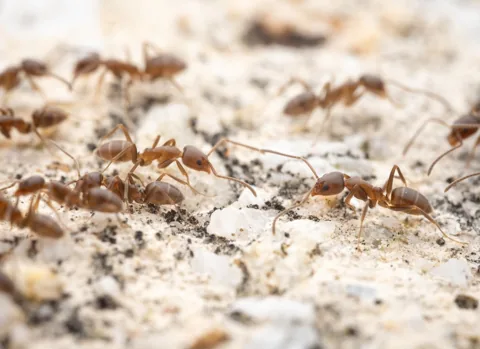 Argentine Ant
Linepithema humile
The Argentine ant is the most common ant in and around homes in California; its nests are linked into huge multi-queen supercolonies. It is native to Argentina and Brazil. Texas A&M says it was discovered in New Orleans in 1891, is now established in many places in the southern United States, and has been found in Arizona, California, Illinois, Maryland, Missouri, Oregon, Texas and Washington.
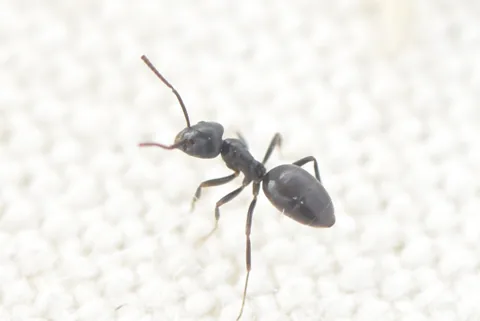 Odorous House Ant
Tapinoma sessile
The odorous house ant is a small native ant found across most of the United States that trails into homes for sweets and gives off a strong, rotten odor when crushed. Texas A&M says it ranges from Canada to Mexico but is rarely found in the southwestern deserts.
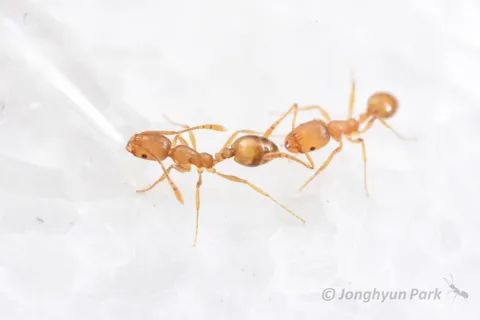 Pharaoh Ant
Monomorium pharaonis
The Pharaoh ant is a tiny, yellowish ant that nests inside heated buildings and is a serious pest in hospitals, apartments, hotels and food businesses. Texas A&M says it occurs throughout the United States but generally only in heated buildings, because it usually can't survive outdoors all year; it does nest outside in subtropical areas such as Hawaii, Florida and southern Texas.
No photo yet
Vine mealybug
Planococcus ficus
Vine mealybug is an invasive mealybug that now occurs in all the major grape-growing areas of California. Unlike the other mealybugs found on grapes, it lives on roots as well as on the trunk, leaves and clusters, and it can spread grapevine leafroll viruses.
Is it an Argentine ant?
Argentine ants are light to dark brown, with one node in the waist, and all the workers are about the same size. Sources differ on that size: Texas A&M and UC IPM give 1/8 inch, while Clemson's fact sheet says about 1/16 inch. Queens are larger. They do not sting, though Clemson says they may bite when provoked.[3][1][2]
The behavior gives them away: trails of thousands of ants running to food, often along pipes and wires. Clemson says the trails can run 200 feet or more from the nest. Crushed workers may give off a musty odor. Clemson notes that the odorous house ant, which is often confused with the Argentine ant, smells of rotten coconut when crushed.[2][1]
Argentine ants are introduced: native to Argentina and Brazil, found in New Orleans in 1891, and now established across much of the southern United States and in California, with other populations in states including Arizona, Oregon and Washington. UC IPM calls it the most common ant in and around the house and garden in California. If you are not sure which ant you have, use the ant identification guide linked below before buying bait.[3][2][1]
Why they keep coming back: supercolonies
Unlike most ant species in California, UC IPM says, Argentine ant colonies aren't separate but linked to form one large supercolony with multiple queens, and Texas A&M describes colonies of many nests holding hundreds of queens and many thousands of workers, with ants moving freely between nests. Clemson says a colony is roughly 10% queens.[1][3][2]
New nests form by budding: one or more queens walk off with a group of workers to a new site rather than going out on their own as most ants do. Texas A&M says colonies split in spring and summer, and both Texas A&M and Clemson say colonies come together for the winter and divide again in spring or summer. The nests are shallow and flimsy, and the ants move them often.[1][3][2]
This is why killing the ants in one nest, or in your house, rarely ends the problem. Texas A&M says new colonies quickly move into an area after colonies are eliminated from a building. In a southern California study, ants marked at feeding stations near homes were found at least 61 m (200 feet) away, and after bait and spray treatments the researchers concluded that the ants coming back were immigrants from untreated areas. The researchers concluded that much larger areas likely need treatment in urban settings.[3][4]
Not every population behaves the same. A genetic study found no aggression between Argentine ant colonies in California, which form a supercolony, while colonies in the southeastern United States were strongly aggressive toward each other.[11]
Sweet liquid baits: the main tool
A bait mixes a slow-acting insecticide with food. Foragers carry it home and pass it mouth to mouth to other workers, larvae and queens. UC IPM says baits are a key tool for ants and the only type of insecticide it recommends in most situations, and that properly used they are more effective and safer than sprays.[1]
For Argentine ants, choose sweet bait. UC IPM says sweet baits attract them all year, while protein baits attract them mainly in spring. Texas A&M also says they are particularly attracted to sweet baits. If you are unsure, UC IPM suggests offering a small amount of more than one type and watching which the ants take.[1][3]
- Low concentration works better on the colony. UC IPM says prepackaged borate stations usually hold 5.4% borate, which can kill foragers in the home but is less effective against major infestations because foragers die before they get the bait home. Liquid borate at 0.5 to 1.0% in sugar water has more effect on the colony.[1]
- Research gives a narrower picture of the low end. In laboratory tests with 25% sugar water, 1% boric acid had the delayed kill a bait needs, while 0.5% did not. Another study found the ants drank noticeably less sugar water when it held more than 1% boric acid.[5][6]
- Fast-acting baits defeat the purpose. UC IPM says bait stations with propoxur or indoxacarb aren't very effective because they act too quickly, and that granules containing cyfluthrin or permethrin look like bait but are contact insecticides that kill foragers without controlling the colony.[1]
- Active ingredients in ant baits sold to homeowners include boric acid and other borates, fipronil, hydramethylnon and avermectin (abamectin). Look for the active ingredient on the label and follow the label directions.[1]
Where to put baits and how to keep them working
Indoors, Clemson says to place baits at the closest point to where the ants come in, make sure they are feeding, and not to disturb or spray the ants at the bait. Give them a few days to carry it back to the colony. While baiting, wipe up trails and food residue so the bait is the best meal around.[2][1]
Outdoors is where you reach the colony. UC IPM recommends liquid bait in larger refillable stations, placed in shady areas where ants trail, usually at least one on each side of the house, checked regularly and refilled as needed. Refillable stations matter because liquid bait is used up quickly or dries out, and Texas A&M also advises regular checks to see whether stations need replenishing.[1][3]
How far apart? There is no homeowner rule in the extension sources used here. In California vineyards, ants carried marked sugar water an average of 12 to 16 m and generally foraged within 36 m, though a few went as far as 63 m. The researchers suggested bait stations at intervals of 36 m or less. That is a farm figure, but it shows why one station in a corner of a large yard is not enough.[8]
- Start early. UC IPM says treatments in late winter and early spring, when ant numbers are just beginning to grow, are the most effective.[1]
- Don't use insecticide sprays while you are baiting, and replace bait that has dried up or gone rancid.[1]
- Keep stations out of reach of children and pets. UC IPM notes stations can be tucked into mulch so they aren't immediately visible.[1]
- Expect a delay. With low-dose liquid borate, UC IPM says it may take several days to a week to see results.[1]
Why sprays disappoint
Spraying the ants you see indoors does not stop more from coming in, according to UC IPM. A foundation spray kills foragers, usually a small part of the colony, without reaching the queens; the ants build back up and invade again, and barrier sprays sometimes trap ants indoors and make things worse. UC IPM also says not to spray pyrethroids such as bifenthrin and cypermethrin outdoors, especially on driveways, sidewalks and foundations, because they wash into waterways, and California regulations now limit pyrethroid perimeter treatments.[1]
Not every extension source rules sprays out. Texas A&M says perimeter treatments with a wettable powder or microencapsulated product repel foragers when Argentine ants are numerous and dominant, and that nests found outdoors can be drenched with a residual insecticide. Clemson also says sprays or granules can be applied to nests or around the structure, provided all nests are treated. Texas A&M turns to bait stations along trails when colonies can't be found, and Clemson calls baiting the preferred treatment indoors.[3][2]
For a quick fix while bait takes hold, UC IPM says vacuuming trails or wiping them with soapy water may be as effective as a spray at temporarily removing foraging ants, and soapy water also removes their scent trail.[1]
Fix the yard: water, shelter and routes in
Argentine ants nest in moist, but not wet, places. Outdoors Texas A&M and Clemson list spots under stones, boards, logs, slabs and mulch, in rotting wood and stumps, along sidewalks, and in exposed or covered soil. UC IPM says the nests are often shallow, just below the surface, but go deeper in dry soil.[3][2][1]
- Water: fix leaky faucets and sprinkler heads, which draw thirsty ants, and Clemson advises keeping lawn and flowerbed watering to a minimum so the soil isn't kept moist.[1][2]
- Shelter: clear piles of boards, plywood, sheets of tin, construction materials and decaying plant debris from the yard.[2]
- Foundation strip: keep plants, grass and mulch away from the foundation. UC IPM's quick tips say at least a foot.[1]
- Routes in: trim branches and shrubs touching the house or power lines, and caulk cracks around the foundation and where pipes and wires enter.[2][1]
- Indoors: store sweets and pet food in closed containers, clean up spills, and check potted plants, which the ants may nest in. Texas A&M says indoor nests are usually near water pipes, sinks and potted plants.[1][3]
Ants on trees and shrubs: the honeydew connection
Argentine ants feed heavily on honeydew, the sugary waste of aphids, soft scales, mealybugs and whiteflies. UC IPM says outbreaks of scales and aphids frequently occur when ants tend them, because the ants protect them from their natural enemies. So ants on a plant usually point to a sap-feeding pest problem, and the two need to be managed together.[1][2]
Research backs this up. In Spanish citrus orchards, keeping ants out of trees lowered California red scale on the fruit by 21 to 41%, and in the orchard dominated by Argentine ants it also reduced woolly whitefly. In California vineyards, liquid sugar baits reduced Argentine ants and fruit damage at most sites, but their effect on mealybugs was inconsistent, and the authors advise treating liquid baiting as a program over several seasons, since the sap feeders can take longer to drop after the ants are suppressed.[12][7]
- Band the trunk. UC IPM says a band of sticky material keeps ants out of trees and shrubs. On young or sensitive trees, protect the trunk from injury by wrapping it with a collar of heavy paper, duct tape or fabric tree wrap and putting the sticky material on that; check it every one or two weeks, and stir it with a stick so debris and dead ants don't form a bridge. The sticky band guide covers this in detail.[1]
- Cut off the bypasses. Trim branches so they don't touch buildings or other plants, forcing the ants to climb the banded trunk.[1]
- Bait near the tree. UC IPM says bait stakes can also be used around trees.[1]
- Treat the sap feeders too: see the aphid and scale insect guides for the next steps. When planting near the house, UC IPM suggests avoiding trees and shrubs that support large numbers of honeydew-producing insects.[1]
When to call a professional, and what they may use
Clemson calls Argentine ants one of the most persistent and troublesome house-infesting ants and says a pest management professional may be needed when colonies are very large. UC IPM recommends hiring one trained in IPM if baits, exclusion and sanitation don't solve it, and notes professionals have access to more effective materials, such as fipronil, and to equipment that can prevent environmental contamination. Ask for baits and spot treatments rather than monthly perimeter sprays.[2][1]
University of California researchers tested a lower-impact professional program: one perimeter spray of 0.03% fipronil mixed with an ant trail pheromone at the start of the season, followed by baiting with 1% boric acid in a biodegradable water-absorbing gel. Compared with programs that used follow-up sprays, they reported it was effective and economically feasible. In earlier field tests in heavily infested areas, sugar-water hydrogels with the higher of the very low thiamethoxam doses tested worked better than the lowest, and the authors suggest hydrogels may be a cost-effective way to deliver liquid bait.[9][10]
Other approaches under study include trail pheromones that confuse foraging, mass trapping, deterrents and RNA interference. A 2021 review covers them as alternatives to broadcast insecticide sprays.[13]
Common questions
- Why do Argentine ants come back after the exterminator sprays?
- Sprays kill foragers, not the queens in many linked nests, and ants from untreated neighboring areas move in. In a California study, the researchers concluded that ants returning after treatment came in from untreated areas.[1][4]
- What bait works best on Argentine ants?
- A slow-acting sweet liquid bait. UC IPM recommends liquid borate at 0.5 to 1.0% in sugar water in refillable stations outdoors; stronger prepackaged borate stations kill foragers but do less to the colony.[1]
- Can I make my own boric acid ant bait?
- The extension sources used here don't give a homemade recipe, and any pesticide use should follow a registered product's label. UC IPM says low-concentration borate products registered for home use exist but may be hard to find in stores.[1]
- Are Argentine ants dangerous?
- They don't sting, though they may bite when provoked. Clemson notes that because they also feed on garbage, sewage and dead animals, food they have walked through may need to be thrown out.[2]
- How do I tell Argentine ants from odorous house ants?
- Both are small brown one-node ants that trail to sweets. Clemson says crushed odorous house ants smell of rotten coconut, while crushed Argentine ants may have a musty odor. The ant identification guide covers the differences.[2]
- Will Argentine ants ever go away completely?
- Usually not from an outdoor area. UC IPM calls total elimination unrealistic; the goal is keeping them out of the house and off valuable plants. Clemson says complete control requires eliminating all nests.[1][2]
Photo credits
- Argentine Ant: Philipp Hoenle, public domain (CC0), via iNaturalist
- Odorous House Ant: Thompson Hyggen, public domain (CC0), via iNaturalist
- Pharaoh Ant: (c) Jonghyun Park, some rights reserved (CC BY) — via iNaturalist, CC BY 4.0
Sources
- University of California Statewide IPM Program, “Ants: Pest Notes for Home and Landscape.” ipm.ucanr.edu/home-and-landscape/ants/ (accessed 2026-11-10)
- Clemson Cooperative Extension, Home & Garden Information Center, “HGIC 2401: Argentine Ants.” hgic.clemson.edu/factsheet/argentine-ants/ (accessed 2026-11-10)
- Texas A&M AgriLife Urban and Structural Entomology Program, “Argentine Ant, Linepithema humile.” urbanentomology.tamu.edu/urban-pests/ants/argentine/ (accessed 2026-11-10)
- Journal of Economic Entomology, via PubMed, “Vega and Rust (2003), Determining the foraging range and origin of resurgence after treatment of Argentine ant in urban areas, J Econ Entomol 96:844-849.” pubmed.ncbi.nlm.nih.gov/12852625/ (accessed 2026-11-10)
- Journal of Economic Entomology, via PubMed, “Rust, Reierson and Klotz (2004), Delayed toxicity as a critical factor in the efficacy of aqueous baits for controlling Argentine ants, J Econ Entomol 97:1017-1024.” pubmed.ncbi.nlm.nih.gov/15279286/ (accessed 2026-11-10)
- Journal of Economic Entomology, via PubMed, “Klotz et al. (2000), Toxicity and repellency of borate-sucrose water baits to Argentine ants, J Econ Entomol 93:1256-1258.” pubmed.ncbi.nlm.nih.gov/10985039/ (accessed 2026-11-10)
- Journal of Economic Entomology, via PubMed, “Daane et al. (2008), Testing baits to control Argentine ants in vineyards, J Econ Entomol 101:699-709.” pubmed.ncbi.nlm.nih.gov/18613568/ (accessed 2026-11-10)
- Journal of Economic Entomology, via PubMed, “Hogg et al. (2018), Foraging distance of the Argentine ant in California vineyards, J Econ Entomol 111:672-679.” pubmed.ncbi.nlm.nih.gov/29361129/ (accessed 2026-11-10)
- Journal of Economic Entomology, via PubMed, “Choe et al. (2021), Development and demonstration of low-impact IPM strategy to control Argentine ants in urban residential settings, J Econ Entomol 114:1752-1757.” pubmed.ncbi.nlm.nih.gov/33970228/ (accessed 2026-11-10)
- Journal of Economic Entomology, via PubMed, “Rust et al. (2015), Laboratory and field evaluations of polyacrylamide hydrogel baits against Argentine ants, J Econ Entomol 108:1228-1236.” pubmed.ncbi.nlm.nih.gov/26470250/ (accessed 2026-11-10)
- Molecular Ecology, via PubMed, “Buczkowski, Vargo and Silverman (2004), The diminutive supercolony: the Argentine ants of the southeastern United States, Mol Ecol 13:2235-2242.” pubmed.ncbi.nlm.nih.gov/15245397/ (accessed 2026-11-10)
- Bulletin of Entomological Research, via PubMed, “Calabuig, Garcia-Mari and Pekas (2014), Ants affect the infestation levels but not the parasitism of honeydew and non-honeydew producing pests in citrus, Bull Entomol Res 104:405-417.” pubmed.ncbi.nlm.nih.gov/24229500/ (accessed 2026-11-10)
- Insects, via PubMed, “Suiter et al. (2021), Alternative methods of ant control with emphasis on the Argentine ant, Linepithema humile, Insects 12:487.” pubmed.ncbi.nlm.nih.gov/34073959/ (accessed 2026-11-10)