❓ Common Questions About Pharaoh Ant
How do I confirm I actually have this pest (not something similar)?
The most reliable confirmation is a physical specimen — capture one and compare to reference images on this page. For cryptic pests (bed bugs, termites), look for secondary signs: frass, shed skins, mud tubes, or bites with a specific pattern. When uncertain, a professional inspection is faster than months of misidentification.
Can I treat this myself or do I need a professional?
DIY is effective for small, accessible infestations caught early. Professionals are worth the cost when: the infestation is inside wall voids or structural elements, multiple rooms are affected, you have health-risk pests (hantavirus, venomous species), or DIY has already failed twice.
How long until the infestation is completely gone?
Expect 3–8 weeks for most infestations with proper treatment. Insects with dormant life stages (pupae, eggs) extend the timeline because those stages are impervious to most insecticides. Follow-up treatments at 2 and 4 weeks catch each new cohort as they emerge.
What's the most common mistake people make treating this pest?
Treating only the visible pest population while ignoring the harborage site, entry point, or breeding location. Killing adults provides temporary relief but the population rebuilds from hidden egg cases, pupae, or new arrivals through unaddressed entry points.
Exterior ant control: where the colony actually lives
Interior ant trails almost always lead to an exterior colony — the kitchen ants are foragers from a colony in the yard, under a paver, in a planter, or against the foundation. Exterior treatment with a non-repellent product (fipronil, chlorantraniliprole, indoxacarb) applied as a band around the foundation (twelve inches up the wall, twelve inches out from the foundation) intercepts foragers during their commute and transfers via contact to the rest of the colony. This is more durable than interior-only treatment because new foragers never reach the structure. For specific colony locations (visible mound, paver, planter), direct treatment with a drench or granule labeled for the species is highly effective. Both approaches work better than scattered exterior 'ant killer' applications without a target.
When to escalate from DIY to professional
DIY pest control is appropriate for most common household pests when caught early and treated correctly. Escalation to a licensed professional makes sense in specific situations, not just when frustration builds. Wall-void and structural infestations — termites, carpenter ants, rodents nesting inside walls — usually require equipment and access homeowners don't have. Bedbugs at moderate-to-heavy infestation levels almost always require professional treatment; DIY rarely succeeds past the first few isolated bugs. Multi-unit dwellings (apartments, condos) need building-wide coordination that individual unit treatments can't replicate. Health-sensitive households — anaphylaxis risk to stings, immunocompromised individuals, pregnancy, infants — should default to professional because professionals can use the lowest-toxicity option that solves the problem rather than what's available at retail. The financial break-point is roughly when DIY material costs approach one professional visit; below that, DIY is usually fine.
When to call a professional for ants
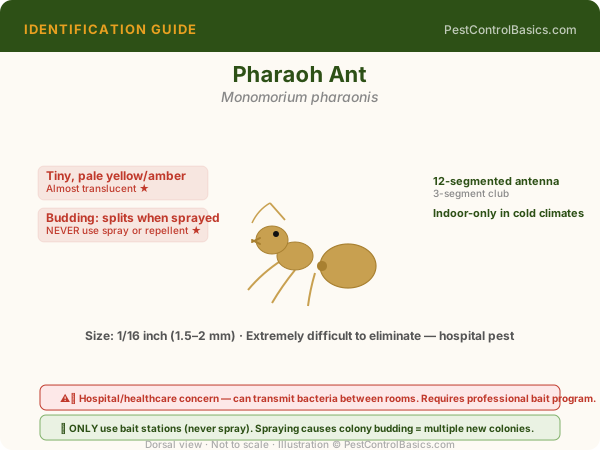
DIY ant control handles most situations. Professional service is justified when: the species is Pharaoh ants (multi-colony budding makes DIY treatment counterproductive without the right product set), carpenter ants with structural moisture issues that require diagnosis, the colony location is inside wall voids or inaccessible spaces where homeowner application can't reach, the home has had three or more recurrences in a year despite reasonable DIY treatment, or the household includes people with serious ant venom allergies. Professional treatment usually combines exterior non-repellent perimeter, targeted bait at active colony locations, and structural exclusion work. Quarterly treatment programs in high-pressure regions (southern states, areas with established Argentine ant populations) are reasonable insurance against recurrence.
Carpenter ants signal a moisture problem first
Carpenter ants don't eat wood — they excavate galleries in wet or previously wet wood. A carpenter ant infestation almost always points to a moisture source: roof leak, plumbing leak, missing flashing around windows or chimneys, wet siding, or moist crawlspace wood. Treating the ants without finding the moisture source produces a temporary kill and a long-term recurrence. The investigation order: identify where the ants are entering (foragers tend to follow consistent paths along edges), look for parent and satellite colony evidence (frass piles of wood and insect parts — different from termite frass), find the moisture source feeding the colony location, and treat both the moisture and the colony. Boric acid bait, fipronil bait, or non-repellent perimeter products combined with moisture remediation produce durable control.
Working with extension services and public resources
Every state has a Cooperative Extension Service — a university-affiliated public outreach program — and most homeowners don't know it exists. Extension publishes pest fact sheets specific to local conditions, offers free pest identification (often by photo submission), and runs Master Gardener volunteer programs that handle public inquiries. State departments of agriculture license and regulate pest control operators; their websites verify licenses and accept complaints. State and local health departments track vector-borne diseases and publish risk data that's more current than national averages. The EPA's pesticide product database lets you look up registered uses for any product before buying. The National Pesticide Information Center (1-800-858-7378) answers homeowner pesticide questions free of charge. These resources are paid for by taxes already; underusing them in favor of paid services is leaving money on the table.
Outdoor ant management: protecting the indoor perimeter
Many indoor ant problems originate from outdoor colonies that find access points into the structure, which means the most effective long-term ant management often happens outdoors. Reducing landscape conditions that support colonies near the foundation is the first step: pulling mulch back six to twelve inches from the foundation, trimming shrubs and tree branches that touch the structure (eliminating direct access bridges), removing leaf litter and debris from the foundation area, and addressing any wood debris (firewood, scrap lumber) stored against the structure. Granular baits applied to the perimeter address foraging colonies, while perimeter sprays (where appropriate) create a brief barrier during peak pressure periods. The granular and liquid approaches work together: granular baits target the colony, liquid perimeter sprays kill foraging individuals that would otherwise cross. For chronic problems, identifying and treating actual colony locations (typically following workers back to their entry points, then tracing further) is more efficient than blind perimeter treatment.
How treatment thresholds change what 'success' should mean
Most homeowners frame pest control as elimination — zero individuals seen — but professional programs operate on threshold concepts that better match what's actually achievable and economically reasonable. A treatment threshold is the population level at which intervention is justified; below it, the cost and disruption of treatment outweigh the damage prevented. For aesthetic pests like the occasional ant or spider, the threshold is essentially zero only because tolerance is low, not because zero is biologically realistic. For pests with health implications (cockroaches, rodents) or property damage potential (termites, carpenter ants), thresholds are set well below visible damage to allow time for response. The implication for self-evaluation: a program that drops a cockroach population by 95% without reaching zero may be functioning correctly, and pushing for the last 5% may require disproportionate effort or treatment intensity that creates other problems. Reframing 'success' as durable reduction below threshold rather than absolute zero produces saner program design, more reasonable expectations of paid services, and less wasted DIY effort chasing the long tail of a population that's already controlled in any practical sense.
Why different ant species need different baits
The category 'ant bait' covers products with very different active ingredients and matrices, and matching the right bait to the species is critical. Sugar-loving species — common pavement ants, odorous house ants, Argentine ants — respond to liquid sugar baits like borax-based sugar bait. Protein-feeding species and species with seasonal preferences shift toward protein require oil- or protein-based bait matrices. Carpenter ants are technically protein/sugar-feeding but respond best to specific protein-rich baits like indoxacarb-based products. Pharaoh ants are notoriously difficult and respond only to specific bait formulations (typically methoprene-based growth regulator baits or hydramethylnon at low concentrations); standard ant sprays will cause Pharaoh ant colonies to bud and multiply, making the problem dramatically worse. Identifying the species — typically possible from a clear photograph — and selecting the right bait matrix multiplies effectiveness compared to using a single 'all ants' product. Many DIY ant treatments fail not because the homeowner used a bad product but because the right product was used against the wrong species.
Odorous house ants: why they're harder than they look
Odorous house ants are one of the most commonly misidentified household ant species, and the misidentification often leads to treatment failure. These ants have multiple queens per colony, satellite nests in multiple locations, and the ability to relocate the colony rapidly if disturbed, which means that spray treatments often produce a brief reduction followed by relocation and re-emergence in a new location nearby. The right approach for odorous house ants is non-repellent bait, applied where foragers are active, with explicit avoidance of any contact spray that would disrupt the trail and trigger relocation. Bait acceptance can be slow with this species, often taking days to a week before colony-level effects appear, and treating impatience by switching to a faster-acting spray is precisely the mistake that creates a chronic problem. Homeowners frustrated with persistent small ant infestations are very often dealing with odorous house ants treated repeatedly with the wrong approach; switching to a bait-only protocol and tolerating the slower onset typically resolves problems that years of spraying could not.
The economics of preventive versus reactive treatment
Preventive treatment costs money in a year when nothing is happening, which is precisely why most households avoid it. The decision to spend on prevention requires a willingness to compare what you actually spend against a counterfactual you never directly observe — the infestations you would have had without it. This is a hard mental move, and it's why preventive pest control consistently underconsumed relative to its economic value. The way to think about it more clearly is to compute the expected annual cost of treatment for a property like yours given local pest pressure, then compare that against the cost of a preventive program. In most regions and for most property types, a preventive program comes in lower in expected value, sometimes substantially. The variance is also lower: instead of a year with zero pest spending followed by a year with a large unexpected expense, you have a small consistent line item that smooths out the cash flow. For households where unexpected expenses are particularly painful, that variance reduction is itself worth something even before counting the expected-value benefit.
Nuptial flights: what swarming ants tell you about pressure
Most ant species produce reproductive swarms — winged males and females leaving the colony to mate and establish new colonies elsewhere — and the timing of these flights is one of the most useful diagnostic signals in residential ant management. A nuptial flight near or inside a structure indicates that a mature colony exists nearby, often within a few hundred feet, and that new colonies are about to be established in surrounding areas. For species that infest structures, this is the moment at which exclusion work has the highest leverage: sealing gaps now prevents the new mated queens from finding harborage in walls and voids. Different species swarm at different times of year and under different conditions, with most species favoring warm, humid post-rain afternoons. Recognizing the swarm event, identifying the species from the alate morphology, and acting on exclusion within the same season is dramatically more effective than waiting until the new colonies announce themselves as visible trails six months later. Homeowners who learn the swarm patterns for their specific region can use the events as a calendar trigger for inspection and prevention rather than treating them as the curiosity they're often dismissed as.