❓ Common Questions About Odorous House Ant (OHA)
How do I confirm I actually have this pest (not something similar)?
The most reliable confirmation is a physical specimen — capture one and compare to reference images on this page. For cryptic pests (bed bugs, termites), look for secondary signs: frass, shed skins, mud tubes, or bites with a specific pattern. When uncertain, a professional inspection is faster than months of misidentification.
Can I treat this myself or do I need a professional?
DIY is effective for small, accessible infestations caught early. Professionals are worth the cost when: the infestation is inside wall voids or structural elements, multiple rooms are affected, you have health-risk pests (hantavirus, venomous species), or DIY has already failed twice.
How long until the infestation is completely gone?
Expect 3–8 weeks for most infestations with proper treatment. Insects with dormant life stages (pupae, eggs) extend the timeline because those stages are impervious to most insecticides. Follow-up treatments at 2 and 4 weeks catch each new cohort as they emerge.
What's the most common mistake people make treating this pest?
Treating only the visible pest population while ignoring the harborage site, entry point, or breeding location. Killing adults provides temporary relief but the population rebuilds from hidden egg cases, pupae, or new arrivals through unaddressed entry points.
When to call a professional for ants
DIY ant control handles most situations. Professional service is justified when: the species is Pharaoh ants (multi-colony budding makes DIY treatment counterproductive without the right product set), carpenter ants with structural moisture issues that require diagnosis, the colony location is inside wall voids or inaccessible spaces where homeowner application can't reach, the home has had three or more recurrences in a year despite reasonable DIY treatment, or the household includes people with serious ant venom allergies. Professional treatment usually combines exterior non-repellent perimeter, targeted bait at active colony locations, and structural exclusion work. Quarterly treatment programs in high-pressure regions (southern states, areas with established Argentine ant populations) are reasonable insurance against recurrence.
How professional pest control programs differ from one-off treatments
A single treatment — DIY or professional — addresses what's visible today, but most pest pressure is cyclical. Professional pest control programs that work long-term are structured around inspection, monitoring, treatment, and follow-up as a recurring cycle rather than discrete events. The inspection phase identifies conducive conditions (moisture, harborage, food access, exclusion gaps) that one-time treatments don't address. The monitoring phase uses sticky traps, bait stations, or visual sweeps to catch population rebounds early, before they become visible infestations again. The treatment phase targets the specific life stages active during that visit — different than blanket spraying everything. The follow-up phase verifies treatment efficacy and adjusts. Homeowners can replicate this structure on a quarterly or seasonal schedule without buying expensive equipment, and the underlying logic — track, treat targeted, verify — produces consistently better results than reactive treatment after problems become obvious.
Bait placement specifics that improve uptake
Where bait is placed matters as much as which bait. Place bait directly on trails when possible — workers find it faster than placements at points without active traffic. Use multiple small placements rather than fewer large ones; ants share food via trophallaxis, so distributed availability collapses the colony faster than concentrated availability. Replace fresh bait every few days during heavy uptake — ants ignore dried-out or contaminated bait, and continuous fresh availability accelerates colony collapse. Don't combine repellent sprays in the same area as the bait, and don't clean trails with surface cleaners during the treatment window (the trail pheromone helps recruit workers to the bait). If uptake is low after several days, switch bait type — colonies sometimes shift feeding preference seasonally.
Exterior ant control: where the colony actually lives
Interior ant trails almost always lead to an exterior colony — the kitchen ants are foragers from a colony in the yard, under a paver, in a planter, or against the foundation. Exterior treatment with a non-repellent product (fipronil, chlorantraniliprole, indoxacarb) applied as a band around the foundation (twelve inches up the wall, twelve inches out from the foundation) intercepts foragers during their commute and transfers via contact to the rest of the colony. This is more durable than interior-only treatment because new foragers never reach the structure. For specific colony locations (visible mound, paver, planter), direct treatment with a drench or granule labeled for the species is highly effective. Both approaches work better than scattered exterior 'ant killer' applications without a target.
Common DIY mistakes that defeat otherwise correct treatments
Most DIY pest control failures aren't product failures — they're application failures. The recurring patterns we see across reader emails and field experience: treating only where pests are visible rather than where they live (the active surface is rarely the harborage), spraying repellents over residual products and breaking the residual film, applying baits in already-treated areas (the residual kills foragers before they return with bait), overdiluting product because 'less chemical is safer' (it's not — it accelerates resistance), expecting overnight results when the kill curve is two to four weeks for most products, and stopping treatment at the first sign of improvement rather than completing the protocol. Each of these failure modes is independently preventable with attention to the product label and the pest's biology, and avoiding them improves outcomes more than upgrading to a more expensive product.
Carpenter ants and what they're really telling you
Carpenter ant activity is sometimes treated as a standalone pest problem, but it's almost always a symptom of underlying moisture or wood condition issues that deserve attention. Carpenter ants excavate galleries in wood that's already softened by moisture or decay; they don't initiate damage in sound dry wood. Finding carpenter ant activity indoors implies that somewhere in the structure, wood is wet or has been wet — a slow plumbing leak, a window flashing failure, ice dam damage from a previous winter, condensation in an unventilated wall cavity, or roof leak in an attic. Eliminating the visible carpenter ants without finding and correcting the moisture source produces temporary results: the existing colony dies, but new colonies establish in the same damp wood. The diagnostic worth pursuing involves walking the perimeter looking for sources of water intrusion, checking under sinks and around toilets, inspecting attic for any roof leaks, and tracing carpenter ant frass (which looks like coarse sawdust) back to its source. Repairing the moisture issue and treating the ants together produces durable results.
The cost of doing nothing: implicit pest tolerance and its hidden expenses
Pest control discussions usually frame the costs of treatment without quantifying the costs of non-treatment, but the latter are often larger and almost always less visible. Cockroach allergens add measurable healthcare costs in homes with asthma. Rodent activity in attics damages insulation (reducing R-value and adding seasonal heating and cooling costs) and creates fire risk through wire chewing that doesn't show up until something fails. Termite damage in unmonitored properties produces structural repair bills in the five-figure range, often discovered during unrelated renovation. Stored-product pests destroy food inventory at rates that aren't tracked because items are discarded individually rather than tallied. The cumulative cost of doing nothing isn't a single line item but a sum of small chronic losses across years. The framing that helps: pest control isn't a luxury expense layered onto a working baseline; it's a maintenance expense that competes with the slow accumulating cost of allowing a problem to continue. Households running the comparison honestly almost always find that modest preventive spending is the cheaper path.
Ant trail disruption: counterproductive in most cases
When an ant trail appears in a kitchen or pantry, the instinctive response is to wipe it down with cleaner and remove visible ants, but this approach often makes the problem worse. Foraging trails carry workers between the colony and a food source; wiping the trail disrupts the pheromone path and triggers scouts to find new routes, often producing multiple smaller trails replacing the original concentrated one. The better approach is to let an active trail run while placing bait near it and waiting. Ants encountering bait carry it back along the trail to the colony; trail integrity ensures bait moves efficiently back to feed larvae and the queen. After 24-48 hours of bait deployment, trail activity typically increases briefly as workers retrieve bait, then declines sharply as the colony begins to fail. Cleaning the trail prematurely interrupts this process and forces re-baiting. The discipline is counterintuitive — tolerating visible ants while bait works — but produces colony-level elimination rather than the temporary trail removal that wiping accomplishes.
Nuptial flights: what swarming ants tell you about pressure
Most ant species produce reproductive swarms — winged males and females leaving the colony to mate and establish new colonies elsewhere — and the timing of these flights is one of the most useful diagnostic signals in residential ant management. A nuptial flight near or inside a structure indicates that a mature colony exists nearby, often within a few hundred feet, and that new colonies are about to be established in surrounding areas. For species that infest structures, this is the moment at which exclusion work has the highest leverage: sealing gaps now prevents the new mated queens from finding harborage in walls and voids. Different species swarm at different times of year and under different conditions, with most species favoring warm, humid post-rain afternoons. Recognizing the swarm event, identifying the species from the alate morphology, and acting on exclusion within the same season is dramatically more effective than waiting until the new colonies announce themselves as visible trails six months later. Homeowners who learn the swarm patterns for their specific region can use the events as a calendar trigger for inspection and prevention rather than treating them as the curiosity they're often dismissed as.
Why product instructions are often suboptimal in practice
Pesticide labels are legal documents written to satisfy regulatory requirements, not field guides written to maximize success in a specific home. The instructions cover the broadest reasonable use case, which means they're rarely tuned for the specific construction type, climate, or pest pressure you're dealing with. A label might call for application every six weeks because that's what the registration data supports across a wide range of conditions, but the actual reapplication interval that matches the residual life of the active ingredient in your specific application context could be shorter or longer. This is not an invitation to ignore label directions — doing so is illegal and frequently dangerous — but it does mean that following the label is the floor, not the ceiling, of good practice. Knowledgeable users overlay the label with conditions-aware judgment: shorter re-treatment intervals during heavy rain or high humidity, denser application in known harborage, and supplementary monitoring after treatment to verify that the work actually performed as expected. The label tells you what's permitted; experience tells you what's optimal within that envelope.
Odorous house ants: why they're harder than they look
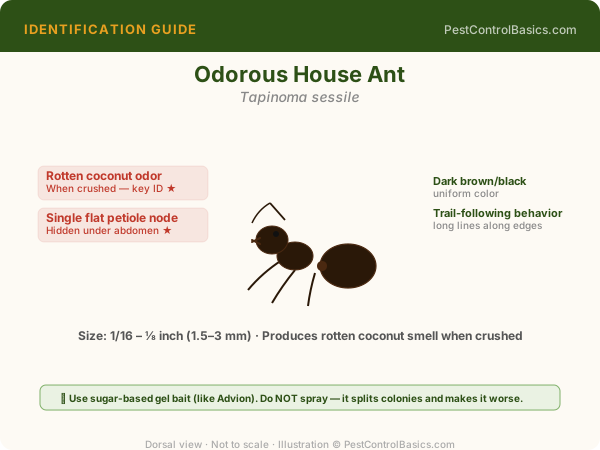
Odorous house ants are one of the most commonly misidentified household ant species, and the misidentification often leads to treatment failure. These ants have multiple queens per colony, satellite nests in multiple locations, and the ability to relocate the colony rapidly if disturbed, which means that spray treatments often produce a brief reduction followed by relocation and re-emergence in a new location nearby. The right approach for odorous house ants is non-repellent bait, applied where foragers are active, with explicit avoidance of any contact spray that would disrupt the trail and trigger relocation. Bait acceptance can be slow with this species, often taking days to a week before colony-level effects appear, and treating impatience by switching to a faster-acting spray is precisely the mistake that creates a chronic problem. Homeowners frustrated with persistent small ant infestations are very often dealing with odorous house ants treated repeatedly with the wrong approach; switching to a bait-only protocol and tolerating the slower onset typically resolves problems that years of spraying could not.