On this page
How to identify it
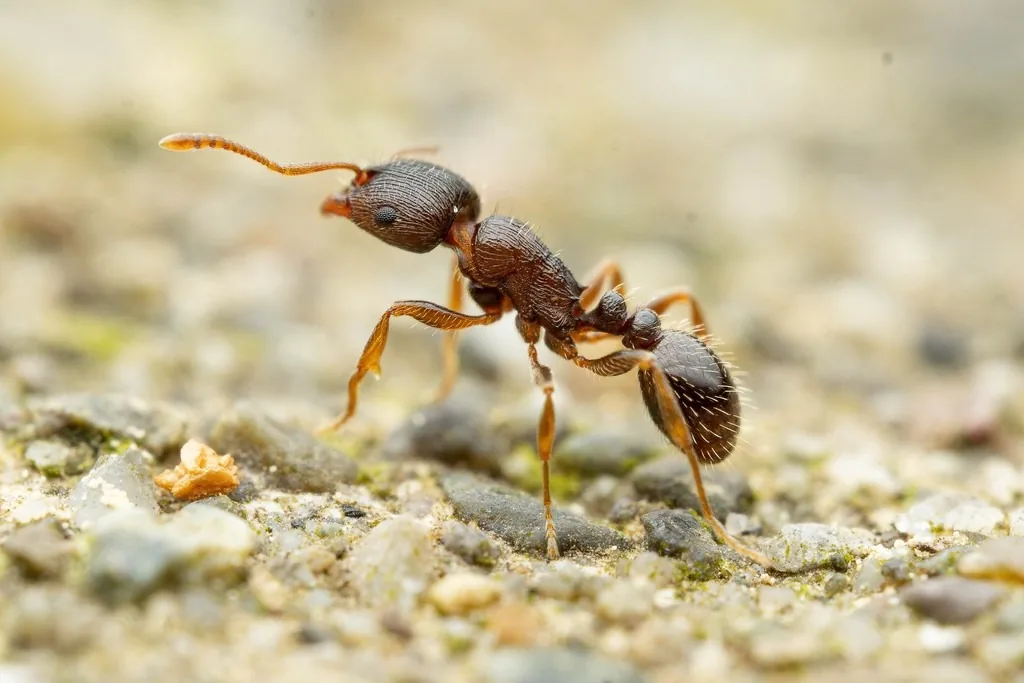
- Workers are dark brown to black. Sources give slightly different sizes: Penn State says about 2.5 to 4 mm, UC IPM 3/16 inch, and Minnesota about 1/8 inch.[1][2][5]
- Under magnification, parallel grooves run along the head and thorax, and two small spines point up and back from the rear of the thorax.[1][5]
- The waist has two nodes.[1][2][5]
- Small piles of sand or soil appear at cracks in sidewalks, slabs and foundation walls where they dig out nests.[1]
- Winged reproductives are about twice the size of workers and also have a grooved head and thorax; Penn State says the spines show on females but not on males.[1]
Look-alikes
| Look-alike | How to tell them apart |
|---|---|
| Odorous house ant | Has a single hidden node at the waist, no grooves or spines, and smells rotten when crushed.[3][5] |
| Winged termites | Winged pavement ants have a narrow waist, elbowed antennae and hind wings smaller than front wings; termites have a broad waist and equal wings.[2][5] |
Where it lives
Found from New England through the Midwest and Mid-Atlantic to Tennessee, and in parts of California and Washington; colonies nest under sidewalks, building slabs and large rocks and enter buildings through cracks in foundations and slabs.[1]
Biology and life cycle
Likely brought to the United States in ship ballast soil from Europe in the 1700s and 1800s.[1]
Winged reproductives usually swarm in spring but can emerge almost any time of year inside heated buildings. Penn State says swarms in late fall and into February are not unusual even in cold climates. Minnesota gives May through July for swarms and says they can also happen indoors in winter when the nest is under a heated slab.[1][5]
After mating, queens burrow into the soil and start laying eggs, and Penn State says workers develop over a two-to-three-month period. Little is known about their colony biology; most of it comes from watching the ants above ground.[1]
Workers eat almost anything: sweets, grease, dead insects and seeds. Minnesota also lists meats, pet food, bread and nuts, and Penn State says grease, dead insects and small seeds are stored in the nest.[1][2][5]
Most colonies are under sidewalks, building slabs and large rocks. Minnesota says they are common under homes built on concrete slabs, entering through cracks in the concrete, and can sometimes nest indoors in wall voids.[1][5]
Workers lead nestmates to food with chemical trails. Researchers identified the trail pheromone of T. immigrans as a single compound from the poison gland, and in field tests synthetic trails leading to apple bait recruited workers.[6]
Penn State and UC IPM use the older name Tetramorium caespitum for this ant. Minnesota Extension and recent research use T. immigrans (formerly T. caespitum), the name iNaturalist lists for North American pavement ants.[1][2][5][6][4]
Damage and signs
- Indoors, workers will eat nearly any food that falls to the floor.[1]
Health risk
Pavement ants carry a stinger in the last abdominal segment but are mainly a food-contamination nuisance.[1]
Control
Prevention
Keep plants, grass and mulch several inches from the foundation, fix leaky faucets and sprinklers, and manage aphids and scales whose honeydew feeds ants.[2]
Keep them out
Follow trails to where ants enter, then caulk cracks around foundations and where pipes and wires come in; ants like to trail along wires and pipes.[2]
Sanitation
Store sugar, syrup, honey and pet food in closed containers wiped clean on the outside, rinse soft drink cans, clean up grease and spills, and take garbage out daily.[2]
Vacuum trails or wipe them with soapy water, which removes the scent trail; indoor sprays usually aren't necessary.[2]
Pesticides
Use slow-acting baits (for example boric acid, fipronil or hydramethylnon) where ants are active so workers carry bait to the colony; keep baits stocked and expect two weeks or longer for control.[1]
Perimeter sprays kill only foragers, not the colony or queens, and ants quickly rebuild; baits are the recommended insecticide in most situations.[2][5]
Minnesota says to look for and treat outdoor nests first. If you can't find one, a perimeter spray gives only temporary control, and when pavement ants nest under a heated slab, baiting is the most effective approach.[5]
Common questions
- Why are there little piles of sand on my floor?
- Pavement ants nesting under slabs push excavated soil out through cracks, leaving small sand piles indoors and along sidewalks.[1]
- Do pavement ants sting?
- They have a stinger, but they're mainly a nuisance that forages for food.[1]
- Why are winged ants coming up through my floor in winter?
- Pavement ants nesting under a heated slab can swarm indoors in winter. Penn State says winged pavement ants can emerge almost any time of year in heated buildings, and Minnesota says winged ants swarming inside a building point to an indoor nest. Baiting is the most effective control for nests under a heated slab.[1][5]
Sources
- Penn State Extension, “Pavement Ant.” extension.psu.edu/pavement-ant (accessed 2026-11-11)
- University of California Statewide IPM Program, “Pest Notes: Ants, Publication 7411 (October 2012).” ipm.ucanr.edu/legacy_assets/PDF/PESTNOTES/pnants.pdf (accessed 2026-11-11)
- Penn State Extension, “Odorous House Ant.” extension.psu.edu/odorous-house-ant (accessed 2026-11-11)
- iNaturalist, “Tetramorium immigrans taxon page (order and family).” www.inaturalist.org/taxa/569552 (accessed 2026-11-11)
- University of Minnesota Extension, “Ants.” extension.umn.edu/insects-infest-homes/ants (accessed 2026-11-11)
- Journal of Chemical Ecology, via PubMed, “Chalissery et al. (2022), Identification of the trail pheromone of the pavement ant Tetramorium immigrans (Hymenoptera: Formicidae), J Chem Ecol 48(3):302-311.” pubmed.ncbi.nlm.nih.gov/34738201/ (accessed 2026-11-11)