The short answer
- Identify the ant first. Its species tells you where it nests and what it eats, and so how to treat it.[4][1]
- Follow the trail back to where the ants come in and, if you can, to the nest. Clean the trail with soapy water and caulk the entry point.[1][4]
- Use a slow-acting bait that matches what the ants are eating: sweet baits for sugar feeders such as Argentine ants, protein or grease baits for thief and pharaoh ants, oily baits for fire ants.[1][4]
- Don't spray while you bait. Sprays kill the workers that would carry bait home, and with pharaoh ants repellent sprays can split one colony into several.[4][1][6]
- Expect baits to take several weeks or more. Pharaoh ant baiting can take several months to a year.[1][4][6]
- Carpenter ants need their nests found and treated, and the moisture problem fixed. Fire ants in the yard respond best to the two-step method.[2][5][11]
Ant profiles
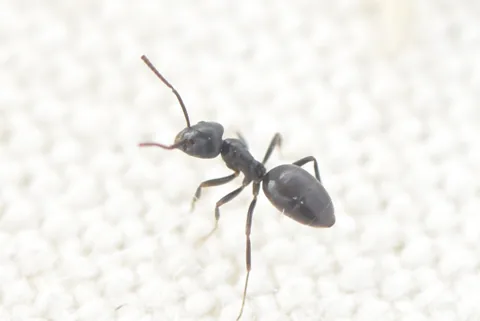 Odorous House Ant
Tapinoma sessile
The odorous house ant is a small native ant found across most of the United States that trails into homes for sweets and gives off a strong, rotten odor when crushed. Texas A&M says it ranges from Canada to Mexico but is rarely found in the southwestern deserts.
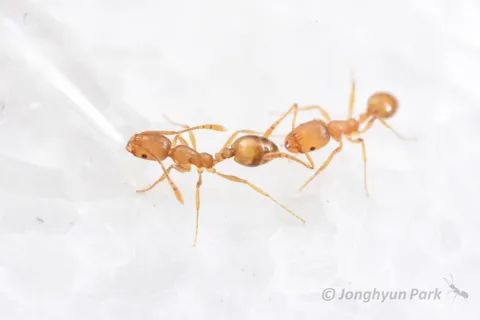 Pharaoh Ant
Monomorium pharaonis
The Pharaoh ant is a tiny, yellowish ant that nests inside heated buildings and is a serious pest in hospitals, apartments, hotels and food businesses. Texas A&M says it occurs throughout the United States but generally only in heated buildings, because it usually can't survive outdoors all year; it does nest outside in subtropical areas such as Hawaii, Florida and southern Texas.
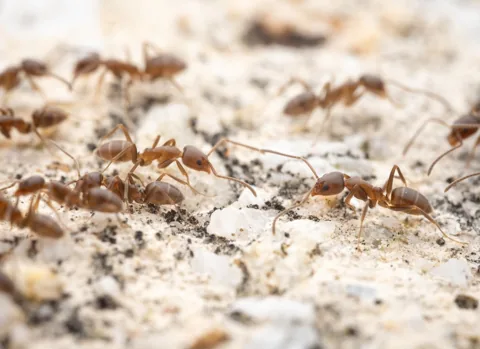 Argentine Ant
Linepithema humile
The Argentine ant is the most common ant in and around homes in California; its nests are linked into huge multi-queen supercolonies. It is native to Argentina and Brazil. Texas A&M says it was discovered in New Orleans in 1891, is now established in many places in the southern United States, and has been found in Arizona, California, Illinois, Maryland, Missouri, Oregon, Texas and Washington.
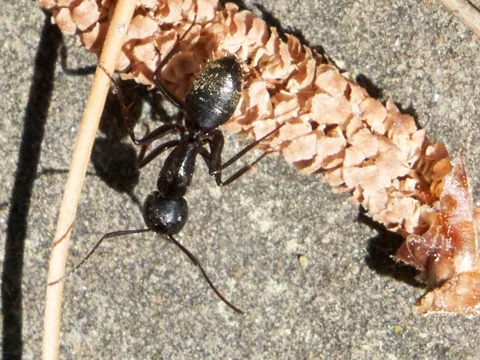 Carpenter Ants
Camponotus species
Carpenter ants don't eat wood the way termites do; they excavate it to nest, usually starting where wood is damp or decayed, and indoor nests are often satellites of a parent colony outdoors. Minnesota and Clemson extension both stress that they don't eat wood; they tunnel into it to make a nest.
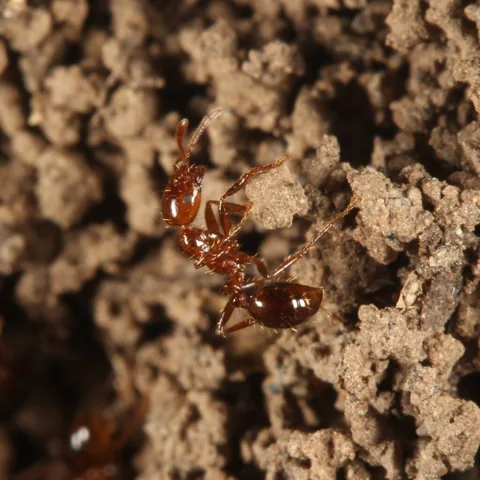 Red Imported Fire Ant
Solenopsis invicta
The red imported fire ant is an aggressive stinging ant that infests most of the southern United States and parts of California, building mounds in open, sunny areas such as lawns, parks and roadsides. USDA APHIS says imported fire ants came from South America, probably in soil on cargo ships, and now infest more than 367 million acres in Alabama, Arkansas, California, Florida, Georgia, Louisiana, Mississippi, North Carolina, Oklahoma, South Carolina, Tennessee, Texas, Virginia and Puerto Rico.
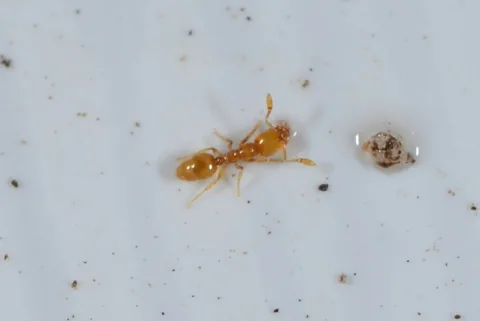 Thief Ant
Solenopsis molesta
The thief ant is a tiny native ant named for nesting near larger ants and stealing their food, larvae and pupae. Also called the grease ant, it trails indoors to greasy and protein-rich foods and is small enough to get into packaged food.
Why spraying the ants you see doesn't work
Minnesota Extension says the most effective way to control ants is to get insecticide into the nest and kill the queens, and that killing foraging workers has little effect because only a small share of the ants are out of the nest at any one time. UC IPM puts the share for carpenter ants at about 10%.[4][2]
UC IPM's ant Pest Note makes the same point about perimeter sprays around a foundation: they kill foraging ants without killing the colony and its queens, so the population builds back up and invades again. Barrier sprays sometimes make things worse by trapping ants indoors.[1]
Step 1: Identify the ant, then find the trail and nest
Ants lay a scent (pheromone) trail between food and the nest, and they use the same routes over and over, so the trail is a map. Minnesota Extension suggests setting out food the ants like to get them foraging, then watching where they go; it may take 30 minutes or longer to follow them to the nest.[4]
Follow the trail in both directions. UC IPM says to look for where the ants are coming into the building and, if possible, trace them to the nest; ants often enter through holes and cracks in foundations and walls and travel along pipes, wires, baseboards and other structural edges.[1]
Many ants that show up in kitchens nest outdoors and come in for food. Others, including pharaoh, odorous house and Argentine ants, can nest inside wall voids, behind baseboards and cabinets, and near water pipes and sinks.[4][6][8][9]
- Winged ants swarming inside the house mean there is probably a nest indoors.[4][5]
- Carpenter ants forage mostly at night. Penn State suggests checking the basement, attic, garage and exterior with a flashlight between 10:00 p.m. and 2:00 a.m. from May through July.[5][4]
- If you can't tell which ant you have, use the ant field guide linked below, or ask an expert who can identify it.[4]
Step 2: Match the bait to the ant
Ant baits mix a slow-acting insecticide with a food: sugars, proteins, oils, or a combination. Different attractants work for different ants, and some species change what they want through the year as the colony's needs change.[1][4]
UC IPM's simplest test is to offer a small amount of a sweet bait and a protein bait side by side and see which one the ants feed on. A refillable station with two or more cups lets the ants choose.[1]
- Sweet feeders: Argentine ants take sweet baits year-round and protein baits mainly in spring. Odorous house ants and carpenter ants also feed on sweets and honeydew, though both take insects or other protein too.[1][9][4]
- Protein and grease feeders: thief ants and pharaoh ants prefer protein or greasy baits year-round.[1]
- Fire ants prefer oily baits. Fire ant baits are corn grits coated with soybean oil that carries the insecticide.[1][11][3]
- Carpenter ants are finicky. UC IPM suggests first putting out nontoxic sugar milk (equal parts sugar and milk) or diced crickets or mealworms, then swapping in several toxic baits once they're feeding and letting them choose.[2]
Step 3: Bait so the workers carry it home
A bait only works if workers live long enough to share it with the rest of the colony, including the queens and brood. UC IPM says bait stations with propoxur or indoxacarb aren't very effective against household ants because the insecticide acts too fast, and borate stations with 5.4% borate kill foragers in the home but do less to major infestations. Liquid borate baits at 0.5 to 1.0% in sugar water have more impact on the colony.[1][6]
- Outdoors first. UC IPM recommends baiting mainly outdoors and using baits indoors only for a serious infestation when you can't find where ants get in, since indoor bait can draw more ants inside.[1]
- Put baits on or next to trails and near nests. Outside, UC IPM spaces stations every 10 to 20 feet around the foundation and at nest openings.[1][4]
- Use enough bait. Minnesota Extension lists too little bait, competing food, changing food preferences, and bait contaminated by pesticide or household chemicals as reasons baits fail.[4]
- Remove competing food: crumbs, sweet residues and spills in cracks around sinks and pantries.[1][4]
- Check and refill stations. Liquid baits get used up or dry out, and baits can go rancid.[1][6]
- Avoid granular "bait" products that contain cyfluthrin or permethrin. UC IPM says they are contact insecticides that kill foragers fast and don't control the colony.[1]
- Keep baits away from pets and small children, and confirm ants are a target pest on the label.[1][2]
Bait vs spray, and why sprays break up pharaoh ant colonies
Minnesota Extension says not to spray insecticide while using bait, because spraying keeps ants from carrying the bait back to the nest. UC IPM adds that if ants can be washed away and kept out, indoor sprays aren't needed at all: vacuuming the trail or mopping it with soapy water removes the scent trail and can work as well as a spray to get rid of foragers for a while.[4][1]
Pharaoh ants are the clearest case for baits over sprays. Their colonies spread across many nests, often in wall or cabinet voids and behind baseboards, with workers moving freely between them, and some colonies have hundreds of queens. Texas A&M says liquid or dust formulations of repellent insecticides are not recommended indoors because they typically cause colony budding, where groups of workers carry brood off to start new nests, which makes the infestation worse.[6][1][14][3]
Lab studies show how fast this happens. At Universiti Sains Malaysia, almost all workers moved and carried the entire brood to a new nest site by day 1 after a pyrethroid was applied to their nest. At Purdue, cypermethrin, a repellent pyrethroid, caused colony budding, though the response was delayed. In a 2025 UC Riverside study of store-bought aerosol sprays, pyrethroid-based sprays made budding more likely at a low application rate, and essential-oil-based sprays did so at a high rate.[14][13][15]
- For pharaoh ants, Texas A&M recommends placing bait stations extensively throughout the building along trails where the ants are active, so that workers from every colony feed on them.[6]
- Check stations routinely and replace them when the bait is gone. In warm months, place baits outdoors where ants are seen.[6]
- Purdue's lab study found that nonrepellent liquid insecticides controlled pharaoh ants as indoor treatments; fipronil gave a 100% reduction in activity by 2 days after treatment on concrete and mulch.[13]
Non-repellent perimeter treatments
A perimeter treatment is a residual insecticide applied in a band around the outside of the foundation. Minnesota Extension says one can keep ants out when you can't find the nest, though spraying is temporary and has little to no effect on the nest itself.[4][1]
Repellent and non-repellent products work differently. In UC Riverside tests, fast-acting bifenthrin and beta-cyfluthrin cut off recruitment, so fewer Argentine ants were exposed and killed, while slower-acting fipronil let ants keep foraging across the treated surface, so more of the colony was exposed. Penn State describes the non-repellent professional perimeter product for carpenter ants: it is applied outside, ants don't avoid it, and usually only one treatment is needed.[17][5]
- In a Purdue study around apartment buildings, fipronil left 2% of pretreatment ant numbers at 8 weeks; imidacloprid and cyfluthrin matched it for 4 and 2 weeks, respectively. Treatments ran 2 feet up the wall and 3 feet out from it.[16]
- UC IPM and Penn State note that fipronil perimeter products are applied by licensed professionals; retail perimeter sprays are mostly pyrethroids such as bifenthrin, cypermethrin and lambda-cyhalothrin.[1][2][5]
- UC IPM says every-other-month perimeter spray programs carry more risk of environmental harm than baits in stations and are less effective than a bait-based program, and California restricts pyrethroid perimeter sprays because of water quality.[1]
- Don't spray where you have bait out, and follow the label. The perimeter spray guide linked below covers application limits.[4][1]
Carpenter ants: find and treat the nests
Carpenter ants don't eat wood; they hollow it out for nests, often starting where wood is wet or decayed. Indoor nests are usually satellites of a parent colony outdoors in a tree, stump, woodpile or landscaping. Penn State says the parent colony is often within 100 yards of the house, and that both the parent and satellite nests must be destroyed or the ants will be back within days or weeks.[2][5][7]
Look for piles of coarse, stringy sawdust mixed with dead insect parts sifting out of cracks, behind moldings and under porches, and listen for a faint rustling in walls. Check wood near roof leaks, bad flashing, gutters, sweating pipes and leaking tubs or showers.[5][2]
- Treat the nest directly. UC IPM says to apply insecticide into the nest, drilling holes if needed; pyrethroid sprays such as permethrin or cyfluthrin and dusts of disodium octaborate tetrahydrate or desiccants such as diatomaceous earth work. Avoid breathing desiccant dusts.[2]
- Indoors, Texas A&M says all insecticides should be applied only as crack, crevice or hole treatments. Dusts puffed into holes reach the voids where ants are active.[7][5]
- Treat or remove outdoor nests in trees, stumps and wood piles with a product labeled for that use.[5][7]
- Fix the moisture. Texas A&M calls moisture the most important factor in attracting carpenter ants. Repair leaks, replace decayed wood, and keep wood dry; Penn State says carpenter ants usually won't infest sound wood below 15 percent moisture.[7][5]
- Trim branches off the house, keep mulch 2 to 3 inches deep, and store firewood off the ground and away from the house.[2][7]
- Penn State says it is unlikely a satellite colony can be eliminated without one or more professional-use products, and Minnesota Extension says carpenter ant control usually needs a professional.[5][4]
Fire ants: the two-step method
Texas A&M's fire ant program calls the two-step method the best proven approach for fully infested yards (five or more mounds for each quarter-acre). Step one is broadcasting a fire ant bait over the whole yard; step two is treating individual problem mounds.[11][12]
UC IPM recommends baits for fire ants because foragers carry them back to the colony. Spraying foraging ants won't control a colony, and spraying a mound may make the colony disperse.[3]
- Step one: broadcast bait with a hand-held seed spreader, ideally between late August and mid-October so it works over the winter. Use fresh bait from an unopened container, apply when the ground is dry and no rain is expected for 24 to 48 hours, and don't mix it with fertilizer or seed.[11][3]
- Apply when ants are foraging. Put a little bait or a greasy food next to a mound; if ants find it within 30 minutes, they are active. UC IPM gives 70 to 90°F as the best range.[11][3]
- Step two: treat mounds that are a nuisance with a labeled drench, granule, dust or bait. Drenches generally eliminate mounds within a few hours; granules are watered in with 1 to 2 gallons without disturbing the mound.[11]
- Hot water: 2 to 3 gallons of very hot or boiling water poured on a mound kills the ants about 60% of the time and kills the grass it touches. Otherwise the ants usually move.[11]
- Timing of results: indoxacarb baits reach maximum control in about 2 weeks and hydramethylnon in 3 to 6 weeks; IGR baits are slower, 4 to 6 weeks or several months, but suppress colonies longer. Broadcast baits give 80% to 90% control, rarely 100%.[12][3][11]
Sanitation and sealing
Exclusion and cleanup make baits work and keep the next colony out. UC IPM says to caulk cracks and crevices around foundations and other entry points, and that combined with outdoor baiting this should manage most home ant invasions.[1]
- Wipe up trails with soapy water or window cleaner, or wipe them with a mild vinegar and water solution, to remove the scent trail. Window cleaners kill ants on contact but leave no residue.[1][4]
- Caulk entry points or plug them temporarily with petroleum jelly.[1]
- Store sweets and other attractive food in sealed containers and clean up grease and spills.[1][2]
- Control aphids, scales and other honeydew-producing insects on plants near the house, and trim branches and shrubs away from walls.[1][2][4]
- Pull back debris, lumber, stumps, thick mulch and leaf litter from the foundation.[4][2][10]
How long ant baits take
- Household ants: control with baits isn't immediate and may take several weeks or more to be complete. Low-concentration liquid borate baits may take several days to a week to show results.[1]
- Minnesota Extension says baits may take several weeks to several months to eliminate a colony.[4]
- Pharaoh ants: a baiting program may take several months to a year, depending on the size of the problem.[6]
- Fire ants: about 2 weeks for indoxacarb baits, 3 to 6 weeks for hydramethylnon, and 4 to 6 weeks or more for IGR baits.[12][3]
- Timing: UC IPM says baiting in late winter and early spring, when ant populations are just starting to grow, is most effective.[1]
- If ants return after treatment, Minnesota Extension says nest sites may need to be retreated.[4]
When to call a professional
Minnesota Extension says some ants are harder to control than others, and to consider a pest management professional if ants keep coming back after you have tried to control them. UC IPM recommends a professional trained or certified in IPM, who has access to more effective materials such as fipronil.[4][1]
- Carpenter ants nesting inside the house, especially when you can't find the parent colony.[5][4][7]
- Pharaoh ants spread through a building, which need extensive baiting and follow-up over months.[6]
- Argentine ants, which Texas A&M says are hard to control in buildings over the long term because new colonies quickly move in when old ones are eliminated.[9]
- Large fire ant infestations where stings are a concern for people or pets.[3]
Common questions
- What is the fastest way to get rid of ants in the house?
- For the ants you can see, vacuuming or wiping the trail with soapy water works about as well as a spray. For the colony, put out a slow-acting bait the ants will eat and stop spraying; it takes several weeks or more.[1][4]
- Should I use sugar or protein bait?
- Offer a little of each and watch which one the ants feed on. Argentine ants favor sweets year-round, while thief and pharaoh ants prefer protein or greasy baits.[1]
- Why do I see more ants after putting out bait?
- Bait draws ants to it, which is why UC IPM recommends baiting mainly outdoors. Leave the bait alone and don't spray the ants feeding on it; they need to carry it back to the nest.[1][4]
- Can I spray pharaoh ants?
- Not with repellent sprays or dusts. Texas A&M says they typically cause the colony to bud into more nests. Use baits placed extensively along trails instead.[6][13]
- Does a perimeter spray keep ants out?
- It can reduce ants coming in, but it doesn't kill the colony. In a Purdue field study, non-repellent fipronil held ant numbers down for 8 weeks; the pyrethroid cyfluthrin held them down for 2 weeks.[16][1][4]
Photo credits
- Odorous House Ant: Thompson Hyggen, public domain (CC0), via iNaturalist
- Pharaoh Ant: (c) Jonghyun Park, some rights reserved (CC BY) — via iNaturalist, CC BY 4.0
- Argentine Ant: Philipp Hoenle, public domain (CC0), via iNaturalist
- Carpenter Ants: (c) Linda Watson, some rights reserved (CC BY) — via iNaturalist, CC BY 4.0
- Red Imported Fire Ant: (c) Natasha Taylor, some rights reserved (CC BY) — via iNaturalist, CC BY 4.0
- Thief Ant: (c) Elias Freyhof, some rights reserved (CC BY) — via iNaturalist, CC BY 4.0
Sources
- University of California Statewide IPM Program, “Pest Notes: Ants, UC ANR Publication 7411 (2012).” ipm.ucanr.edu/legacy_assets/PDF/PESTNOTES/pnants.pdf (accessed 2026-11-10)
- University of California Statewide IPM Program, “Pest Notes: Carpenter Ants (Home and Landscape).” ipm.ucanr.edu/home-and-landscape/carpenter-ants/ (accessed 2026-11-10)
- University of California Statewide IPM Program, “Pest Notes: Red Imported Fire Ant (Home and Landscape).” ipm.ucanr.edu/home-and-landscape/red-imported-fire-ant/ (accessed 2026-11-10)
- University of Minnesota Extension, “Ants.” extension.umn.edu/insects-infest-homes/ants (accessed 2026-11-10)
- Penn State Extension, “Carpenter Ants.” extension.psu.edu/carpenter-ants (accessed 2026-11-10)
- Texas A&M Urban and Structural Entomology Program, “Pharaoh Ant, Monomorium pharaonis.” urbanentomology.tamu.edu/urban-pests/ants/pharoah/ (accessed 2026-11-10)
- Texas A&M Urban and Structural Entomology Program, “Carpenter Ants, Camponotus sp..” urbanentomology.tamu.edu/urban-pests/ants/carpenter/ (accessed 2026-11-10)
- Texas A&M Urban and Structural Entomology Program, “Odorous House Ant, Tapinoma sessile.” urbanentomology.tamu.edu/urban-pests/ants/odorous-house-ant/ (accessed 2026-11-10)
- Texas A&M Urban and Structural Entomology Program, “Argentine Ant, Linepithema humile.” urbanentomology.tamu.edu/urban-pests/ants/argentine/ (accessed 2026-11-10)
- Texas A&M Urban and Structural Entomology Program, “Little Black Ant, Monomorium minimum.” urbanentomology.tamu.edu/urban-pests/ants/little_black/ (accessed 2026-11-10)
- Texas A&M AgriLife Texas Imported Fire Ant Research and Management Project, “Two-Step Method.” fireant.tamu.edu/controlmethods/twostep/ (accessed 2026-11-10)
- Texas A&M AgriLife Texas Imported Fire Ant Research and Management Project, “Fire Ant FAQ.” fireant.tamu.edu/manage/faq/ (accessed 2026-11-10)
- Journal of Economic Entomology, abstract via PubMed, “Buczkowski et al. 2005, Efficacy of simulated barrier treatments against laboratory colonies of Pharaoh ant.” pubmed.ncbi.nlm.nih.gov/15889742/ (accessed 2026-11-10)
- Journal of Economic Entomology, abstract via PubMed, “Tay and Lee 2015, Induced disturbances cause Monomorium pharaonis nest relocation.” pubmed.ncbi.nlm.nih.gov/26470251/ (accessed 2026-11-10)
- Journal of Economic Entomology, abstract via PubMed, “Feng, Choe and Lee 2025, Effects of over-the-counter aerosol products on sociotomy of Monomorium pharaonis.” pubmed.ncbi.nlm.nih.gov/40834271/ (accessed 2026-11-10)
- Journal of Economic Entomology, abstract via PubMed, “Scharf et al. 2004, Impacts of residual insecticide barriers on perimeter-invading ants, with particular reference to the odorous house ant.” pubmed.ncbi.nlm.nih.gov/15154488/ (accessed 2026-11-10)
- Journal of Economic Entomology, abstract via PubMed, “Soeprono and Rust 2004, Effect of delayed toxicity of chemical barriers to control Argentine ants.” pubmed.ncbi.nlm.nih.gov/15666760/ (accessed 2026-11-10)