The short answer
- Bait, don't spray. Set out sweet, slow-acting ant bait right next to the trails, keep it stocked, and give it two weeks or longer. Penn State and Wisconsin both say the workers carry the bait back to the nest, where it can reach the queens.[1][3][2]
- Keep sprays away from the bait. Wisconsin, Arizona and UC IPM all say insecticide sprays used near or during baiting reduce how well the bait works.[3][4][7]
- Expect more ants for a few days. Wisconsin says activity may rise after you set bait as the colony recruits workers to it; keep refilling until the trails stop.[3]
- Cut what draws them in: seal entry points along the trail, wipe up sweet spills, fix leaks and soggy spots near the foundation, pull mulch and plants back from the walls, and manage aphids and soft scales on nearby shrubs.[2][3][4][6]
Ant profiles
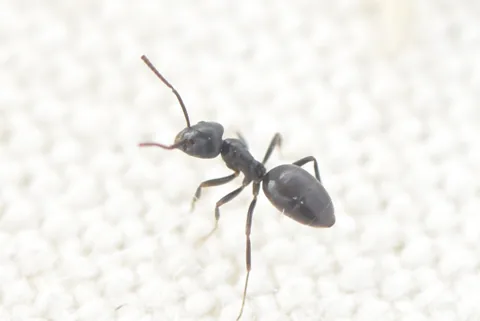 Odorous House Ant
Tapinoma sessile
The odorous house ant is a small native ant found across most of the United States that trails into homes for sweets and gives off a strong, rotten odor when crushed. Texas A&M says it ranges from Canada to Mexico but is rarely found in the southwestern deserts.
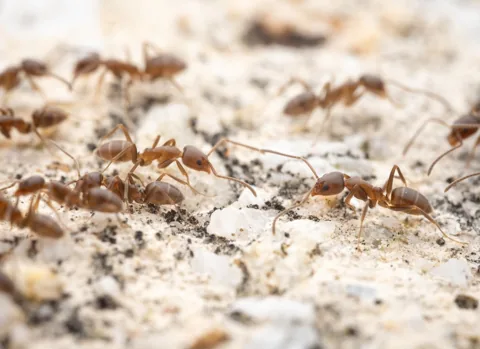 Argentine Ant
Linepithema humile
The Argentine ant is the most common ant in and around homes in California; its nests are linked into huge multi-queen supercolonies. It is native to Argentina and Brazil. Texas A&M says it was discovered in New Orleans in 1891, is now established in many places in the southern United States, and has been found in Arizona, California, Illinois, Maryland, Missouri, Oregon, Texas and Washington.
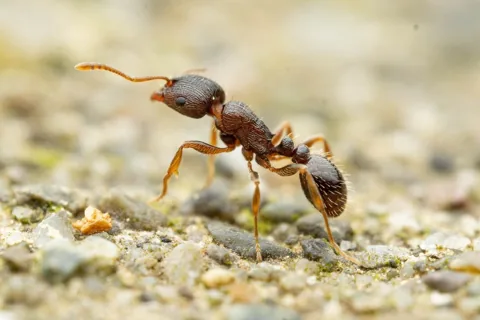 Pavement Ant
Tetramorium immigrans
The pavement ant is an introduced, soil-nesting ant that lives under sidewalks, slabs and stones. Penn State calls it one of the most commonly encountered house-infesting ants in Pennsylvania and says its range runs from New England to the Midwest and south through the Mid-Atlantic states to Tennessee, with populations in parts of California and Washington.
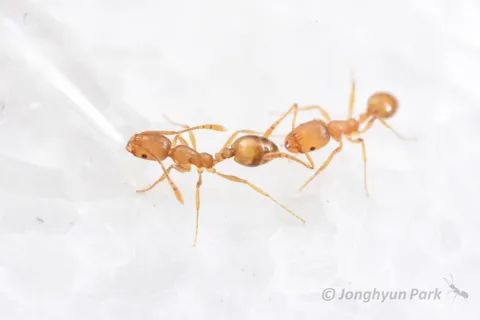 Pharaoh Ant
Monomorium pharaonis
The Pharaoh ant is a tiny, yellowish ant that nests inside heated buildings and is a serious pest in hospitals, apartments, hotels and food businesses. Texas A&M says it occurs throughout the United States but generally only in heated buildings, because it usually can't survive outdoors all year; it does nest outside in subtropical areas such as Hawaii, Florida and southern Texas.
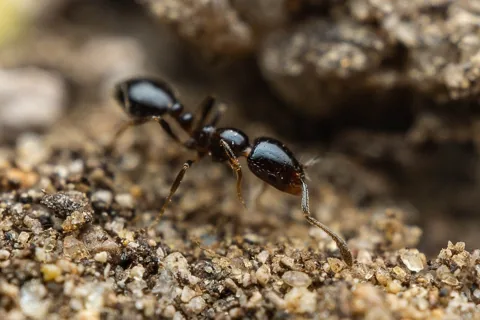 Little Black Ant
Monomorium minimum (iNaturalist files it under Monomorium carbonarium)
The little black ant is a tiny native ant that nests outdoors in lawns and under stones, and indoors in woodwork, wall voids and masonry. It is most noticeable when long foraging trails reach food cabinets and pantries.
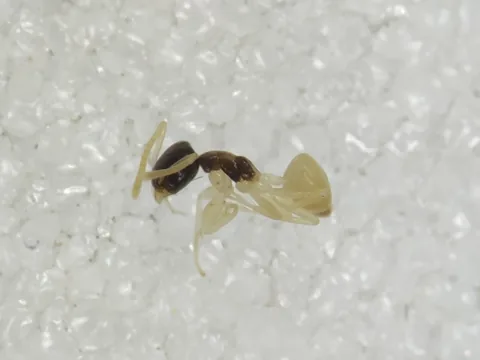 Ghost Ant
Tapinoma melanocephalum
The ghost ant is a tiny tropical tramp ant whose pale abdomen and legs make it hard to see. It nests indoors and out, forages on set trails and favors sweets, and because each colony is spread over many nests it is hard to eliminate.
Is it an odorous house ant?
Crush one and smell it. Minnesota and Wisconsin compare the odor to rotten coconut or blue cheese, and Missouri calls it a fruity-coconut smell. Workers are all one size, brown to black, with a single flattened node at the waist that is hidden under the abdomen.[6][3][5][1][2]
"Sugar ant" is a nickname, not a species. Texas A&M uses it for the pharaoh ant, which is golden yellow to reddish brown. The ant identification guide sorts out the small dark ants that trail to sweets, and the odorous house ant profile has the full description.[9][1]
- Size: Penn State gives 1/16 to 1/8 inch (2.4 to 3.3 mm), Minnesota about 1/10 inch, Missouri 2 to 3 mm, Utah State about 3 mm, and Wisconsin and Texas A&M about 1/8 inch. Arizona's Backyard Gardener gives 1/8 to 1/4 inch.[1][6][5][2][3][8][4]
- Pavement ants are similar in size and color but have two easily seen nodes at the waist and don't give off the odor when crushed.[2]
- Argentine ants are a similar size but dull brown rather than dark brown to shiny black, and Utah State notes their trails look much like odorous house ant trails.[7][2]
- How common: Missouri calls it the most common home-infesting ant in that state, Wisconsin calls it one of the most common ants in and around buildings there, and Utah State calls it an emerging pest in Utah.[5][3][2]
Why they pour in after a rain
Outdoors, odorous house ants live mostly on honeydew from aphids and soft scales and on plant nectar. Missouri says that when rain washes those foods away, the ants invade homes in large numbers looking for food, mostly for sweets during rainy spells in spring and fall.[5][1]
Other sources describe the same pattern in general terms. Arizona's Backyard Gardener says they often invade by the thousands after a change in the weather, and UC IPM says ants may appear suddenly indoors when outdoor food runs short or the weather changes, including flooded conditions.[4][7]
Moisture and food near the house also pull colonies closer. In lab tests by University of Tennessee researchers, colonies moved toward moist nest sites over time and moved workers and brood to nest sites near food, and the authors concluded that more moisture or food near a home likely explains larger numbers of these ants near buildings.[12]
- Temperature: Arizona says they are most active between 70 and 86 degrees F. Utah State says workers may be found foraging between 43 and 95 degrees F and forage day or night, avoiding the hottest conditions.[4][2]
- Winged swarmers: Penn State says they appear May through July, Minnesota says June through July, and Utah State says mating flights are infrequent and happen in early to mid summer.[1][6][2]
Why they are hard to get rid of
A single odorous house ant colony is often many nests. Utah State says colonies have multiple egg-laying queens, split off new subcolonies by budding, and don't fight ants from related subcolonies, so connected nests can grow into supercolonies that cover large areas. Any queen that survives can keep laying eggs.[2][5][3]
Colony size depends on where they live. Texas A&M gives a few hundred to 10,000 ants, usually with several queens, and Penn State says several thousand workers is typical. Utah State says colonies in natural areas can be as small as 15 to 30 workers, while urban colonies can reach tens of thousands and supercolonies hundreds of thousands. Genetic work from North Carolina State found that this ant has moved into cities many times, and that many-queen colonies occur across habitats.[8][1][2][13]
Nests move. Wisconsin says a disturbed nest quickly relocates to another sheltered spot, and Utah State says spots the ants leave after a disturbance, such as an insecticide application, are likely to be reoccupied once it wears off. In winter the subcolonies gather into a few overwintering nests and bud out again through spring.[3][2]
Find the trails and where they get in
Baits and any other treatment work best on the trails, so spend time following them. Wisconsin says odorous house ants follow well-established trails day and night, often along the edges of siding, deck boards and door frames. Utah State says trails can run 33 to 157 feet, and some have been recorded at over 150 feet.[3][2]
- Indoors, check along baseboards and carpet edges, along pipes, and near sinks, drains and bathtubs, and wall voids where warm pipes run.[2][5]
- To find the trail, Utah State suggests putting a dab of jelly on note cards along walls or baseboards where you've seen ants, then following the trail that forms back to where it enters a wall or comes in from outside.[2]
- Outdoors, trails connect nests with food such as shrubs and trees carrying aphids or scales. Pull back grass, mulch and soil along foundations, patio edges and sidewalks, because trails can run just below the surface.[2]
- Common entry points are foundation cracks, gaps under sliding door frames and behind window frames, and along utility lines and heating ducts, plus branches or plants touching the house.[2][4]
Use sweet bait, and keep it stocked
Sugar-based baits are the main tool. Penn State says baits with slow-acting ingredients such as hydramethylnon, fipronil or boric acid let workers share the bait with the queens and young before they die, and to choose baits made for sweet-loving ants. Missouri says this ant is best managed with sweet baits.[1][5][3]
Utah State says sweet liquid baits are very effective against this ant and that baiting programs commonly fail because the ants run out of bait. A large colony can drain small bait stations quickly, so refillable stations that hold more liquid help keep bait available.[2][7]
- Place baits along the trails and near nests without disturbing the trail, and bait as many trails as you can find, since each trail tends to lead to its own set of nests.[2][3][5]
- If the ants ignore a bait, move it to a different spot on the trail or try a different bait. Utah State says these ants don't like fat-based foods and that their food preference stays about the same through the year.[2]
- Check stations often and refill or replace them; liquid baits can dry out. Penn State says control may take two weeks or longer.[2][7][1]
- Don't spray around the bait, and clean up competing sweets such as spills and residue around sinks and pantries so the bait is the best food on offer.[3][4][7]
- Keep baits where children and pets can't reach them.[1][2]
- The general ant guide covers how ant baits work and how to match bait to other species.[7]
Why spraying makes odorous house ants worse
Repellent sprays split colonies. Utah State says inadequate insecticide applications can cause a colony to split into new subcolonies, and that repellent barrier sprays that cut a trail between indoors and outdoors can strand ants inside, away from their nests, creating more problems indoors. Repellent and fast-acting sprays also kill ants before they carry anything home and don't mix with baiting.[2][4]
Sprays also tend to leave this species behind. In a Purdue study at an apartment complex, barrier treatments cut overall ant numbers, but odorous house ants became more frequent in the treated areas over the following 1 to 8 weeks. A later Purdue lab study of 12 urban pest ants found the odorous house ant was the least susceptible to all three insecticide classes tested, and suggested broadcast spraying may kill off other ants and leave this one with less competition.[10][11]
UC IPM makes the general point for all ants: spraying the foundation kills foragers without killing the colony and queens, can trap ants indoors, and the ants build back up and invade again.[7]
Non-repellent perimeter treatments: where sources differ
Some extension services include an outdoor perimeter treatment for odorous house ants and some steer away from them. If you use one, the type of product matters.[2][7][8]
- Utah State recommends non-repellent products for the foundation and the ground right around it, alongside baiting. Ants can't detect a non-repellent, so they keep walking over it and carry it back to the nest, where it spreads through the colony. Fipronil, imidacloprid and thiamethoxam are among the non-repellent active ingredients it lists. Most of these products may only be applied to the foundation and the ground immediately around it, so read the label.[2]
- In the Purdue apartment study, barrier treatments with fipronil, imidacloprid (both non-repellent, per Utah State's list) and cyfluthrin (repellent) all reduced ant numbers; fipronil lasted longest, to 8 weeks, against 4 weeks for imidacloprid and 2 for cyfluthrin.[10][2]
- Texas A&M says that when many ants appear around the foundation, a residual perimeter treatment may repel foragers and keep them from re-infesting the building.[8]
- UC IPM says perimeter sprays won't provide permanent control and are less effective than a bait-based program, and asks homeowners hiring a company to request baits and spot treatments rather than perimeter treatments or monthly sprays. California limits perimeter treatments with pyrethroids because of water quality concerns.[7]
- Whatever you use, the label sets where it may go. The perimeter spray guide covers how to apply a foundation treatment.[2][7]
Treating nests you find
Outdoor nests are shallow, usually under a board, stone, firewood, patio blocks, mulch or plastic, and under loose bark. Minnesota says to look for them and treat any you find. Wisconsin says a nest can be treated with an aerosol or liquid ant product, but because colonies have many connected nests, treating one may not end the problem.[6][5][3][8]
Utah State says to work fast: a water-based residual insecticide applied directly to an exposed nest can eliminate it, but treat before the ants pick up their brood and move. For a nest in mulch, rake the mulch back, treat the nest, then rake the mulch back over it and treat the surface. An incomplete treatment with a repellent product can split the nest into several.[2]
Nests indoors in wall voids or other places you can't reach are best handled with bait. Utah State says nests under slabs or foundations may need a licensed professional.[3][2][8]
Fix moisture, mulch and aphids around the house
Utah State says odorous house ants prefer moist, shady places near food, and indoors they nest where there is moisture and heat. Missouri links indoor nests to moisture in wall voids near pipes, heaters, bath traps and toilets, and Wisconsin adds damp wood or insulation and areas near plumbing fixtures or vents.[2][5][3]
- Fix water: sprinklers hitting the foundation, broken sprinkler heads, leaking gutters, water pooling by the foundation, and leaking pipes, toilets and sinks.[2]
- Pull back cover: keep plants, grass and dense mulch away from the foundation, and move rocks, boards, firewood and other objects lying against the house. Utah State suggests replacing wood mulch next to the house with pea gravel.[3][7][2]
- Prune shrubs and trees that touch the house, since ants climb vegetation that contacts the building to get in.[2][7]
- Manage aphids and soft scales on trees and shrubs near the house; their honeydew is a main outdoor food for this ant.[2][6][7]
- Indoors, store sweets in sealed containers and wipe up spills. Washing a trail with soapy water removes the scent trail the ants follow.[4][7]
- Seal cracks the trails lead to, though Arizona notes this is easier said than done with an ant this small that comes in large numbers.[4][3]
Follow-up and when to call a professional
Plan on follow-up. Utah State says these ants are persistent and that new nests should be checked for after treatment, because when colonies are wiped out the territory can be recolonized by odorous house ants or other ants once the product wears off. Ants from a neighboring property can also move back in.[2]
Minnesota says persistent odorous house ant problems should be handled by a pest management professional, and Wisconsin suggests one with experience managing ants when the problem is extensive.[6][3]
Where to go next
If the ant doesn't match, or you have ant mounds in the lawn rather than trails in the kitchen, these guides cover the other cases.[7][6]
- Not sure of the species: the ant identification guide, including small dark ants and the "sugar ant" nickname.[9][6]
- Other kitchen ants and how to match baits to them: the ants in the house guide.[7][1]
- Mounds in the lawn: the ant hills guide.[7]
- Outdoor foundation treatments: the perimeter spray guide.[2][7]
Common questions
- Why do odorous house ants show up after it rains?
- Missouri says rain washes away the honeydew and nectar they feed on outdoors, so they come indoors in large numbers looking for sweets, mostly in rainy spells in spring and fall. UC IPM says flooded conditions can also drive ants indoors.[5][7]
- What bait works best for odorous house ants?
- A sweet, slow-acting bait. Penn State lists hydramethylnon, fipronil or boric acid baits made for sweet-loving ants, and Utah State says sweet liquid baits in refillable stations work well. Keep them full; running out is a common reason baiting fails.[1][2]
- Why are there more ants after I put out bait?
- That is the bait working. Wisconsin says activity can increase as the colony recruits more workers to collect it. Leave the bait alone, keep it stocked, and don't spray.[3]
- Can I just spray them?
- Sprays kill the workers you see but not the colony, and repellent sprays can split the colony into more nests or strand ants indoors. A Purdue lab study also found this ant the least susceptible of 12 pest ants tested.[2][7][11]
- Are odorous house ants harmful?
- They are a nuisance. Utah State says they can't sting and don't bite unless provoked, and Penn State says they contaminate stored pantry food.[2][1]
Photo credits
- Odorous House Ant: Thompson Hyggen, public domain (CC0), via iNaturalist
- Argentine Ant: Philipp Hoenle, public domain (CC0), via iNaturalist
- Pavement Ant: (c) Jake Nitta, some rights reserved (CC BY) — via iNaturalist, CC BY 4.0
- Pharaoh Ant: (c) Jonghyun Park, some rights reserved (CC BY) — via iNaturalist, CC BY 4.0
- Little Black Ant: (c) Jake Nitta, some rights reserved (CC BY) — via iNaturalist, CC BY 4.0
- Ghost Ant: (c) Elias Freyhof, some rights reserved (CC BY) — via iNaturalist, CC BY 4.0
Sources
- Penn State Extension, “Odorous House Ant (S. Jacobs).” extension.psu.edu/odorous-house-ant (accessed 2026-11-10)
- Utah State University Extension, “Odorous House Ants (R. Davis and A. Taylor, October 2019).” extension.usu.edu/planthealth/research/odorous-house-ant.pdf (accessed 2026-11-10)
- University of Wisconsin-Madison Division of Extension, “Odorous House Ants, Garden Facts XHT1285 (P. J. Liesch and D. Pierret, revised 2021).” hort.extension.wisc.edu/files/2021/05/Odorous_House_Ants.pdf (accessed 2026-11-10)
- University of Arizona Cooperative Extension, Yavapai County, “Odorous House Ants, Backyard Gardener #15 (J. Schalau).” extension.arizona.edu/sites/extension.arizona.edu/files/attachment/OdorousHouseAnts.pdf (accessed 2026-11-10)
- University of Missouri Extension, “G7392: Controlling Ants in and Around the Home.” extension.missouri.edu/publications/g7392 (accessed 2026-11-10)
- University of Minnesota Extension, “Ants.” extension.umn.edu/insects-infest-homes/ants (accessed 2026-11-10)
- University of California Statewide IPM Program, “Pest Notes: Ants.” ipm.ucanr.edu/home-and-landscape/ants/ (accessed 2026-11-10)
- Texas A&M AgriLife Urban and Structural Entomology Program, “Odorous House Ant, Tapinoma sessile.” urbanentomology.tamu.edu/urban-pests/ants/odorous-house-ant/ (accessed 2026-11-10)
- Texas A&M AgriLife Urban and Structural Entomology Program, “Pharaoh Ant, Monomorium pharaonis.” urbanentomology.tamu.edu/urban-pests/ants/pharoah/ (accessed 2026-11-10)
- Journal of Economic Entomology, abstract via PubMed, “Scharf, Ratliff and Bennett 2004, Impacts of residual insecticide barriers on perimeter-invading ants, with particular reference to the odorous house ant.” pubmed.ncbi.nlm.nih.gov/15154488/ (accessed 2026-11-10)
- Pest Management Science, abstract via PubMed, “Buczkowski 2021, A comparison of insecticide susceptibility levels in 12 species of urban pest ants with special focus on the odorous house ant.” pubmed.ncbi.nlm.nih.gov/33620757/ (accessed 2026-11-10)
- Environmental Entomology, abstract via PubMed, “Toennisson, Klingeman and Vail 2021, Odorous house ant colony movement in response to moisture, shade, and food proximity.” pubmed.ncbi.nlm.nih.gov/33159439/ (accessed 2026-11-10)
- PLoS ONE, abstract via PubMed, “Menke and others 2010, Is it easy to be urban? Convergent success in urban habitats among lineages of a widespread native ant.” pubmed.ncbi.nlm.nih.gov/20169204/ (accessed 2026-11-10)