The short answer
- Find out which ant it is. Small crater-shaped hills in thin grass are usually cornfield or turfgrass ants; piles of sand along sidewalk cracks are usually pavement ants; big mounds from about a foot to several feet across are usually field ants. Mounds of fluffy soil with no opening in the center, in the South, may be fire ants, which need a different plan.[1][3][12][5][15]
- If the mounds aren't hurting anything, tolerate them. These ants rarely injure turf and they eat other insects, including the eggs of lawn pests.[1][3][2][19]
- Rake the hills flat or wash them out with a strong stream from the hose whenever they rise above the grass.[7][8]
- Grow thicker grass: water regularly and mow at 3 to 4 inches. Cornfield ants nest where the grass is thin or bare.[3][1]
- For ants that keep coming back, use an outdoor ant bait the ants will carry home, and don't spray around it.[3][12][4]
- Treat only the mound, not the whole lawn, and only as a last resort. Large field ant mounds need the insecticide soaked deep into the nest.[7][1][5][8]
Ants that build lawn mounds
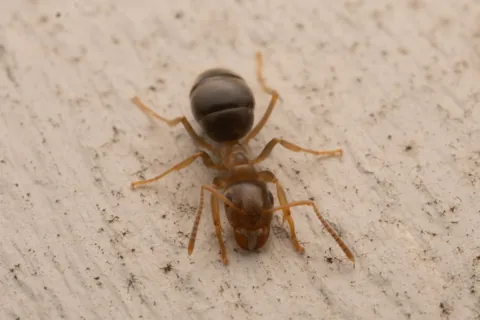 Cornfield Ant
Lasius neoniger (also called turfgrass or lawn ant); Lasius americanus, formerly L. alienus, shares the name
The cornfield ant is a small, light to dark brown ant and one of the most abundant ants in North America. It is the ant behind many of the small crater-shaped soil mounds in thin lawns, along driveways and between paving stones.
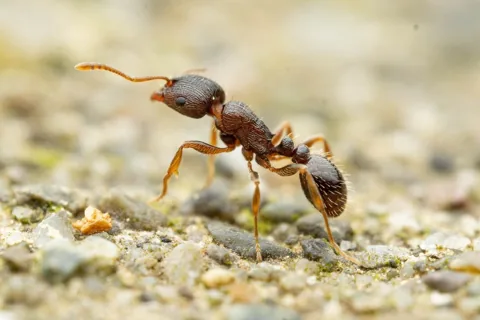 Pavement Ant
Tetramorium immigrans
The pavement ant is an introduced, soil-nesting ant that lives under sidewalks, slabs and stones. Penn State calls it one of the most commonly encountered house-infesting ants in Pennsylvania and says its range runs from New England to the Midwest and south through the Mid-Atlantic states to Tennessee, with populations in parts of California and Washington.
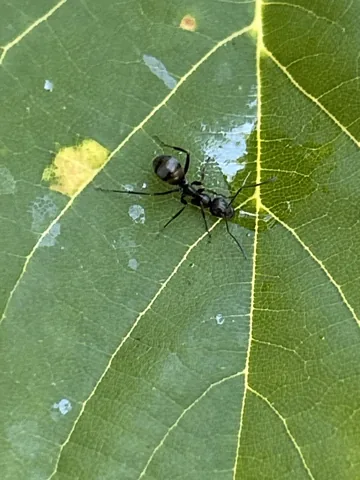 Field Ants
Formica species (e.g., F. subsericea, F. integra, F. exsectoides)
Field ants are medium to large ants in the genus Formica, among the most common ants in yards. They nest in soil, and in Wisconsin their mounds can reach three to four feet wide, spoiling lawns and making mowing difficult.
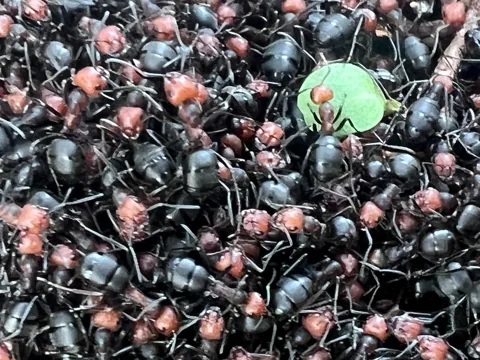 Thatching Ants
Formica obscuripes (western thatching ant) and related mound-building Formica
Thatching ants are medium to large red-and-black or black ants that build mounds of thatch such as fir needles and grass stems; they are beneficial predators but bite in numbers and spray formic acid when a mound is disturbed.
 Western harvester ant
Pogonomyrmex occidentalis
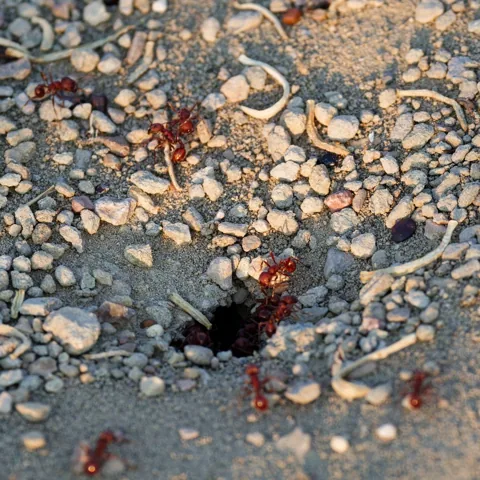
The western harvester ant is a reddish-brown, seed-collecting ant of open western grasslands. Its broad, flat mounds, often covered with small pebbles and surrounded by a wide ring of bare ground, are easy to spot, and workers give very painful stings when the nest is disturbed.
 Red Imported Fire Ant
Solenopsis invicta
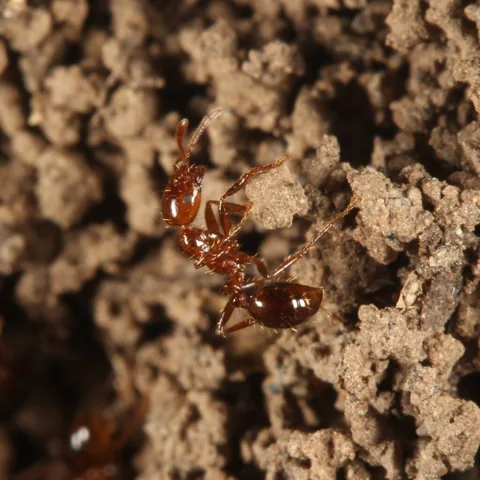
The red imported fire ant is an aggressive stinging ant that infests most of the southern United States and parts of California, building mounds in open, sunny areas such as lawns, parks and roadsides. USDA APHIS says imported fire ants came from South America, probably in soil on cargo ships, and now infest more than 367 million acres in Alabama, Arkansas, California, Florida, Georgia, Louisiana, Mississippi, North Carolina, Oklahoma, South Carolina, Tennessee, Texas, Virginia and Puerto Rico.
Do ant hills hurt the lawn?
Not much, in most yards. Minnesota Extension says ants that nest in lawns don't feed on or injure the grass. North Dakota State says the turfgrass and cornfield ants behind most lawn complaints rarely cause actual injury to turfgrass. UMass calls ants generally negligible pests on home lawns that seldom cause a loss of vigor in moderately maintained turf.[1][3][2]
The damage they can do is mostly physical. Digging tunnels can break off roots and root hairs and dry out the soil, so the grass around a nest may thin out. The soil they bring up can smother nearby grass, make the lawn bumpy, and in the case of large mounds, damage mower blades. A Pacific Northwest handbook says a turf nest is a series of tunnels and galleries that may run three or more feet below the surface, with several openings to the surface.[2][10][4]
Field ants are the exception that does real damage. Wisconsin Extension says their mounds can keep turf from growing and can be a hazard when mowing, and some species kill plants that shade their mounds by injecting formic acid into the roots. NC State says Formica ants will severely damage nearby vegetation to keep shade off the mound.[5][4]
Which ant is building the hills?
The ant tells you how much of a problem you have. Iowa State says the soil-nesting ants found in Iowa are not biting or stinging pests. The ones to take seriously are fire ants in the South and harvester ants in western grasslands, because both sting. Minnesota Extension notes fire ants don't occur in the upper Midwest, and Iowa State says they aren't present in Iowa.[1][7][13][16]
- Cornfield and turfgrass ants (Lasius): light to dark brown, about 1/10 to 1/8 inch long. They make small crater-shaped mounds several inches wide, especially where the grass has thinned or is bare, and also nest along gravel drives, in pavement cracks and between patio pavers. UMass says Lasius neoniger appears to be the most common ant in New England turf.[1][3][9][2]
- Pavement ants (Tetramorium): dark brown to black, about 2.5 to 4 mm long, with fine lines on the head and thorax. Most colonies are under sidewalks, slabs and large rocks, and in warm months the ants push small piles of sand and soil up through sidewalk cracks. UC IPM lists them as nesting in lawns or under stones and building mounds along sidewalks and foundations. Like fire ants, they have a two-segment waist.[12][11]
- Field ants (Formica): medium to large, black, brown, red or a mix, and often mistaken for carpenter ants. Wisconsin Extension gives 1/5 to 3/8 inch; Minnesota Extension gives about 1/8 to 1/4 inch for workers. They build the biggest mounds. Minnesota Extension says some species make mounds up to 10 inches across, while Wisconsin Extension says mounds can be three to four feet wide and over two feet tall. NC State says mounds of the Allegheny mound ant (F. exsectoides) are particularly large. Wisconsin Extension says they don't come indoors for food and Utah State says they seldom do, though NC State says workers can enter buildings in large numbers looking for food. Disturb a mound and they can give a painful, pinching bite.[5][1][4][6]
- Harvester ants (Pogonomyrmex), grassland ants of the West: reddish-brown, 5 to 7 mm. Their mounds are broad and flat with a wide area cleared of plants around them; Utah State says nests average 12 feet across. They defend the mound with painful stings and are occasional pests of lawns and playgrounds.[13][14]
- Fire ants (Solenopsis), in the South: a mound of fluffy, worked soil with no opening in the center, usually only a few inches tall in turf. Their stings form small pustules that itch. If you have them, use the fire ant guide linked below.[15][16]
When to leave ant hills alone
Minnesota Extension's advice for both cornfield and field ants is to tolerate the nests when possible, and says it is rarely necessary to treat cornfield ant nests for the sake of the turf. Iowa State says most soil-nesting ants are beneficial and don't need control, and that ant mounds in prairies and pastures can be ignored if possible. Wisconsin Extension sees no need to control field ants where there's no human activity.[1][7][5]
Lawn ants also work for you. UMass and NC State point out that many ants eat other insects, and the Cornell-produced school IPM guide calls turfgrass ants an integral part of soil culture. In Purdue field plots, ants were predators of Japanese beetle eggs, the eggs that become white grubs; diazinon and isofenphos treatments cut both ant numbers and egg predation, while imidacloprid did not.[2][4][9][19]
The same school guide sets a simple threshold: a few mounds in turf aren't really a concern, but mounds on sports fields should be dealt with because they create unsafe footing and reduce turf vigor.[9]
Rake, hose and grow them out
Iowa State's first step is to rake the hills flat or wash them out with a forceful stream of water from the garden hose whenever they rise above the grass tops. Expect to do it most often during heavy nesting activity, such as wet spring weather.[7][8]
Repeated disturbance can also move or shrink the colony. NC State says frequently digging up a mound or flooding it with a hose may not kill the colony but could make it relocate to a less objectionable spot, and the school IPM guide says frequent disturbance may keep a colony small or encourage it to move.[4][9]
- Water and mow high. North Dakota State's best strategy for lawns is to water regularly and mow at three to four inches to encourage grass growth and discourage ant nesting.[3]
- Fill in thin spots. Cornfield ants nest in thinning or bare grass, and Minnesota Extension says encouraging the grass to grow more fully discourages them. UMass notes lawn ants prefer dry, well-drained soils.[1][2]
- Don't scalp the turf. In University of Kentucky experiments, lawn ants built more mounds in response to scalped turf and to sand-filled holes.[18]
- Cut off their food. NC State suggests reducing pet food, fruit and bird feeders and removing moist wood and debris, and Utah State suggests controlling aphids, scales and mealybugs on nearby plants, since field ants feed on their honeydew.[4][6]
Ant baits for lawn ants
Baits use the ants' own foraging against them: workers carry the bait home and feed it to the colony, including the queen. North Dakota State calls outdoor baits the best chemical option for cornfield and turfgrass ants, and Penn State recommends baits for pavement ants, noting that slow-acting baits with hydramethylnon, fipronil or boric acid don't kill the workers before they share the bait with the queen and young.[3][12]
- Liquid baits, most of which contain boric acid, are best for small areas; granular baits, some with hydramethylnon, cover larger areas. Don't water granular bait in, because water breaks it down faster.[3]
- Match the bait to the ant. NC State says baits for Formica ants should be ones listed for sweet-loving ants, and that fire ant baits won't attract them.[4]
- Don't use other insecticides around the baits; they keep ants from reaching the bait.[3]
- Expect up to a week before you see results, according to North Dakota State; Penn State says pavement ant control may take two weeks or longer. Replace bait as it's used up.[3][12]
- For harvester ants, Utah State suggests granular ant baits labeled for lawn use, placed around the nest opening.[14]
- Keep baits where children and pets can't reach them; NC State suggests bait stations where pets have access.[12][4]
Treating a mound directly
When a mound has to go and baits haven't worked, treat that mound rather than the whole yard. UMass says mound-directed applications take longer but cut the amount of pesticide used and the chance of misapplying it, and that applications made directly to the mound make the product more effective. Iowa State says overall lawn treatments for ant colonies are seldom necessary.[2][8]
Choose a product with directions for treating lawns. Minnesota Extension says granules and dusts are most effective, with active ingredients such as permethrin or deltamethrin, and liquids can work if they soak into the nest; a large nest may need half a gallon or more of mixed product. Iowa State's approach is to rake the hill flat, then sprinkle granules on the soil or drench the mound with a diluted solution.[1][7]
- Big field ant mounds need the insecticide deep. Wisconsin Extension says the queen can be two to three feet underground, so surface treatments won't work. Rake debris off the mound, push a metal rod or wood dowel as deep as possible to make four to six channels, pour the mixed liquid into them, then put the debris back.[5]
- Active ingredients the extension sources name for lawn ant mounds include bifenthrin, carbaryl, cyfluthrin, deltamethrin, permethrin and esfenvalerate. Use only a product labeled for lawns and ants, and follow the label.[5][7][1][4]
- Timing: UMass says to make the first application as soon as surface activity shows up, often early May. Retreat if activity resumes.[2][1]
- If you used granules, Iowa State says to water the mound area to move the insecticide into the soil and away from the surface, and keep children and pets off until the grass has dried.[8]
- NC State's turf table warns against applying lambda-cyhalothrin within 20 feet of any body of water.[4]
Hot water, borax and other home remedies
Wisconsin Extension says hot water and borax are not effective against field ants, whose queens sit too deep for them. For fire ants, Texas A&M says 2 to 3 gallons of very hot or boiling water poured on a mound kills the colony about 60% of the time, and that it kills the grass it touches. Either way, scalding water leaves a dead patch in the lawn.[5][17]
Liquid boric acid baits are a different matter: North Dakota State lists them as an option for small areas, because the ants carry them home.[3]
Why not spray the whole lawn?
Broadcast treatments hit more than ants. North Dakota State warns that broad-spectrum insecticides can harm beneficial insects such as ground-nesting bees, and asks homeowners to try non-chemical methods and baits first, using a broad-spectrum lawn application only as a last resort. UMass says a broad-spectrum cleanup can hurt the predatory insects that help control lawn pests.[3][2]
Turf research backs this up. In University of Kentucky golf course plots, clothianidin, bifenthrin and their combination each temporarily reduced one or more groups of predators, while chlorantraniliprole had little or no effect; the authors note that switching to the more selective product may mean ant mounds need targeted management of their own. UMass adds that field studies show some insecticides don't kill lawn ants but make them move away.[20][2][19]
Ant mounds on putting greens and sports fields
Closely mowed turf shows mounds most. In a University of Kentucky study of 735 mounds on 30 sand-based putting greens, more than 90% sat in a 2-meter band just inside the green's edge. The main nests were in the natural soil of the surrounding rough, and the mounds on the green were satellite nests used by foraging workers. The authors recommend focusing control on the perimeter of the green.[18]
On school grounds and sports fields, the Northeastern school IPM guide says mounds should be addressed because of footing, and that pesticide applications there must be done by a certified applicator.[9]
When lawn ants come into the house
Cornfield and turfgrass ants sometimes forage indoors and lay scent trails to any food they find. North Dakota State suggests keeping the kitchen clean, wiping counters with a mild vinegar solution to remove trails, and sealing cracks and entry points. Minnesota Extension says to check for and treat nests in the lawn and nearby areas when the ants are getting indoors. Field ants indoors are usually a temporary problem that goes away on its own.[3][1]
The indoor ant guide linked below covers trails, baits and sealing in more detail.[1]
Common questions
- Are ant hills bad for my lawn?
- Usually not. Lawn ants don't eat grass and rarely injure it, though tunneling can dry the soil and thin the grass, and big mounds smother grass and bump mower blades.[1][3][2]
- What's the easiest way to get rid of ant hills?
- Rake them flat or wash them out with a strong stream from the hose when they rise above the grass, and keep the grass thick by watering regularly and mowing at 3 to 4 inches.[7][3]
- Does pouring boiling water on an ant hill work?
- Not on field ants, according to Wisconsin Extension. Texas A&M says it kills fire ant colonies about 60% of the time. It also kills the grass it touches.[5][17]
- Why do the ant hills keep coming back after I rake them?
- Raking removes the soil, not the colony, and a turf nest may run three or more feet down. Keep raking, thicken the grass, and use a bait if they persist.[10][7][3]
- Can I use fire ant bait on regular lawn ants?
- NC State says fire ant baits won't attract Formica field ants; use a bait listed for sweet-loving ants instead.[4]
Photo credits
- Cornfield Ant: (c) Jack Forrester, some rights reserved (CC BY) — via iNaturalist, CC BY 4.0
- Pavement Ant: (c) Jake Nitta, some rights reserved (CC BY) — via iNaturalist, CC BY 4.0
- Field Ants: Milwaukee County Parks - Natural Areas Program, public domain (CC0), via iNaturalist
- Thatching Ants: (c) Ryan McMinds, some rights reserved (CC BY) — via iNaturalist, CC BY 4.0
- Western harvester ant: (c) Daughter Dad, some rights reserved (CC BY) — via iNaturalist, CC BY 4.0
- Red Imported Fire Ant: (c) Natasha Taylor, some rights reserved (CC BY) — via iNaturalist, CC BY 4.0
Sources
- University of Minnesota Extension, “Ants.” extension.umn.edu/insects-infest-homes/ants (accessed 2026-11-10)
- UMass Amherst Center for Agriculture, Food, and the Environment, “Ants in Lawns (P. Vittum, revised May 2011).” www.umass.edu/agriculture-food-environment/home-lawn-garden/fact-sheets/ants-in-lawns (accessed 2026-11-10)
- North Dakota State University Extension, “THEM! Controlling Nuisance Outdoor Ants around the Home (P. Beauzay, July 1, 2021).” www.ndsu.edu/agriculture/ag-hub/ag-topics/crop-production/crop-pest-report/diagnostic-lab/them-controlling-nuisance-outdoor (accessed 2026-11-10)
- NC State Extension, “Nuisance Ants in Turf (TurfFiles, October 2017).” content.ces.ncsu.edu/formica-ants-in-turf (accessed 2026-11-10)
- University of Wisconsin-Madison Extension, Wisconsin Horticulture, “Field Ants (XHT1204, revised January 2011).” hort.extension.wisc.edu/articles/field-ants/ (accessed 2026-11-10)
- Utah State University Extension, “Field Ants.” extension.usu.edu/planthealth/ipm/notes_nuisance/field-ants (accessed 2026-11-10)
- Iowa State University Extension and Outreach, Yard and Garden, “How to Manage Ant Mounds in Lawns, Gardens, and Pastures (reviewed April 2023).” yardandgarden.extension.iastate.edu/how-to/how-manage-ant-mounds-lawns-gardens-and-pastures (accessed 2026-11-10)
- Iowa State University Extension and Outreach, Yard and Garden, “Ants in Lawns (D. Lewis, May 14, 1999).” yardandgarden.extension.iastate.edu/article/1999/5-14-1999/antsinlawns.html (accessed 2026-11-10). Archived 1999 article; the insecticides it names are no longer used here, only its raking, watering-in and re-entry advice.
- Northeastern IPM Center / Cornell Integrated Pest Management, “Turfgrass Ant and Cornfield Ant (School IPM Best Practices, reviewed February 2020).” schools.northeastipm.org/pests/turfgrass-ant-and-cornfield-ant (accessed 2026-11-10)
- Pacific Northwest Pest Management Handbooks (Oregon State, Washington State and University of Idaho Extension), “Turfgrass: Ant.” pnwhandbooks.org/insect/hort/turfgrass/turfgrass-ant (accessed 2026-11-10)
- University of California Statewide IPM Program, “Pest Notes: Ants, UC ANR Publication 7411 (2012).” ipm.ucanr.edu/legacy_assets/PDF/PESTNOTES/pnants.pdf (accessed 2026-11-10)
- Penn State Extension, “Pavement Ant (updated May 12, 2026).” extension.psu.edu/pavement-ant (accessed 2026-11-10)
- Colorado State University Extension (Western Colorado Insects), “Harvester Ants (Colorado Insects of Interest).” wci.extension.colostate.edu/wp-content/uploads/sites/14/2017/04/HarvesterAnts.pdf (accessed 2026-11-10)
- Utah State University Extension, “Harvester Ants.” extension.usu.edu/pests/ipm/ornamental-pest-guide/insects/hymenoptera/harvester-ants (accessed 2026-11-10)
- Texas A&M AgriLife Texas Imported Fire Ant Research and Management Project, “How to Tell if You Have Fire Ants.” fireant.tamu.edu/learn/how-to-tell/ (accessed 2026-11-10)
- NC State Extension, “Managing Fire Ants in Your Yard.” content.ces.ncsu.edu/managing-imported-fire-ants-in-urban-areas (accessed 2026-11-10)
- Texas A&M AgriLife Texas Imported Fire Ant Research and Management Project, “Two-Step Method.” fireant.tamu.edu/controlmethods/twostep/ (accessed 2026-11-10)
- Journal of Economic Entomology, abstract via PubMed, “Maier and Potter 2005, Factors affecting distribution of the mound-building ant Lasius neoniger and implications for management on golf course putting greens.” pubmed.ncbi.nlm.nih.gov/16022318/ (accessed 2026-11-10)
- Journal of Economic Entomology, abstract via PubMed, “Zenger and Gibb 2001, Impact of four insecticides on Japanese beetle egg predators and white grubs in turfgrass.” pubmed.ncbi.nlm.nih.gov/11233105/ (accessed 2026-11-10)
- Pest Management Science, abstract via PubMed, “Larson, Redmond and Potter 2012, Comparative impact of an anthranilic diamide and other insecticidal chemistries on beneficial invertebrates and ecosystem services in turfgrass.” pubmed.ncbi.nlm.nih.gov/22076810/ (accessed 2026-11-10)