On this page
How to identify it
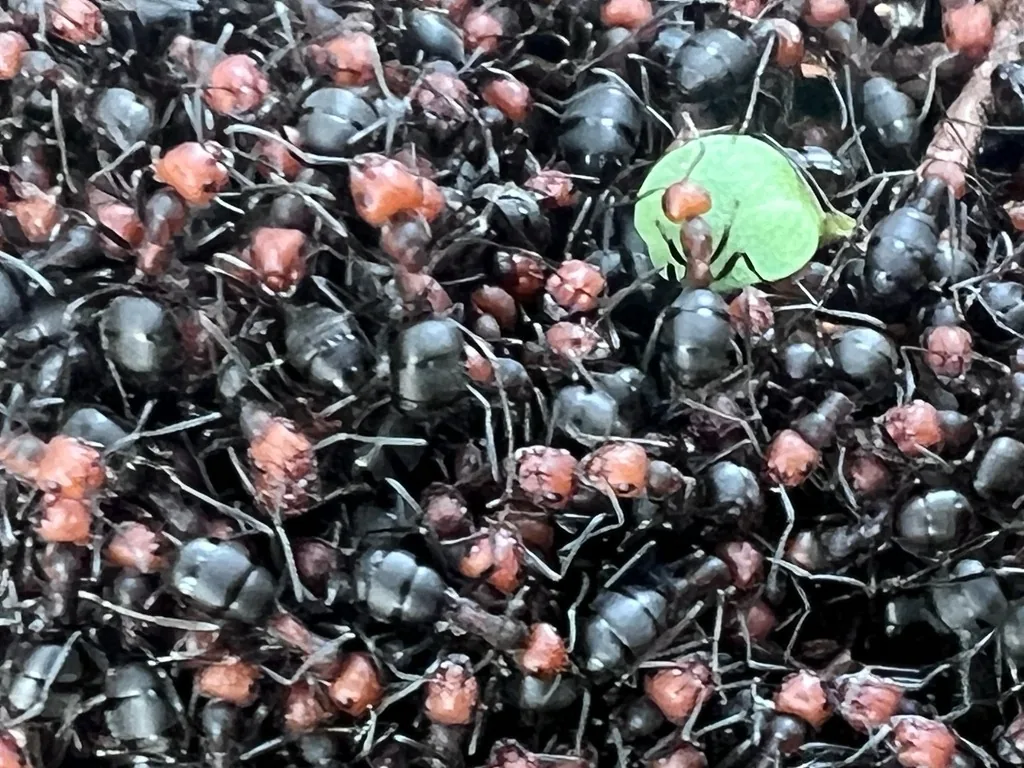
- Workers are 3/16 to 5/16 inch long and come in a range of sizes.[1][2]
- They are black or red and black; western thatching ant workers usually have a reddish-orange head, though some are all black or dark brown.[1][2]
- The nest is topped by a mound of plant debris, from several centimeters to about a meter high, often built around a shrub stem or fence post.[1][2]
Look-alikes
| Look-alike | How to tell them apart |
|---|---|
| Carpenter ants | Thatching ants nest in soil mounds or decayed logs and only rarely in wall voids.[1] |
| Field ants | Related Formica ants that nest in soil without thatch mounds.[2] |
Where it lives
The western thatching ant is widespread across the western United States and Canada, east to Michigan and Missouri and south to Arizona and New Mexico, and especially common in the Pacific Northwest.[2]
Biology and life cycle
Colonies hold 10,000 to 40,000 ants and often several queens, and one colony may spread across several mounds.[2]
They hunt many other insects and collect honeydew from aphids, treehoppers and scales, guarding them from predators.[1][2]
Swarm timing varies by source: WSU gives late summer to early fall in Washington, while Animal Diversity Web lists mating flights in June and July for the western thatching ant.[1][2]
Damage and signs
- They are pests mainly where mounds sit in landscapes people use; they sometimes nest in decayed logs and rarely in house walls.[1]
Health risk
When a mound is disturbed they bite in mass and spray formic acid, which is painful.[1][2]
Control
Prevention
They are fierce predators of other insects and should be left alone wherever possible.[1]
Keep them out
Seal entry points, keep vegetation away from the house, clean up food sources and wipe up ants indoors with a wet, soapy sponge.[1]
Pesticides
Treating only the entrance hole often just moves the colony a few feet; the whole mound and its underground part must be treated, which may mean digging into the nest, and protective clothing helps avoid bites.[1]
Common questions
Sources
- Washington State University Extension (PestSense), “Thatching Ants (PestSense fact sheet, reviewed January 12, 2026).” pestsense.cahnrs.wsu.edu/fact-sheet/thatching-ants/ (accessed 2026-10-16)
- Animal Diversity Web, University of Michigan Museum of Zoology, “Formica obscuripes (western thatching ant).” animaldiversity.org/accounts/Formica_obscuripes/ (accessed 2026-10-16)
- iNaturalist, “Formica obscuripes taxon page (order and family).” www.inaturalist.org/taxa/69267 (accessed 2026-10-06)