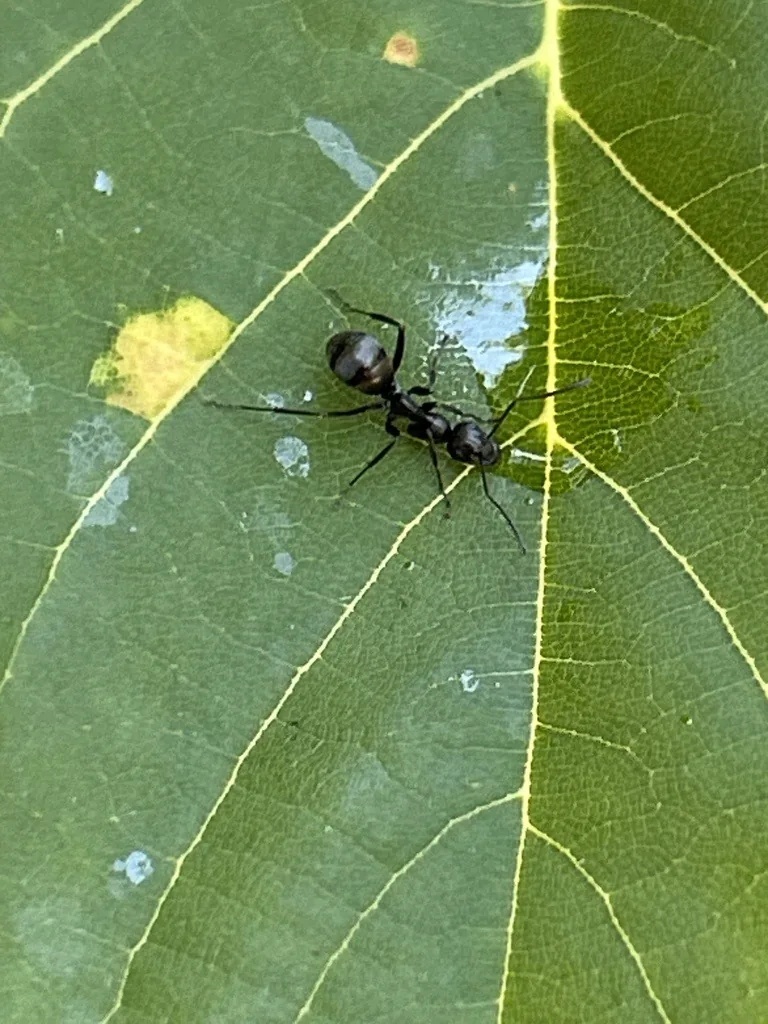
How to identify it
- Workers range from about 1/5 to 3/8 inch long and come in more than one size within a colony.[1][2]
- Color varies by species: black, brown, tan, reddish, or red and black.[4][1]
- They have a single node in the waist, a bumpy thorax with a dip in the middle, and three tiny simple eyes (ocelli) on top of the head.[2][4]
- Many species exist; NC State highlights the all-black Formica subsericea, the red two-toned F. integra and the red-black Allegheny mound ant, F. exsectoides. This page uses F. subsericea as the example.[3]
Look-alikes
| Look-alike | How to tell them apart |
|---|---|
| Carpenter ants | Field ants are often confused with carpenter ants, but the dip in the field ant's thorax and its three ocelli set it apart, and it rarely forages indoors.[2][4] |
| Fire ants | Both build mounds in sunny turf, but field ants are not a human health hazard the way fire ants are, and fire ant baits do not attract them.[3] |
Where it lives
Found well beyond any one region: it is one of the most common ants in Wisconsin, Utah State calls it the most common ant in yards and gardens, and Nebraska and North Carolina extension also cover it.[1][2][3][4]
Biology and life cycle
Colonies can survive 10 or more years; a queen lays the eggs that become workers and males.[1]
They prefer open, sunny, warm spots near sidewalks, slabs and pavement, and also nest under rocks, logs, landscape timbers and firewood.[3][4][2]
They feed outdoors on live and dead insects and on honeydew from aphids and other sap-feeding insects.[1][2]
Winged ants leave the colony to mate in spring and fall, and the swarms themselves can be a nuisance.[3][2]
Damage and signs
Health risk
If disturbed, field ants can give painful, pinch-like bites to people and pets, but they don't pose the health hazard fire ants do.[1][3]
Control
Prevention
There is no need to control field ants where people aren't active; ants play a useful role in the ecosystem.[1][3]
Keep them out
Seal possible entryways if workers come inside, and store food in airtight containers.[2]
Sanitation
Reduce food sources such as pet food, fallen fruit and bird seed, remove moist wood and debris, and control aphids, scales and mealybugs on nearby plants.[3][2]
Traps and physical control
Repeatedly disturbing a mound by digging or flooding it with a hose may not kill the colony but can push it to a less troublesome spot.[3]
Pesticides
To kill the queen, which can be 2 to 3 feet deep, rake debris off the mound, poke several deep channels, and drench them with a labeled liquid insecticide such as bifenthrin, carbaryl, cyfluthrin, deltamethrin or permethrin.[1]
Outdoor granular baits and liquid bait stakes are also options; Wisconsin notes that hot water and borax do not work on field ants.[4][1]
Common questions
- Are field ants carpenter ants?
- No. They are often mistaken for carpenter ants, but field ants nest in soil, rarely come inside for food, and have a notch in the thorax that carpenter ants lack.[2][1][4]
- Why doesn't treating the top of the mound work?
- The queen can live 2 to 3 feet underground in large mounds, so surface treatments don't reach her and the colony survives.[1]
Sources
- University of Wisconsin-Madison Extension, Wisconsin Horticulture, “Field Ants (XHT1204).” hort.extension.wisc.edu/articles/field-ants/ (accessed 2026-10-06)
- Utah State University Extension, “Field Ants (IPM nuisance pest notes).” extension.usu.edu/planthealth/ipm/notes_nuisance/field-ants (accessed 2026-10-06)
- NC State Extension, “Nuisance Ants in Turf (TurfFiles).” content.ces.ncsu.edu/formica-ants-in-turf (accessed 2026-10-06)
- University of Nebraska-Lincoln Extension, “Identification of Structure-Invading Ants in Nebraska (EC1570, revised October 2023).” extensionpubs.unl.edu/publication/421/pdf/view (accessed 2026-10-06)
- iNaturalist, “Formica subsericea taxon page (order and family).” www.inaturalist.org/taxa/133027 (accessed 2026-10-06)