On this page
How to identify it
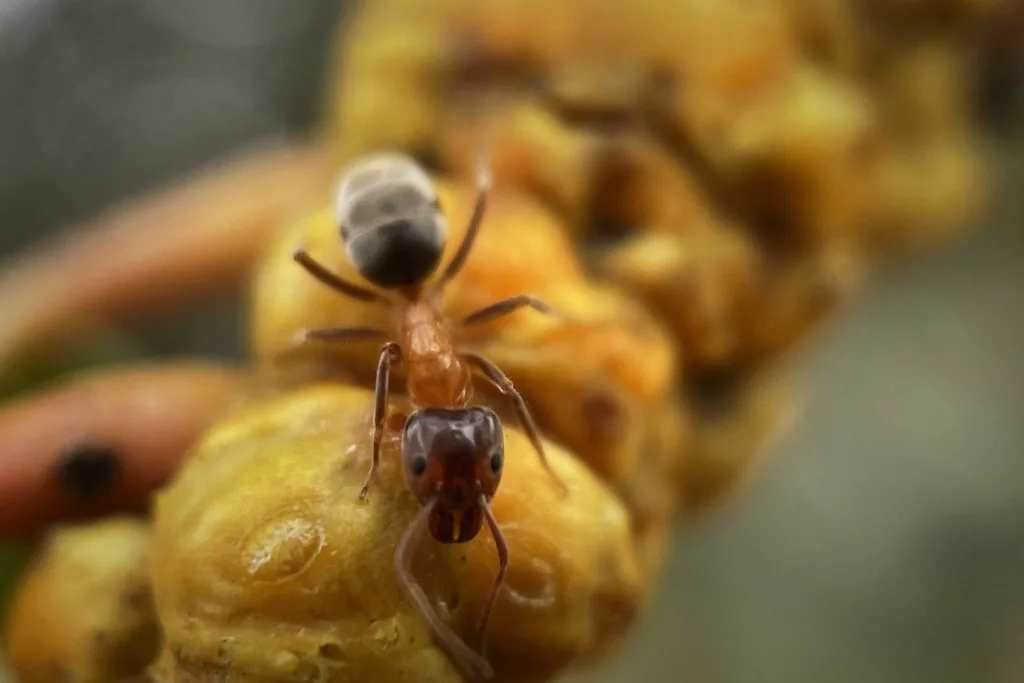
- Brownish-black head, yellowish-red thorax and a black abdomen covered in very fine hairs that look like velvet.[1]
- Workers come in many sizes; the waist has a single node and the thorax is evenly rounded.[1][2]
- When disturbed they release an alarm odor described as rotten coconut or a strong butyric-acid smell.[2]
Look-alikes
| Look-alike | How to tell them apart |
|---|---|
| Carpenter ants | Velvety tree ants share carpenter ants' mixed worker sizes, similar coloring and size and a similar alarm odor, so they are often misidentified; their wood excavations and frass are finer-textured.[2] |
| Odorous house ant | A related ant in the same subfamily that also gives off a smell when crushed.[2] |
Where it lives
Three species occur in North America, all in the western United States and Mexico; their importance as structural pests is probably underreported, especially in California, Oregon and Washington.[2]
Biology and life cycle
Colonies are usually tied to hollows in trees, stumps and logs and also nest under loose bark and rocks.[1][2]
They eat other insects, scavenge dead animals and collect honeydew from aphids, mealybugs and scales; they are partial to sweets.[1][2]
In summer they become more active at night.[2]
Damage and signs
Health risk
They are aggressive when disturbed: they bite painfully and spray defensive secretions.[1][2]
Control
Keep them out
Trim tree branches and shrubs that touch the building and seal exterior cracks and holes.[1]
Sanitation
Repair water leaks, keep the area ventilated and replace badly damaged wood.[1]
Pesticides
Find and treat all colonies around the structure: sweet ant baits placed along foraging trails first, then sprays; a perimeter spray around the foundation helps keep undetected outdoor colonies out.[1][2]
When to call a professional
Indoor treatment often fails because foragers rest in hollows of wood and insulation that look like nests; professionals use dusts for those resting sites and satellite nests.[2]
Common questions
- What ant smells like coconut when you squish it?
- In the West, often the velvety tree ant; its alarm odor is described as rotten coconut.[2]
- Do velvety tree ants bite?
- Yes; they are aggressive and bite painfully when disturbed.[1][2]
- Are they carpenter ants?
- No, though they look similar and are often mistaken for them.[1][2]
- Do they damage houses?
- They can tunnel in wet or sound wood and in foam insulation.[1][2]
Sources
- Utah State University Extension (Integrated Pest Management), “Velvety Tree Ant, Liometopum spp. (Structural and Nuisance Pests).” extension.usu.edu/planthealth/ipm/notes_nuisance/velvety-tree-ant.php (accessed 2026-10-16)
- Sociobiology (University of California, Riverside authors), “Hoey-Chamberlain, Rust and Klotz: A Review of the Biology, Ecology and Behavior of Velvety Tree Ants of North America. Sociobiology 60(1): 1-10 (2013).” doi.org/10.13102/sociobiology.v60i1.1-10 (accessed 2026-10-16)
- iNaturalist, “Liometopum occidentale taxon page (order and family).” www.inaturalist.org/taxa/68993 (accessed 2026-10-06)