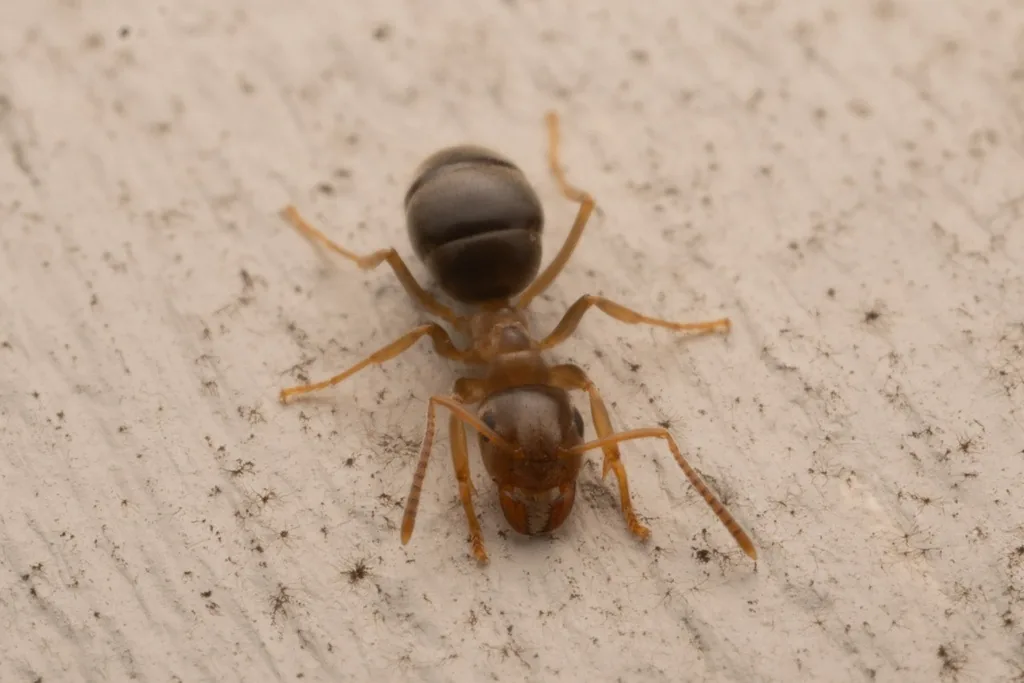
How to identify it
- Workers are about 1/10 to 1/8 inch long and light to dark brown.[2]
- Under magnification, the waist has a single node, the thorax is uneven in profile, and the eyes are fairly large for the head.[2]
- Nests show as a small hole, about 1/8 inch wide, ringed by a crater or cone of excavated soil a few inches across.[1][2]
- Two very similar species share the name: Lasius neoniger, the most common ant in New England turf, and Lasius americanus, which favors woodland stumps and leaf litter.[1][2][3]
Look-alikes
| Look-alike | How to tell them apart |
|---|---|
| Pavement ant | Has a two-node waist, a pair of small spines on the back of the thorax, and fine grooves on the head and thorax.[2] |
| Field ants | Nest in healthy, well-growing parts of the lawn and build much larger mounds, up to a foot across, that can get in the way of mowing.[2] |
Where it lives
Found across nearly all of North America except the far South and Southwest, and believed by some to be the continent's most abundant ant.[1]
Biology and life cycle
Colonies nest in soil in open, sunny spots, especially lawns where grass has thinned, and also under stones, bricks and sidewalks and in rotting logs and stumps.[1][2]
Workers eat live and dead insects and sweets, including honeydew they collect from aphids.[1][2][4]
Winged queens and males swarm from July through September, especially on warm, sunny afternoons.[2]
As with other lawn ants, a mated queen sheds her wings, digs a small chamber and raises the first workers herself; after that, workers run the colony.[3]
Lawn ants, including this one, generally prefer dry, well-drained soils.[3]
Damage and signs
Health risk
Cornfield ants are mainly a nuisance. Like many ants, they also prey on other insects, which helps control some pests.[3][2]
Control
Prevention
Water regularly and mow at 3 to 4 inches to encourage thick grass, which discourages nesting; treating lawn nests just for the turf is rarely necessary.[4][2]
Keep them out
Keep doors and windows in good repair and seal cracks where ants come in.[4]
Sanitation
Indoors, store sweets in sealed containers, keep counters clean, and wipe ant trails with a mild vinegar solution.[4][2]
Pesticides
Baits are the best option for outdoor nests: workers carry the bait home and it can kill the colony, including the queen. Results may take about a week.[4][2]
Liquid baits often contain boric acid and some granular baits contain hydramethylnon; don't use other insecticides near baits, and keep granular bait dry.[4]
If a lawn treatment is needed, apply it directly to mounds early, when activity starts, and keep broad-spectrum products as a last resort to protect beneficial insects.[3][4]
Common questions
- Are the little dirt mounds in my lawn hurting the grass?
- Usually only a little. Cornfield ants don't eat grass and are generally minor lawn pests, though large numbers can thin turf around their mounds.[2][3]
- Why are cornfield ants coming into my kitchen?
- Workers forage for sweets and insects and follow scent trails to food they find indoors. The nest is almost always outside, so treat it there.[4][1][2]
- When do cornfield ants swarm?
- Winged cornfield ants usually swarm from July through September, often on warm, sunny afternoons.[2]
Sources
- University of Maine Cooperative Extension, “Cornfield Ant (Home and Garden IPM fact sheet).” extension.umaine.edu/home-and-garden-ipm/fact-sheets/common-name-listing/corn-field-ant/ (accessed 2026-10-06)
- University of Minnesota Extension, “Ants (Household Insects).” extension.umn.edu/garden-and-home/home-maintenance/household-insects/ants (accessed 2026-10-06)
- UMass Amherst Center for Agriculture, Food, and the Environment, “Ants in Lawns (Pat Vittum, revised May 2011).” www.umass.edu/agriculture-food-environment/home-lawn-garden/fact-sheets/ants-in-lawns (accessed 2026-10-06)
- North Dakota State University Extension, “THEM! Controlling Nuisance Outdoor Ants around the Home (Crop and Pest Report, July 2021).” www.ndsu.edu/agriculture/ag-hub/ag-topics/crop-production/crop-pest-report/diagnostic-lab/them-controlling-nuisance-outdoor (accessed 2026-10-06)
- iNaturalist, “Lasius neoniger taxon page (order and family).” www.inaturalist.org/taxa/69311 (accessed 2026-10-06)